

April 2026 Visa Bulletin: Priority Dates, Filing Charts, and What to Do Next
What Exactly Is the Visa Bulletin and Why Does It Control My Green Card Timeline?
Here is the core problem the bulletin exists to solve. Congress caps the number of green cards USCIS can issue each year in most family and employment categories. Those caps are set in the Immigration and Nationality Act. The numbers are not large relative to the volume of people applying. When more petitions are pending in a category than there are visas available for the year, people wait. The visa bulletin is the government’s way of managing that wait — it tells you, month by month, how far the line has moved.
Your position in that line is set by your priority date. For a family-based petition, that date is recorded when USCIS accepts your Form I-130. For employment-based cases, it is either the I-140 receipt date, or the date your employer’s PERM labor certification was filed with the Department of Labor, depending on which applies to your case. That date does not change. What changes each month is the cutoff date published in the bulletin for your visa category and your country of birth. When the bulletin’s cutoff date moves past your priority date, your number is up — you can proceed with Form I-485 to adjust status here in the U.S. or move forward with a consular immigrant visa interview at a U.S. Embassy or Consulate abroad.
The numbers behind the wait — INA 202: For FY 2026, Congress authorized 226,000 family-sponsored preference visas and a minimum of 140,000 employment-based preference visas worldwide. No single country can use more than 7% of the combined total in a given year — roughly 25,620 visas. That ceiling applies regardless of how many applicants are waiting from that country. It is why an applicant born in India or Mexico in the same visa category as someone born in, say, Poland or Brazil can be waiting 10 to 20 years longer. Same category, same rules, very different wait.
Why Are There Two Different Charts for Final Action Dates vs. Dates for Filing?
The Visa Bulletin publishes two separate charts for both family preference and employment-based categories. Confusing them is a common and costly mistake. Filing under the wrong chart — or missing an authorized filing window — can set a case back by months.
The first is the Final Action Date (FAD) chart. This is the one that governs when a visa number can be issued or when USCIS will approve an adjustment of status application. Your priority date must fall before the FAD cutoff for your category and country before anything can be finalized. USCIS treats this as the default chart for I-485 filings. If you are not sure which chart applies this month, check uscis.gov. This page is updated at the start of each month and is the authoritative source.
The second is the Dates for Filing (DFF) chart. USCIS does not always authorize its use — some months it does, some months it does not. When they do, applicants whose priority dates fall before the DFF cutoff can start the filing process even though their date has not yet cleared the FAD chart. Why does that matter? Because filing under the DFF chart, when USCIS permits it, lets you submit Form I-485 concurrently with Form I-765 for employment authorization and Form I-131 for advance parole. Those two benefits — the right to work and the right to travel — can be in hand months before your priority date fully clears.
For April 2026, the F2A category, which includes spouses and children of Lawful Permanent Residents (LPRs), is listed as current in the Dates for Filing chart. If USCIS authorizes use of that chart this month, F2A applicants can file regardless of their specific priority date. That is a meaningful opening. Whether it stays open next month is not guaranteed.
What are the April 2026 Final Action Dates for Family-Sponsored Categories?
| CATEGORY | PREFERENCE TYPE | ALL AREAS | CHINA (MAINLAND) | INDIA | MEXICO | PHILIPPINES |
|---|---|---|---|---|---|---|
| F1 | Unmarried Sons & Daughters of U.S. Citizens | 01 MAY 2017 |
01 MAY 2017 | 01 MAY 2017 |
15 FEB 2007 |
01 MAY 2013 |
| F2A | Spouses & Children of LPRs | 01 FEB 2024 |
01 FEB 2024 | 01 FEB 2024 |
01 FEB 2023 |
01 FEB 2024 |
| F2B | Unmarried Sons & Daughters (21+) of LPRs | 22 MAY 2017 |
22 MAY 2017 | 22 MAY 2017 |
15 FEB 2009 |
08 APR 2013 |
| F3 | Married Sons & Daughters of U.S. Citizens | 22 DEC 2011 |
22 DEC 2011 | 22 DEC 2011 |
01 MAY 2001 |
01 JUL 2005 |
| F4 | Brothers & Sisters of Adult U.S. Citizens | 08 JUN 2008 |
08 JUN 2008 | 01 NOV 2006 |
08 APR 2001 |
01 FEB 2007 |
Source: U.S. Department of State, Visa Bulletin for April 2026 (CA/VO: March 4, 2026)
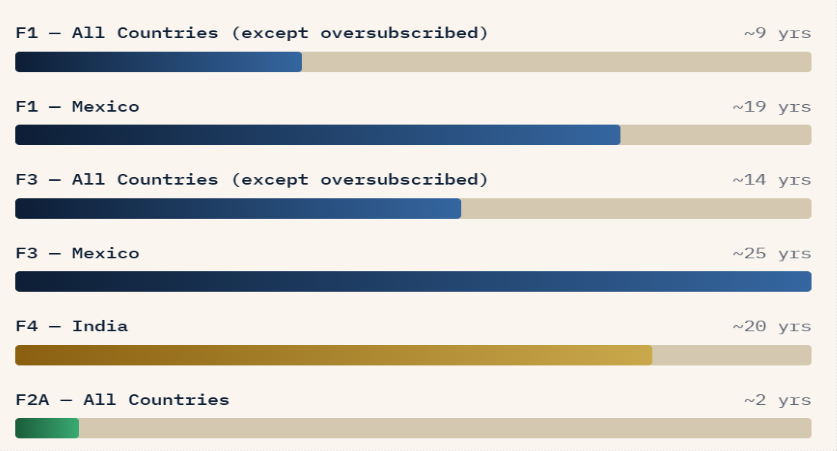
NOTE – USCIS is currently working through petitions filed approximately 25 years ago for Mexican nationals in the F3 category. This is not an anomaly; it is the direct result of the per-country cap structure under INA 202.
Family Category Wait Gap: Years Behind "Current" (Approximate, April 2026)
What Do the April 2026 Employment-Based Priority Dates Mean for My Case?
Employment-based categories have separate numerical allocations and priority date queues. For most countries, the April 2026 bulletin shows favorable dates — with EB-1 and EB-2 listed as “Current” for all chargeability areas except China and India. The table below covers the Final Action Dates for employment-based preference categories this month:
| EB CATEGORY | DESCRIPTION | ALL AREAS | CHINA | INDIA | MEXICO | PHILIPPINES |
|---|---|---|---|---|---|---|
| EB-1 | Priority Workers | Current | 01 APR 2023 | 01 APR 2023 | Current | Current |
| EB-2 | Advanced Degree / Exceptional Ability | Current | 01 SEP 2021 | 15 JUL 2014 | Current | Current |
| EB-3 | Skilled Workers & Professionals | 01 JUN 2024 | 15 JUN 2021 | 15 NOV 2013 | 01 JUN 2024 | 01 AUG 2023 |
| EB-3 Other | Other Workers | 01 NOV 2021 | 01 FEB 2019 | 15 NOV 2013 | 01 NOV 2021 | 01 NOV 2021 |
| EB-4 | Special Immigrants | 15 JUL 2022 | 15 JUL 2022 | 15 JUL 2022 | 15 JUL 2022 | 15 JUL 2022 |
| EB-5 (Unreserved) | Employment Creation — Unreserved | Current | 01 SEP 2016 | 01 MAY 2022 | Current | Current |
| EB-5 Rural | Set-Aside: Rural (20%) | Current | Current | Current | Current | Current |
| EB-5 High Unemployment | Set-Aside: High Unemployment (10%) | Current | Current | Current | Current | Current |
Source: U.S. Department of State, Visa Bulletin for April 2026 — Employment-Based Final Action Dates
I'm From India, China, Mexico, or the Philippines — What's Different for Me?
The EB-2 category makes this concrete. EB-2 covers professionals with advanced degrees. Right now, in April 2026, an EB-2 applicant born in Germany, Brazil, or Nigeria can file. The category is current for them. An EB-2 applicant born in India with the same credentials, the same employer, and an approved I-140 sitting in the same USCIS system is looking at a final action date of July 15, 2014. USCIS is processing cases from over a decade ago for that group. We have sat with clients who have been in this country on H-1B extensions for eight, ten, or twelve years, waiting for that date to move.
Congress has been aware of this imbalance for years. Various legislative proposals have attempted to address it — none have passed. Until those changes are made, applicants from these countries need to work with an attorney who understands the options available under current law. That includes reviewing whether EB category portability under INA § 204(j) applies to your case, whether concurrent filings can be used to get employment authorization and advance parole in hand sooner, and — for green card holders in this situation — whether the timing of a naturalization filing could convert a family member’s pending preference petition into an immediate relative petition, bypassing the cap entirely. These are not workarounds. They are legitimate planning strategies built into the statute. But they require knowing your specific dates, your case history, and what the current bulletin actually makes possible this month.
| CATEGORY | ALL AREAS | CHINA | INDIA | MEXICO | PHILIPPINES |
|---|---|---|---|---|---|
| F1 | 01 MAR 2018 |
01 MAR 2018 |
01 MAR 2018 |
15 APR 2008 |
22 APR 2015 |
| F2A | Current | Current | Current | Current | Current |
| F2B | 08 AUG 2017 |
08 AUG 2017 |
08 AUG 2017 |
15 MAY 2010 |
01 OCT 2013 |
| F3 | 22 NOV 2012 |
22 NOV 2012 |
22 NOV 2012 |
01 JUL 2001 |
15 JUL 2006 |
| F4 | 15 MAY 2009 |
15 MAY 2009 |
15 DEC 2006 |
30 APR 2001 |
22 MAR 2008 |
Dates for Filing — Family-Sponsored (April 2026) — Use only when USCIS authorizes via uscis.gov
How Does the Priority Date and Adjustment of Status Process Actually Work?
The flowchart below outlines the two main procedural paths:
a) Adjustment of Status (AOS) for applicants inside the United States,
b) Consular Processing for applicants abroad.
| CATEGORY | ALL AREAS | CHINA | INDIA | MEXICO | PHILIPPINES |
|---|---|---|---|---|---|
| F1 | 01 MAR 2018 |
01 MAR 2018 |
01 MAR 2018 |
15 APR 2008 |
22 APR 2015 |
| F2A | Current | Current | Current | Current | Current |
| F2B | 08 AUG 2017 |
08 AUG 2017 |
08 AUG 2017 |
15 MAY 2010 |
01 OCT 2013 |
| F3 | 22 NOV 2012 |
22 NOV 2012 |
22 NOV 2012 |
01 JUL 2001 |
15 JUL 2006 |
| F4 | 15 MAY 2009 |
15 MAY 2009 |
15 DEC 2006 |
30 APR 2001 |
22 MAR 2008 |
Dates for Filing — Family-Sponsored (April 2026) — Use only when USCIS authorizes via uscis.gov
Priority date scenario comparison — April 2026
People ask us which path is faster. That is not really the right question. The path that applies to you depends on your situation. If you are in the United States right now with a valid status that is on a work visa, a student visa, or another lawful basis — filing Form I-485 to adjust status here is usually the more practical option. You stay in the country, file the full package at once, and while the case is pending, you can have your work permit and travel document processed simultaneously.
We have had clients wait two years for a green card decision while working and traveling normally throughout, because they filed the documents correctly from the start.
Consular processing is a different situation. Some people have no choice, either because they are outside the United States or because they came in a way that makes them ineligible to adjust status domestically.
Their case:
a) First, it goes through the National Visa Center.
b) Secondly, an immigrant visa interview is conducted via U.S. Embassy or Consulate.
The timeline depends heavily on which post handles the case. Please check the status here: https://travel.state.gov/content/travel/en/legal/visa-law0/visa-bulletin.html.
What we tell our clients is this: do not pick a path based on what you read online about average processing times. Your entry history, how long you have been in the country, whether you have ever been out of status, and whether any waivers are on the table; all of that shapes which option is actually available to you. That conversation needs to happen with an attorney who has reviewed your specific file, not based on a general comparison of two procedures.
People ask us which path is faster. That is not really the right question. The path that applies to you depends on your situation. If you are in the United States right now with a valid status that is on a work visa, a student visa, or another lawful basis — filing Form I-485 to adjust status here is usually the more practical option. You stay in the country, file the full package at once, and while the case is pending, you can have your work permit and travel document processed simultaneously.
We have had clients wait two years for a green card decision while working and traveling normally throughout, because they filed the documents correctly from the start.
Consular processing is a different situation. Some people have no choice, either because they are outside the United States or because they came in a way that makes them ineligible to adjust status domestically.
Their case:
a) First, it goes through the National Visa Center.
b) Secondly, an immigrant visa interview is conducted via U.S. Embassy or Consulate.
The timeline depends heavily on which post handles the case. Please check the status here: https://travel.state.gov/content/travel/en/legal/visa-law0/visa-bulletin.html.
What we tell our clients is this: do not pick a path based on what you read online about average processing times. Your entry history, how long you have been in the country, whether you have ever been out of status, and whether any waivers are on the table; all of that shapes which option is actually available to you. That conversation needs to happen with an attorney who has reviewed your specific file, not based on a general comparison of two procedures.
What Should I Be Doing Right Now Based on This April 2026 Bulletin?
Priority date scenario comparison — April 2026
| CONSIDERATION | PRIORITY DATE CURRENT UNDER FAD/ACTION NOW | PRIORITY DATE WITHIN DFF, NOT YET FAD FILE IF AUTHORIZED | SPONSORING SPOUSE OR CHILD — F2A CURRENT — DFF | APPROACHING NATURALIZATION ELIGIBILITY PLANNING STAGE |
|---|---|---|---|---|
| WHO THIS APPLIES TO | Applicants in valid U.S. immigration status whose priority date is earlier than the Final Action Date. | Applicants whose priority date clears DFF but not yet Final Action Date cutoff. | Lawful permanent residents planning to file I-130 for spouse or unmarried child. | Green card holders nearing 3–5 year naturalization eligibility. |
| APRIL 2026 | FAD varies by category (e.g. F2A Feb 1, 2024) | DFF cutoff differs per category | FAD: Feb 1, 2024 (except Mexico) | No bulletin date applies |
| REFERENCE DATES | Current for most countries (EB1, EB2) | DFF chart applies monthly | DFF current globally | Residence period under INA §316 / §319 |
| IMMEDIATE ACTION REQUIRED | Consult attorney & file I-485 if eligible | Check USCIS DFF authorization | Proceed with next step if I-130 filed | Review N-400 eligibility timeline |
| KEY FORMS INVOLVED | I-485, I-765, I-131 | I-485 / DS-260 | I-130 + I-485 / DS-260 | N-400 |
| SUPPORTING DOCUMENTS NEEDED | Passport, birth cert, police clearance, medical (I-693) | Birth cert, tax records, police clearance | I-130 approval, civil docs | Tax returns, residence proof |
| BENEFIT OF ACTING | EAD + Advance Parole | Faster processing vs waiting FAD | Move to NVC/AOS stage quickly | Immediate relative status after naturalization |
| RISK OF INACTION | Retrogression risk | Miss DFF filing window | Processing delays | Delay in citizenship timeline |
| APPLICABLE INA PROVISION | INA §245, §203 | INA §203(a) | INA §203(a)(2) | INA §316 / §319 |
Data reflects the April 2026 Visa Bulletin (CA/VO: March 4, 2026). Confirm DFF authorization monthly at uscis.gov. This comparison is for informational purposes only and does not constitute legal advice.
For DACA Recipients and Humanitarian Cases
DACA, VAWA, U visas, T visas — these do not follow the same track as a standard family-based or employment-based green card case. Some humanitarian categories have separate numerical allocations and backlogs. Others sit entirely outside the preference system. The visa bulletin is still relevant in some of these situations, just not in the same way.
DACA recipients are a common example of where this gets complicated. A DACA recipient with a U.S. citizen spouse or parent may have a path to adjustment of status, depending on how they entered the country (legally). The same is true for VAWA self-petitioners; their eligibility, timing, and interactions with any pending or prior proceedings must be reviewed individually by the authorities.
We raise this not to discourage anyone in these situations from pursuing a path forward, but because we have seen real harm come from people treating their case like a standard green card filing when it is not. If you or someone you know falls into any of these categories, the starting point is a consultation where your specific facts are on the table—not a general answer based on how the process works for someone else.
Has Your Priority Date Become Current?
The Coleman Law Group represents individuals and families at every stage of the green card and citizenship process — from the initial I-130 or I-140 petition through adjustment of status, consular processing, and naturalization. We practice immigration law in Florida, Texas, New York, New Jersey, and California. Call us to discuss your case, or schedule a consultation online.
