

Applying for a U.S. Green Card is a major milestone in any family’s immigration process. Federal law controls the process; however, its pace and timeframes can vary significantly across states, depending on USCIS service center and office workloads.
This article breaks down the full family-based Green Card application process, wait times among states, and what applicants can expect in 2026.
Understanding the filing procedures and processing sites for family member applications will help alleviate stress and eliminate wasted time. It specifically addresses Florida, California, Texas, New York, and New Jersey, where authorities face a large number of family-related immigration cases.
Understanding Family-Based Green Cards
Family-sponsored green cards – under these, U.S. citizens and lawful permanent residents are allowed to petition on behalf of immediate relatives of the person making the petition. Spouses, unmarried children under 21, and parents of U.S. citizens are exempt from the annual visa limit. Other family categories need to wait longer due to capacity constraints.
USCIS’s focus on digital processing and workload allocation between service centers persists, but backlogs in local field offices continue to significantly affect approval times. It requires an understanding of geography and processing centers while structuring your application.
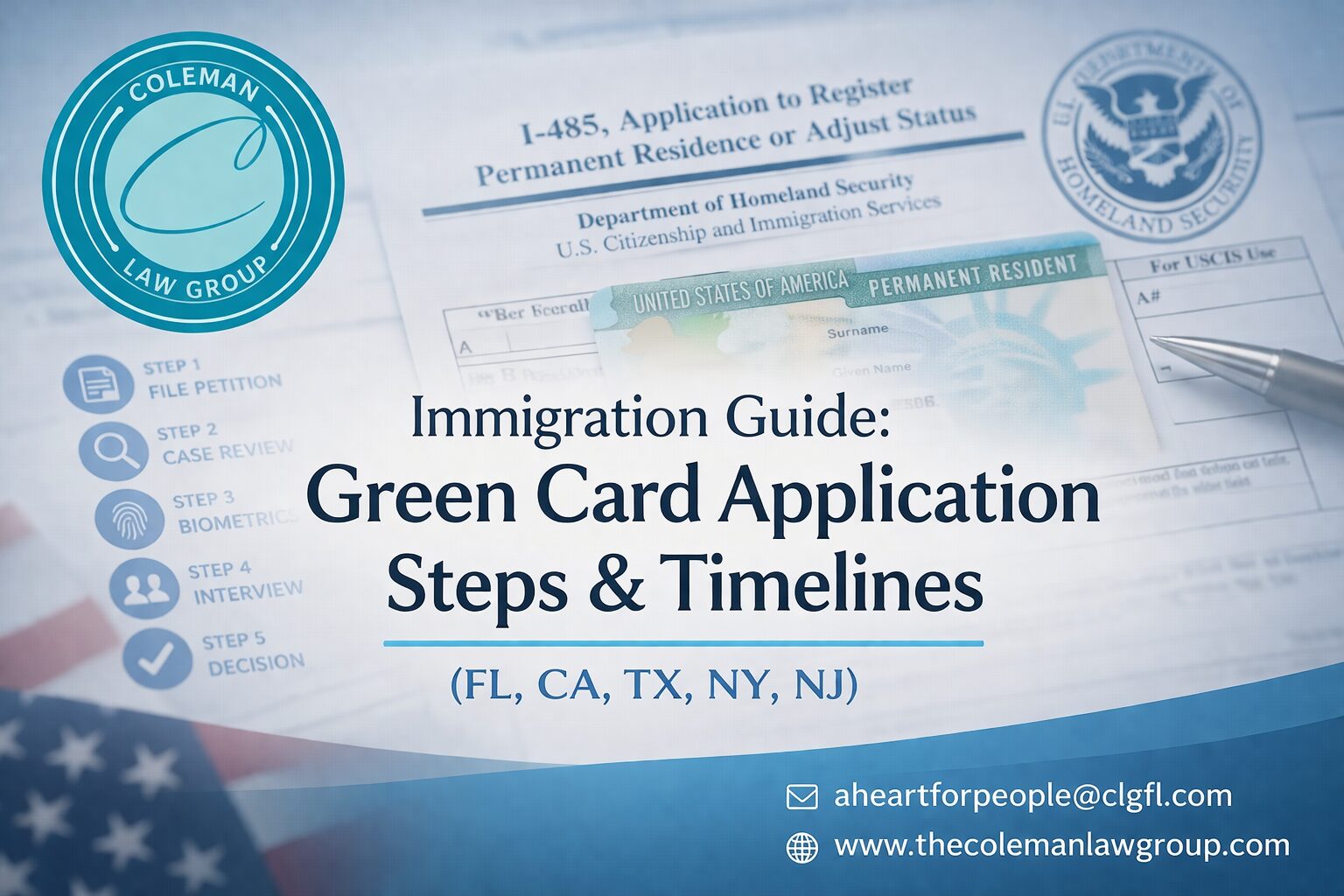
The Family Green Card Timeline and Steps 2026 involve petition submission, eligibility check, background check, interview, and final approval. The location decides the stages of cases.
Process of Availing Family Green Card Applications
It is a general description of one process in the Family Green Card Timeline and Steps 2026.
-
Form I-130, Application for Alien Relative
It starts with the sponsoring U.S. citizen or Green Card holder submitting Form I-130. It establishes the qualifying family relationship reviews of marketing records, such as birth certificates, marriage certificates, and evidence of status.
A petition is filed simultaneously with the application by an immediate family member (spouse or child) using Form I-130 and Form I-485 (Adjustment of Status), as USCIS can process both applications together rather than in consecutive time frames. Simultaneous I-130 and I-485 filing timelines are substantially shorter than those for individual filings. If concurrent with the filing, it is mostly 9 to 18 months, depending on the field office.
In the interim, applicants have work authorization and can move around for a few months before getting permanent approval. It is a great way to minimize your Family Green card timeline & steps in 2026, especially in states with shorter interview wait times.
-
Priority Date and Visa Bulletin
USCIS is processing family-based green card applications based on quotas and priority dates. The priority date is when USCIS receives the Form I-130 petition. The date locks the applicant in line for an immigrant visa.
The U.S. Department of State also releases the Visa Bulletin monthly, listing the priority dates that are currently eligible for processing. Family preference applicants follow up on this bulletin and wait until their priority date is listed as current. They can proceed to the next stages of the green card application process only when their priority date becomes current.
-
Interview and Biometrics
In the green card application process via family sponsorship, the applicant must schedule an interview with a USCIS officer (for adjustment of status within the U.S.) or a consular officer (for consular processing in a foreign country). The officer determines the authenticity of the relationship and verifies the documentation. Biometric evidence includes fingerprints, photos, and signatures. It is used to conduct background checks on the applicant’s identity.
-
Get a Decision on the Application
Depending on the applicant’s eligibility and supporting documentation, the Green Card application is completed either by USCIS or a consular officer after this interview. Upon approval, the applicant receives their Green Card by mail or through a consulate/embassy, as per the decision.
-
USCIS Service Centers and Processing Speed
Interviews take place at local field offices, and a significant part of the initial processing is done at USCIS Service Centers, which directly impacts overall timelines.
Relevant Key Service Centers in These States
The Texas Service Centre handles cases in Texas and surrounding areas, while the California Service Centre handles cases on the West Coast. Other centralized facilities manage East Coast cases for New York and New Jersey through workload balancing.
Differences in staffing levels, case backlogs, and operational effectiveness cause variations in speed. The USCIS processing times for the California vs Texas Service Centers provide a comparison for applicants, with Texas processing family petitions a little faster than California over the last few years.
In 2026, USCIS is still redistributing cases to eliminate bottlenecks, yet service center assignment remains a significant factor in how quickly a petition moves through the system.
-
Adoption vs Consular Processing
USCIS Adjustment of Status (In-Country) Applicants who are already in the U.S. can change their status by using Form I-485. It is the route they can use to stay in the country pending their case and apply for their immediate family members.
Adjustment of status is also related to the Family Green Card Timeline & Steps 2026 because it enables concurrent filing and provides quicker access to other benefits, such as work authorization.
- Parents Processing at the Consulate
Consular processing for parents is when the American citizen’s parent(s) remain in a foreign country and request permanent resident status. After the Form I-130 is approved, the case is sent to the National Visa Center along with the appropriate fee(s), supporting documents, and an affidavit of support. After the documentation, an immigrant visa interview is conducted at a U.S embassy or consulate. Upon a successful interview and physical examination, the parent is issued an immigrant visa and enters the U.S. as a lawful permanent resident.
The Impact of Service Centers/Field Offices on Processing Times
USCIS processing is carried out at the Service Centers (which process initial petitions and conduct general adjudication) and the Field Offices (which conduct interviews and issue decisions). The most applicable centers for family-based green cards are:
| State / Region | Primary Field Office Hub | I-130 Petition (Standalone) | I-485 Adjustment (Concurrent) |
Lawyer’s Insight – The Reality on the Ground |
|
Florida |
Hialeah / Miami | 12 – 14 Months |
8 – 10 Months |
Hialeah is currently ranked among the quicker interview-scheduling offices in the nation. But in this case, marriage-based cases are subjected to stricter scrutiny by officers because of historical fraud trends. Prepare in-depth inquiries, in particular, brief courtships or restricted joint reports. |
|
California |
Los Angeles / San Francisco | 13 – 15 Months |
10 – 13 Months |
The California Service Center (CSC) handles large volumes, which slows file movement even before the cases arrive in the offices. Applicants to LA County tend to wait longer on the higher end of estimates, especially from slots to interviews. Backlogs fluctuate heavily. . |
|
Texas |
Dallas / Houston | 11 – 13 Months |
9 – 11 Months |
The Texas Service Center is performing well. Nevertheless, errors with RFEs are widespread, particularly with the I-864 Affidavit of Support. Minor financial discrepancies may persist for months unless addressed at an earlier stage. |
|
New York |
NYC / Queens | 14 – 18 Months |
12 – 16 Months |
The NYC field offices are the slowest in the country, with too many cases. Final interviews are not scheduled until months after the case approval is ready. The delays are mostly structural, not case based. |
|
New Jersey |
Newark / Mt. Laurel | 13 – 16 Months |
11 – 14 Months |
New York imposes harsh criteria regarding reviews of public charges and joint sponsors. RFEs are commonly caused by incomplete or discrepant tax transcripts. Clear money paperwork is essential to avoid wasting time. |
|
National Average |
All Service Centers | ~14.5 Months |
~11 Months |
These are median timelines. Criminal background or cases of previous immigration violations and repeated RFEs are well beyond these averages, no matter where. |
Reasons for Delays and How to Overcome Them
Knowledge of service center assignments and selection of the right filing strategy decreases delays in the Family Green Card timeline & Steps in 2026
-
Financial Evidence Problems (I-864 Errors)
Another cause of RFEs is errors in the Affidavit of Support. The most frequent issues are outdated tax returns, unavailable tax transcripts, or income that does not qualify under USCIS guidelines. Another common issue is documentation for joint sponsors.
How to prevent it: Be sure to file IRS tax transcripts rather than returns, verify that income qualifies for poverty, and ensure that joint sponsor forms are complete and signed.
-
Background Check and Security Review
Background checks can take longer for applicants with records of immigration offences, overstays, arrests, or travel to high-risk areas. These reviews are generic but delay the process.
How to prevent it: Be completely transparent. Disclose all problems in advance and provide certified court records or explanations to avoid time-wasting during an investigation.
-
Interview Delays and Backlogs at Field Offices
Processing speed varies by location. Certain sections are strained, and big field offices like New York and Los Angeles are experiencing long queues when making interview appointments.
How to prevent it: Once you submit your application in good time, maintain your address and respond to USCIS notices, or find yourself at the back of the queue.
-
Requests for Evidence (RFEs)
RFEs can hold your case pending USCIS’s response, which can add several months to your case schedule. Unclear documentation is the cause of many RFEs, not actual eligibility problems.
How to prevent it: Provide good and well-structured evidence at the first stage and answer RFEs in a comprehensive and timely manner.
Tips on How to Manage Green Card Delays and Why You Should Hire an Immigration Lawyer
Green card delays are common, yet do not necessarily disrupt your plans. Although you may not have control over USCIS backlogs or field office loads, the preparation and timely responses can significantly impact your schedule. These tips can help overcome practical delays, and hiring an immigration lawyer can make a difference.
-
Preempt RFEs
Weak financial documentation, insufficient evidence of the relationship, and a lack of legal explanations frequently lead to RFEs. It can take months to receive an RFE.
How a lawyer helps: An attorney knows potential RFE triggers and presents stronger evidence from the start, reducing the risk of delays.
-
Act Immediately and Effectively upon USCIS Notices
USCIS deadlines are strict. Incomplete replies may lead to significant loss or even rejection.
How a lawyer helps: Lawyers ensure your case does not stagnate by submitting clear, well-organized, and comprehensive documents that address USCIS’s issues directly.
-
Know Local Field Office Realities
Depending on the field offices, processing time varies. Large offices are characterized by lengthy queues in securing interviews and approvals.
How a lawyer helps: Immigration lawyers are familiar with office procedures and work with them to develop possible timelines, estimate interview times, and estimate how long follow-ups may take.
-
Preparing for the Interview with Confidence
The marriage-based green card process includes interviews. Lack of documentation or inconsistencies in responses may lead to slowing down or further examination.
How a lawyer helps: Lawyers prepare customers to answer interview questions, review the materials in advance, and assist applicants in speaking clearly and remaining fluent.
Conclusion
Family immigration is one of the most reliable ways of obtaining permanent residence in the United States. However, 2026 timelines depend on location, service center assignment, and filing strategy. Florida and Texas have shorter processing times for cases; California, New York, and New Jersey may take longer. Filing concomitantly with USCIS processing times at the California and Texas Service Center, along with the expectation of encouragement for an interview, can massively boost your chances. Well-informed families with an understanding of the whole process who plan will feel more confident and clearer about the U.S. immigration system when their child turns 21 in 2026.