

Miami is the top travel destination for most people worldwide. Miami’s sunny weather, beautiful beaches, and exciting nightlife draw people from all over. Considering the above and the city’s growing population, it’s not surprising that its job market is more competitive than ever.
Of course, you know that it means more opportunities for residents and visitors. But before packing your bags for the city, it makes sense to understand all the laws surrounding the country’s immigration. And that can’t be too hard if you have experienced people around you.
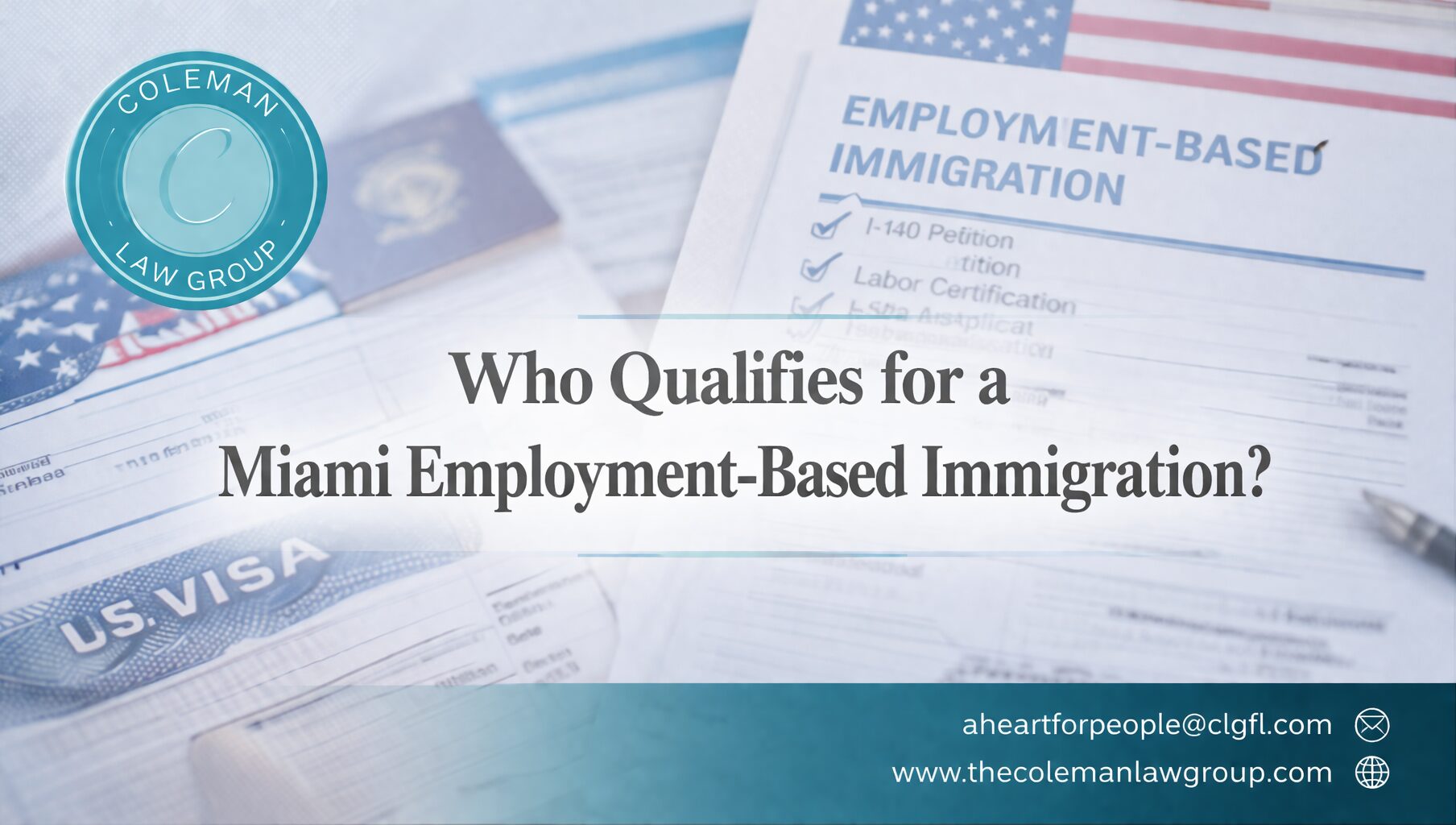
One of the first questions you’ll ask before moving is whether you qualify for this type of immigration. The best way to begin answering it is to discuss all the specific requirements involved. In this article, we will highlight all the visa routes and the key requirements for qualifying for this visa category.
What is Employment-Based Immigration?
As the name suggests, this concept involves moving to another country on account of your skills. It allows foreign nationals with desirable skills and talents to obtain a U.S. Green card/visa through U.S. employment. Applicants will usually require sponsorship from a United States employer to apply for immigration through this route.
Before applying for this type of move, it is important to note that two main categories of visas that qualify you for it. They are:
- Temporary Work Visas: Designed for individuals intending to work in the U.S. for a short time. Your application falls into this option if you want to return to your home country when your present job expires. It is time-specific and subject to certain conditions.
- Permanent Work Visas: This one works for you if you want to relocate permanently to the United States for work.
These two types are significantly different. You can expect different requirements for each of these. Most people will need guidance to choose which works best. A top immigration lawyer can always walk you through the process. Let’s review each type and its subdivisions.
Types of Temporary Employment Visas
As the name signifies, these visas are short-term. So, they are perfect for when you’re seeking short-term opportunities in the United States. You should be opting for this one if you’re traveling to execute short-term contracts or jobs in the United States. In such scenarios, you are expected to return to your home country upon completion of your time frame or tenure in the U.S.
The common types of temporary employment visas are:
-
H-1B (Specialized Occupations)
Perfect for people moving to the United States to take on specialty professions. Some examples of such jobs are medicine, finance, and engineering. You’ll also need a verifiable job offer from a U.S.-based employer, with the job description indicating that the position requires specialized knowledge. Most agencies will require you to provide valid certifications where necessary to prove that you’re qualified for the job.
-
H-1B1 (Free Professional Trade Agreement)
The H-1B1 visa covers specialty employment, and it is a subcategory of the H-1B visa. However, you can only qualify for this one if you are from Chile or Singapore. Besides, you must also possess a bachelor’s degree or equivalent experience in a related field to qualify.
-
H-2A (Seasonal Worker in The Agricultural Field)
If you’re moving to the States to perform seasonal or temporary agricultural work, this visa type is for you. However, it takes citizenship or permanent residency of designated countries to qualify. Your employment-based green card lawyer can explain your eligibility for this visa.
-
H-2B (Seasonal Workers Outside the Agricultural Field)
On the other hand, you can apply for an H-2B visa if you are moving to the United States to take on seasonal jobs outside the agricultural sector. It is also only available for citizens and nationals of designated countries. Contact a skilled employment visa attorney to confirm your eligibility for this visa.
-
H-3 (Trainee or Special Education Visitor)
You should opt for this visa type if you’re seeking training in fields (excluding medical training and the graduate academy) that aren’t available in your country.
-
L-1 (Intracompany Transfers)
This visa type is primarily for applicants employed in multinational organizations. It allows for your transfer to your organization’s U.S. office. However, you must occupy a managerial role or a role that requires specialized knowledge to qualify for immigration through this route. You must also provide proof that you’ve been employed for at least one year by the company’s branch outside the United States.
-
O Category (Individuals with Extraordinary Ability)
This type is available only to applicants with extraordinary achievements or ability in the fields of education, science, athletics, business, or art. It also works for individuals with international recognition in the television and film industries. Assistants to these individuals can also apply for the P-1 visa.
-
P-1 (Team/Individual Athletes or Members of an Entertainment Group)
The P-1 visa is available for verified athletes or members of an entertainment group. The visa typically covers only the period of performance for a specific entertainment or sports event. Individuals who offer coaching or essential services to these people are also eligible for the P-1.
-
P-2 (Individual or Group Artists/Entertainers)
Only artists and entertainers (individuals or groups) qualify for this visa. However, applicants must also be part of a reciprocal exchange program involving a U.S. local organization and a foreign organization. Artists or individuals providing essential services to the above category of people can also apply for this kind of visa.
-
Q-1 (International Cultural Exchange Program)
This category applies to individuals or groups participating in a cultural exchange program that involves the United States and at least one other country. These cultural exchange programs are organized for artistic training and labor exchange. It is also a platform for sharing the culture, traditions, and history of an applicant’s home country.
Types of Permanent Employment Visas
You probably can already tell that these visas are of permanent nature. But that also means that it requires more skills and documentation. While about 140,000 are available each year, you will still need the right work skills to apply. The first step to getting ready for it is to understand the different types of permanent visas and how to apply for them.
Here, let’s review them.
-
First Preference (EB-1)
Here’s one for people with extraordinary ability. It’s available for scientists, business professionals, athletes, researchers, and academics. And yes, you don’t need labor certification to qualify.
-
Second Preference (EB-2)
EB-2 visas are available to holders of an advanced degree or its foreign equivalent. However, you can also apply for it if you can prove at least 10 years of experience in specific fields. The United States Immigration law also allows people whose employment is in the national interest of the U.S. All but the last category of eligibility above must obtain labor certification to complete the process. Family members of EB-2 holders may relocate to the United States via the E-21 and E-22 forms if they have a verified I-40 (green card) form.
-
Third Preference (EB-3)
This type of visa is available for bachelor’s degree holders or holders of any foreign equivalent. It is also available to skilled and non-skilled laborers who already possess a non-temporary employment offer from a U.S. employer. Applicants must also obtain labor certification to qualify.
-
Fourth Preference (EB-4)
The EB-4 falls under the Special Immigrant Visa category. Eligibility includes certain religious workers and retired employees of international organizations. Employees of the U.S. Foreign Service can also apply. This type of visa is eligible for a waiver. However, not all family members of holders are eligible for admission, and that’s why you need an experienced employment-based immigration lawyer to guide you through the process.
Fifth Preference (EB-5)
The EB-5 suits you if you’re already under the Immigrant Investor Program. It is available to immigrants who can prove a willingness to invest up to $1.8 million in a new commercial enterprise. Please note that the specified enterprise must have at least 10 full-time employees on its payroll in the United States to qualify. Investors with at least $900,000 investment in new commercial ventures in targeted employment areas can also apply for this visa.
This type of visa is eligible for a waiver of the labor certification requirement, allowing investors and their families to apply for green cards.
How to Get Started with Your Application
The whole process of applying for a green card using this route can be cumbersome, especially if you don’t have a guide. Hence, there is a need to have an experienced employment visa attorney. Of course, you can still handle the process by yourself through the following steps.
- Find the correct option: There are so many of them out there for different purposes. You should start by reviewing your skills and matching them with available offers.
- Request sponsorship from your employer (Where Applicable): We often recommend working with your new office to make the process easier. Call them and get all the details on what they can do for you. A company that’s not helping you through the process is not a good option to work with.
- Get your papers in order beforehand: Contact the USCIS office to find out which documents you’ll need. Get them available on time to avoid forgetting anything or mixing them up.
- Click Submit: Once you’ve sorted everything and filled out all the papers, it’s time for submission. You’ll always find the proper procedure on the immigration website to help make the submission easier.
- Hire an experienced lawyer: The best way to handle this is to search online for an employment-based immigration lawyer near you. Finding the right representative can make a significant difference in your pursuit. Just be sure you know how to filter the available options for your benefit.
Visa Interview
Once the NVC determines that the file is complete with all required documents, they schedule the applicant’s interview appointment. They’ll then send a file containing all your documents to the embassy or consulate where you’ll be scheduled for an interview. Both you and your attorney will receive appointment letters and emails containing the date and time for the interview. The mail will also include all the guidance you’ll need to obtain a medical examination.
You’ll need to bring a valid passport to the interview, along with the other documents listed in this article. However, it is the consular officer who will determine your qualification for a visa after interviewing you.
Services We Offer
At The Coleman Law Group, we handle immigration services, including family-based immigration. When you contact us, you can expect us to help with processing family-based Green Cards, family preference visas, immediate relative petitions, spousal visas, and child & stepchild petitions. We also cover AOS, consular processing, and waivers for inadmissibility grounds.
The Coleman Law Group Can Help You
How will you know whether you qualify for a work-based visa if you don’t have good guidance? Compassionate immigration lawyers at the Coleman Law Group understand your pain. We can review your situation and tell you your exact status and chances. Our attorneys are qualified and experienced, offering you all the help you’ll need to secure a stress-free employment-based immigration. We also offer flexible payment plans to suit different needs. So, you can begin your process with a few resources. Book a consultation with us now.
Legal Disclaimer
This blog is for informational purposes only and does not constitute legal advice.