

Your initial appearance in a courtroom can be a painful experience, especially when your kids, your home, your fortune, and your future are at stake. The official procedure, the complicated legal process, is buzzing back and forth, is overwhelming until you utter a word in your defense.
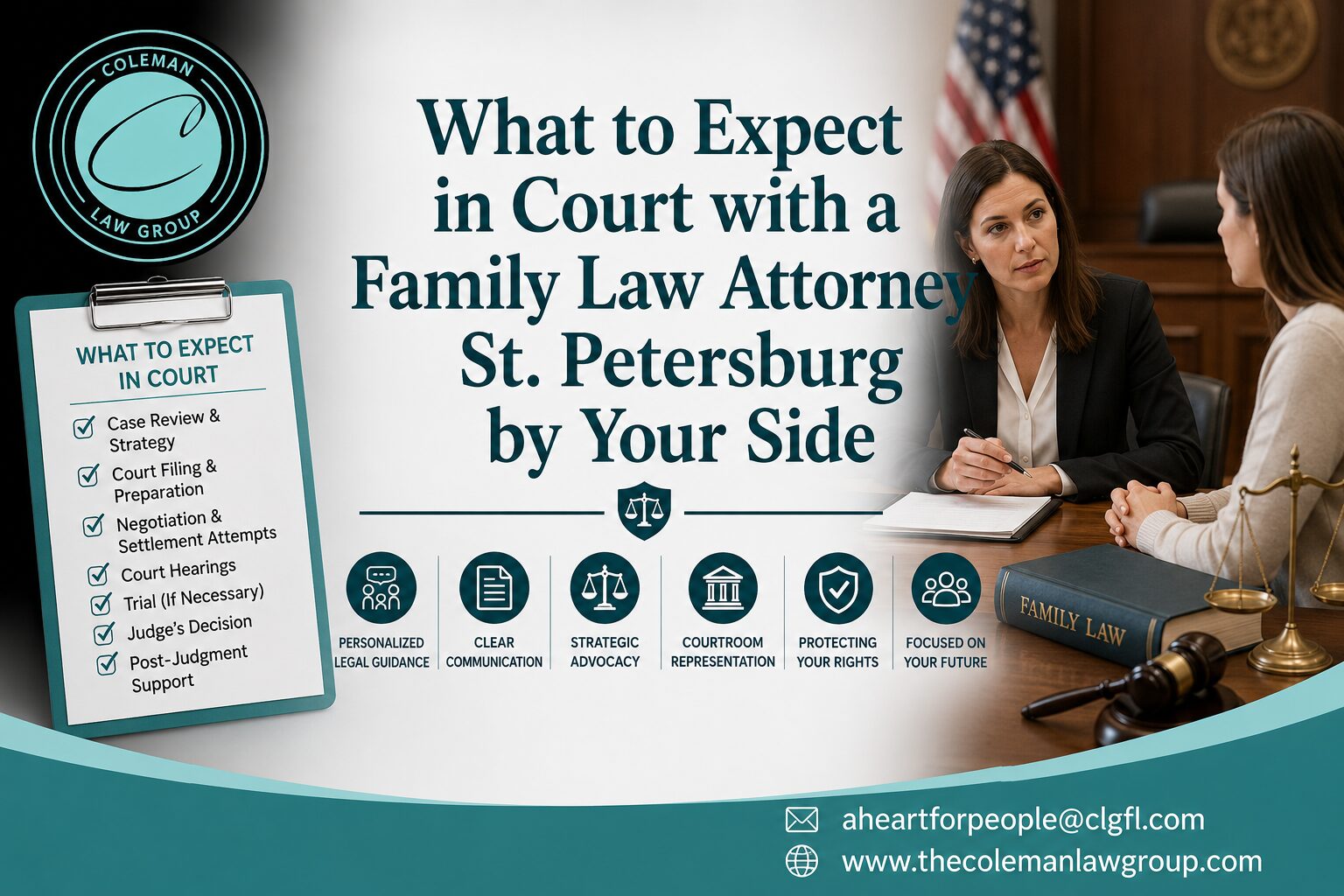
What to Expect in Court with a Family Law Attorney St. Petersburg
It is precisely why the services of a trained Family Law Attorney in St. Petersburg are actually handy but essential to ensure your case is organized and effectively handled. In this article, we will describe what may happen at each step of the court process, from filing a case to the issuance of a final divorce decree to dealing with a child custody or child support matter.
The St. Petersburg Family Court System
The family court in St. Petersburg is governed by Florida family law statutes, which address divorce, child custody, alimony, child support, paternity, domestic violence injunctions, and property division cases.
The Pinellas County family court system provides fair outcomes and considers the needs of individual families. However, the law, paperwork, and court rules are not easy to navigate. This is why one should consider hiring a family court lawyer in St. Petersburg whenever dealing with family matters.
1. The First Meeting and Case Planning
Your Family court lawyer in St. Petersburg will meet with you before your initial court appearance. The first session helps your attorney to evaluate your case, explain the legal options, and map out a case plan.
At this stage, your lawyer will:
- Examine your key documents, such as financial statements, correspondence, and any court orders (you have received)
- Describe the complete court process of divorce in Florida. This includes all the steps from both parties’ ends and the expected time frames for final closure.
- Discuss the key issues in your case and potential complications you may face.
- Talk about your objectives and what you can and cannot expect.
- Consult about the charges and expectations of communication.
2. Pretrial Proceedings and Mediation
Most family law cases in St. Petersburg do not proceed directly to trial. Rather, there are several pretrial stages to promote settlement and limit the issues that require judicial resolution.
3. Preliminary Legal Proceedings
Special proceedings are necessary, e.g., when child custody is involved or when there is an immediate pressing need. These short addresses pressing matters, such as provisional custody, child support, or the tentative right to reside in the marital home until a final decision is taken.
You will have a strategy briefing with your attorney. These hearings are usually 15-30 minutes long, during which the judge is presented with a concise overview of the prevailing disputes to maintain stability as the case proceeds towards the full process.
4. Mediation Requirements
In Florida, most family law cases are mediated before trial. Mediation is a confidential meeting with a third party, called a mediator, to resolve a dispute with the other party. Your Family Law Attorney will attend mediation with you, help facilitate a positive outcome on your behalf, and find assist in finding an amicable resolution.
Mediation has many benefits:
- It may be cheaper than a trial
- You are more in charge of the ultimate decision.
- It is not as confrontational and maintains relationships, which is worthwhile to co-parents and to parties seeking distribution of marital assets.
- Mediation is far faster than waiting for a trial.
However, if there is no comprehensive agreement during mediation, the remaining components of the dispute will proceed to a family court hearing in Florida or trial.
5. Discovery Process
The process of exchanging information during the pretrial procedure to facilitate settlement is called the discovery phase. Your lawyer may use many different discovery methods, such as:
- Interrogatories (written questions sent to another party, who sends the responses under oath)
- A formal request for documents, also known as a request for production (RFP), that includes emails, bank statements, medical records, and so forth.
- Depositions – oral testimony in the form of videos or transcripts provided under oath.
- Subpoenas – court orders third parties (Banks, Government agencies) to provide documents
It allows each side to have access to information and avoid trial surprises. Your lawyer will advise on how to respond to discovery and use it in your case.
The Courtroom Environment
St. Petersburg court cases typically require professionalism at a high level in an organized setting. The judge sitting on the bench, a court reporter at work, and a bailiff keeping things secure.
Domestic relations trials are conducted as bench trials in Pinellas County, where the judge, not a jury, renders the final decision. Such magistrates within the region provide legal representation in family court and have extensive experience in addressing the emotional undertones of such situations.
Etiquette in the Courtroom
Your lawyer will advise you on what to do during the hearing, which is:
- Wearing formal clothes
- Arrive on time for the security check and last-minute preparations.
- Refer to the judge as “Your Honor.”
- Rise when the judge comes in and out of the room
- Only speaking when asked a question or instructed by an attorney
- Being patient and polite, even during heated or emotional testimony
- Silence your cell phones or devices
The Trial Process
Knowing how a family law proceeding works will help you overcome fear and interact comfortably with your lawyer.
1. Opening Statements
Opening statements by both sides kick off the trial. Your Family court lawyer in St. Petersburg will explain what they will seek to prove, what evidence to use, and what relief to ask the court to grant on your behalf. It is not an argument, but a preview of what will be presented at the trial.
2. Presentation of Evidence
Evidence is presented first by the petitioner (the one who initiated the case). It includes:
- Witness Testimony
The attorney will call witnesses (including you, experts such as child psychologists and financial experts, and other witnesses). Your attorney will ask the witnesses questions during “direct examination.” The opposing attorney will then “cross-examine.”
- Documentary Evidence
Present the necessary documents, such as bank records, cell phone texts, emails, photos, and other evidence. Your lawyer will compile these and use them to bolster your claims.
- Expert Testimony
In complex matters such as custody court cases, business valuations, or cases involving the special needs of children, expert witnesses may present their opinions.
3. Your Testimony
When you testify, your lawyer will prepare you. You have sworn to tell the truth. The attorney’s questions will help them share your story in a positive light.
Tips on testifying:
- Only answer the question posed
- Ask for the question again if unsure
- Think carefully before you answer
- Be truthful – credibility is important
- Stay polite if the other party’s lawyer asks questions aggressively
- Cross-Examination
Your attorney will protest against improper questions, and the judge will decide whether they are improper or not. We understand that these questions tend to undermine, pull holes in, or invalidate your memory. Keep yourself relaxed when being cross-examined. Be forthright, do not enter into a quarrel with the attorney, and leave it to your lawyer to counteract any distortions in redirect examination or closing argument.
- Closing Arguments
Both attorneys give closing remarks after the evidence is presented. At this point, your attorney will give an overview of the facts, how the Florida law is applied to your case, and why you should prevail in court.
- The Judge’s Decision
Sometimes judges render decisions immediately following the closing argument. However, in many complex family law cases, judges “take the matter under advisement” and issue a written decision days or weeks later. It enables them to review the arguments, the law, and the evidence and to make a well-reasoned decision.
Special Considerations for Different Family Law Matters
Divorce Proceedings
A divorce court in St. Petersburg must resolve several key issues.
1. Property Division
Florida does not divide marital property equally; it divides it fairly. Your attorney will defend whether the property is marital or separate, its value, and what a fair distribution would be in your case.
2. Alimony
The court decides whether the alimony amount is appropriate by considering the duration of your marriage, the financial status of each spouse, and each spouse’s contributions to the household and lifestyle.
3. Parenting and Time-Sharing
When it comes to minor children, the court will determine the parenting arrangement, including the major decisions and the time-sharing schedule, in the children’s best interests.
4. Child Custody Cases
Custody cases in Florida consider the child’s best interests. Judges determine factors including:
- The suitability of each parent’s home
- The child’s relationship with each parent
- Each parent’s openness to a relationship with the other parent
- The child’s adaptation at home, school, and in the community
- The physical and emotional health of parties
- History of domestic violence or substance abuse
Your lawyer will provide evidence to show why your proposed parenting plan is in the best interests of your children.
Conclusion
The family court at St. Petersburg is not a DIY affair. The consequences are too high: you, your children, your finances, and your legal rights are at stake when you are unprepared or leave the outcome to chance.
Preparation, local knowledge, and advocacy ability affect all the steps described in this article: temporary hearings, mediation, or trial. And when you get into the courtroom in Pinellas County, you need to have a lawyer who is well acquainted with that place, with the judge, and how to fight on your behalf.
Contact The Coleman Law Group, as we focus on protecting your rights and doing our best to help you and your family. Being client-focused and with many years of experience in Florida law, we will help you through the entire process.