

If you are constantly stressed about a pending immigration application, focusing on your job or your kids feels almost impossible. Waiting months for a government update is draining, especially when you know one tiny mistake on a form can completely derail your family’s stability. When you are ready to sponsor your partner, you cannot afford to guess on the paperwork; you need a reliable legal strategy that protects your daily life.
The internet is packed with people giving reckless advice about “secret shortcuts,” but a single misstep can trigger a multi-year travel ban or an unexpected denial. This guide cuts straight through that noise to give you an honest look at advanced spousal and fiancé strategies. Here is what you actually need to know to protect your future and keep your family together.
Choosing Your Strategy: K-1 Fiancé vs. CR-1/IR-1 Spousal Visa
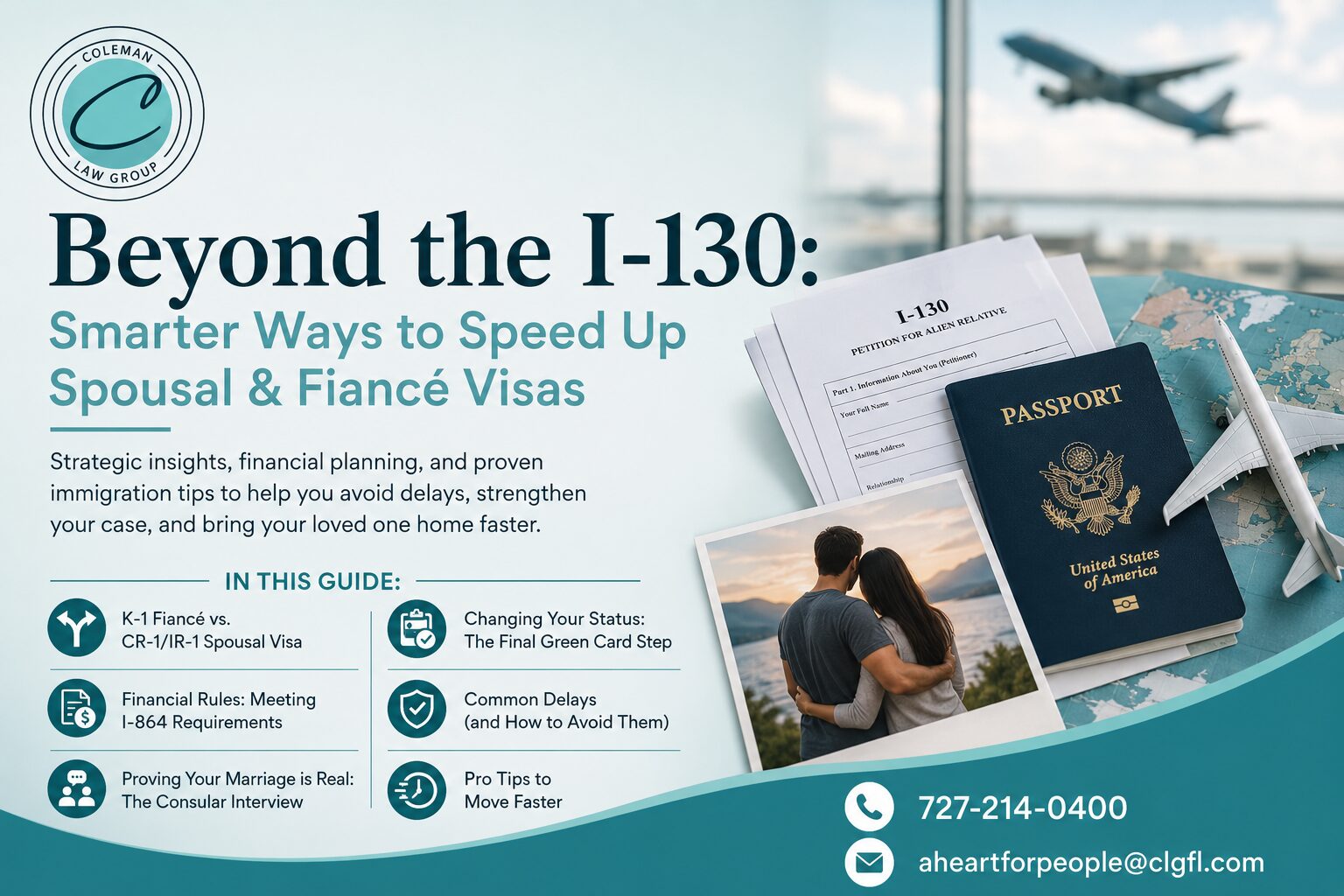
To bring your partner to the U.S., you have to pick a path: a fiancé visa or a spousal visa. There’s no middle ground and no magic fast track. Either way, you’re stuck making hard choices about trading time, cash, and whether your partner can work right away.
Here is how the K-1 fiancé visa and the CR-1/IR-1 spousal visa align under the 2026 immigration rules:
| Strategy Feature | K1 Fiancé Visa | CR-1/IR-1 Spousal Visa |
| Status at Filing | Engaged (Must marry in the U.S. within 90 days of arrival) | Legally Married |
| Time to U.S. Entry | Around 10 to 16 months | Around 17 to 24 months |
| Status on Arrival | Non-immigrant (You apply for a green card after the wedding) | Permanent Resident (Green card holder from day one) |
| Work Authorization | No (Must wait months for a separate work permit to be approved) | Yes (Work authorization is active immediately upon entry) |
| Government Fees | Higher (You pay separate fees for the visa and the green card later) | Lower (One main fee structure handled through the consulate) |
The real difference between the K1 and CR1 visa pathways comes down to where you want to wait.
The fiancé visa gets your partner to the U.S. faster, but it leaves them stuck in a legal holding pattern once they land. They can’t get a job or travel outside the country for months while their green card is being processed. A spousal visa takes longer at first while the applicant is overseas. But once they land, they can work and travel right away.
Financial Rules: Meeting the Affidavit of Support Criteria
You cannot bring your partner to live with you in the United States unless you can prove you can support them financially. The government forces you to sign a binding contract called Form I-864. If your income falls below their strict threshold, your visa application is stopped completely.
To clear this hurdle, your household income has to hit at least 125% of the federal poverty line. Under the 2026 rules, a couple needs to show a steady income of at least $27,050. But if you have kids or support other relatives, that number jumps fast. For a family of three, you’re looking at a minimum of $34,150.
If your personal tax returns do not hit those exact numbers, the government will issue a Request for Evidence (RFE), stalling your file for months. When this happens, your best option is to look into the I-864 affidavit of support joint sponsor requirements.
A joint sponsor acts as a financial backup. Your co-sponsor does not have to be a relative, but they do need to meet a few strict rules:
- They must be a U.S. citizen or a green card holder living in the country.
- They must prove their income independently covers their own household, plus their immigrant partner.
- They cannot just combine a small income with yours; their standalone taxes must clear the financial line for their own family size.
Using a joint sponsor means submitting clear proof of their status, their most recent federal tax returns, and current pay stubs. Miscalculating household sizes on these forms is one of the most common reasons regular couples get hit with long processing delays or total denials.
Proving Your Marriage is Real: The Consular Interview
Clearing the financial hurdles is only the first step. The final, and usually hardest, part is convincing a skeptical government official that your relationship is the real deal. For spousal visas, this happens at a U.S. embassy overseas. For fiancé visas, it takes place before your partner can set foot in the country.
The officer is looking for signs of a fake marriage. Think major age differences, language barriers, or very little time spent together. To get through the consular interview cleanly, you can’t rely on words alone. You need solid, third-party evidence.
Don’t just rely on text messages or pictures. To build a strong case, collect official documents that show your lives are actually intertwined:
- Shared Finances: Look for joint bank statements showing daily bills, shared credit cards, or insurance policies where you’re on each other’s plans.
- Living Together: Do you have a joint lease, property deeds, or official mail sent to the same address? Even if it was overseas, it counts.
- Travel History: Dig up passport stamps, boarding passes, hotel receipts, or rental car confirmations from your trips together.
- Letters from Friends & Family: Ask people who know you as a couple to write sworn statements. They should include their contact info and details on how they’ve seen your relationship.
Changing Your Status: The Final Green Card Step
If you choose the K1 fiancé visa route, your partner enters the country as a temporary visitor. The visa does not give them permanent residence. To stay legally, you must marry within 90 days of them landing in the U.S.
Right after the wedding, you have to file a massive pile of paperwork called an Adjustment of Status application. This is where you officially request that the government change your status to permanent resident. Until this application is approved, your partner is stuck in a legal gray area.
This brings us back to the main difference between the K1 and the CR1 visa paths. With a CR-1/IR-1 Spousal Visa, you completely skip this entire step. Your partner walks off the plane with their green card.
The K-1 fiancé route is a different story. After the wedding, you hit a long, frustrating wait with two big rules:
- No Work: They can’t take a job, earn a paycheck, or even get a Social Security number. You’re stuck waiting months just for the government to approve a work permit.
- No Traveling: Your partner cannot leave the United States. If they step across the border for an emergency back home before getting a special travel permission paper, the government cancels their application instantly, and they cannot get back in.
Filing this last step costs much more and adds months to the wait. It’s risky, too. If you make a small mistake or forget to include your marriage certificate, the government rejects everything. That leaves your partner with no legal status at all.
Calculating the Real Cost: Application and Hidden Fees
Many couples make the mistake of only budgeting for the first government form. In reality, the total price tag for both pathways involves multiple tiers of mandatory government fees, medical exams, and travel expenses that build up quickly.
The initial cost to get a fiancé visa moving is $675 for Form I-129F. However, because this path forces you to complete the green card process after your wedding inside the U.S., you must later pay a massive $1,440 filing fee for the Form I-485 adjustment package. If your partner wants to work while that green card application is pending, adding the optional Form I-765 work permit reduces the fee to an extra $260 when filed concurrently.
The spousal visa route requires more cash upfront, but costs significantly less by the end of the process. You start by filing Form I-130 for $625 online (or $675 on paper). Once the file is transferred to the National Visa Center, you will pay a $120 financial review fee and a $325 consular application fee.
Beyond the strict paperwork costs, both strategies demand identical out-of-pocket expenses that you cannot skip:
Certified Civil Documents
Expect to drop some cash pulling together official birth certificates, old divorce decrees, and certified police clearances from everywhere your partner has ever lived. Plus, if any of those papers aren’t in English, you can’t just translate them yourself. You have to hire a certified translator who will go line by line and officially sign off on the accuracy.
The Mandatory Medical Exam
Every single immigrant must clear a full physical exam and get a complete round of required vaccinations from a government-approved doctor. Don’t count on your regular health insurance here; these clinics don’t take it. You’ll have to pay out of pocket, and expect to drop anywhere between $200 and $500, depending on where you are.
Travel and Hotel Costs
You’ll also need to pay for flights to the embassy interview, a hotel in the capital city where the consulate is, and your one-way ticket to the U.S.
When you add up every government fee from day one until the green card arrives, the difference between the K1 and CR1 visa totals is substantial. The fiancé path costs hundreds of dollars more because of the extra adjustment application required in the U.S., making the spousal visa the cheaper choice, even with the longer wait.
Handling Background Roadblocks: Past Denials, Overstays, and Records
If your record is completely pristine, you only have to deal with the government’s waiting lines. But if you have past visa rejections, missed deadlines, or an old arrest, your application is subject to a much harsher screening process.
Old Visa Denials
Having a tourist or student visa rejected years ago will not instantly kill your current marriage case, but trying to hide it will. The government checks your fingerprints against global databases the moment you file. You must list every past visa refusal on your paperwork. If you hide a denial, the officer will view it as a deliberate lie. That can lead to a lifetime ban from entering the United States.
Visa Overstays and the Discretionary Trap
If your partner is currently in the U.S. and stayed past the expiration date on their I-94, your strategy requires extreme caution. Under standard rules, the government historically forgave overstays for spouses of U.S. citizens who entered legally.
But here is the reality: the rules have gotten incredibly tight. Under the latest USCIS policy shifts, officers are scrutinizing inside-the-U.S. adjustments with a microscope, treating them as a rare privilege rather than something you’re automatically entitled to. If your partner panics and leaves the country to switch to a consular interview abroad, crossing the border can automatically trigger a 3-year or 10-year bar to reentry. You cannot guess whether to stay or leave.
Past Criminal Records
If your partner has any history of arrests or convictions, you need to get certified court files and police certificates. Under federal immigration rules, even a minor mistake from ten years ago can lead to a visa denial at the embassy.
If that happens, your only option is to file a Form I-601 waiver. To get this approved, you have to prove that keeping your partner out of the country would cause “extreme hardship” to you, the U.S. citizen sponsor.
When your case has these hidden tripwires, guessing on forms or relying on advice from internet forums is a recipe for a denial. You need a solid plan to fix these issues before the government tries to deny your case. That is exactly why having a fiancé visa attorney look over your files can make a huge difference.
How the Coleman Law Group Protects Your Future
You do not have to navigate this complicated immigration system on your own. A single missed filing deadline, a poorly answered question, or a weak collection of relationship proof can stall your life for months or cause a painful application denial. At the Coleman Law Group, we serve as your dedicated fiancé visa attorney to handle the heavy legal lifting from day one. We handle the extensive paperwork, ensure your financial files meet the current 2026 guidelines, and prepare you and your partner to handle tough embassy interview questions with total confidence.
Take the stress out of your application and secure your future by calling us at 727-214-0400, or reach out to us directly at aheartforpeople@clgfl.com to set up a confidential review of your case.