

One of the most challenging things a person has to go through when leaving any situation is getting away from domestic abuse. For a non-citizen, that fear is often amplified by the threats of deportation due to their immigrant status. Abusers typically use visa applications, green card sponsorship, and their lawful position to exert control and power.
In an effort to protect the rights of these at-risk immigrants, the Violence Against Women Act (VAWA) self-petition process was designed. Through this process, an eligible victim of domestic abuse may apply independently of the abuser for lawful permanent residence status.
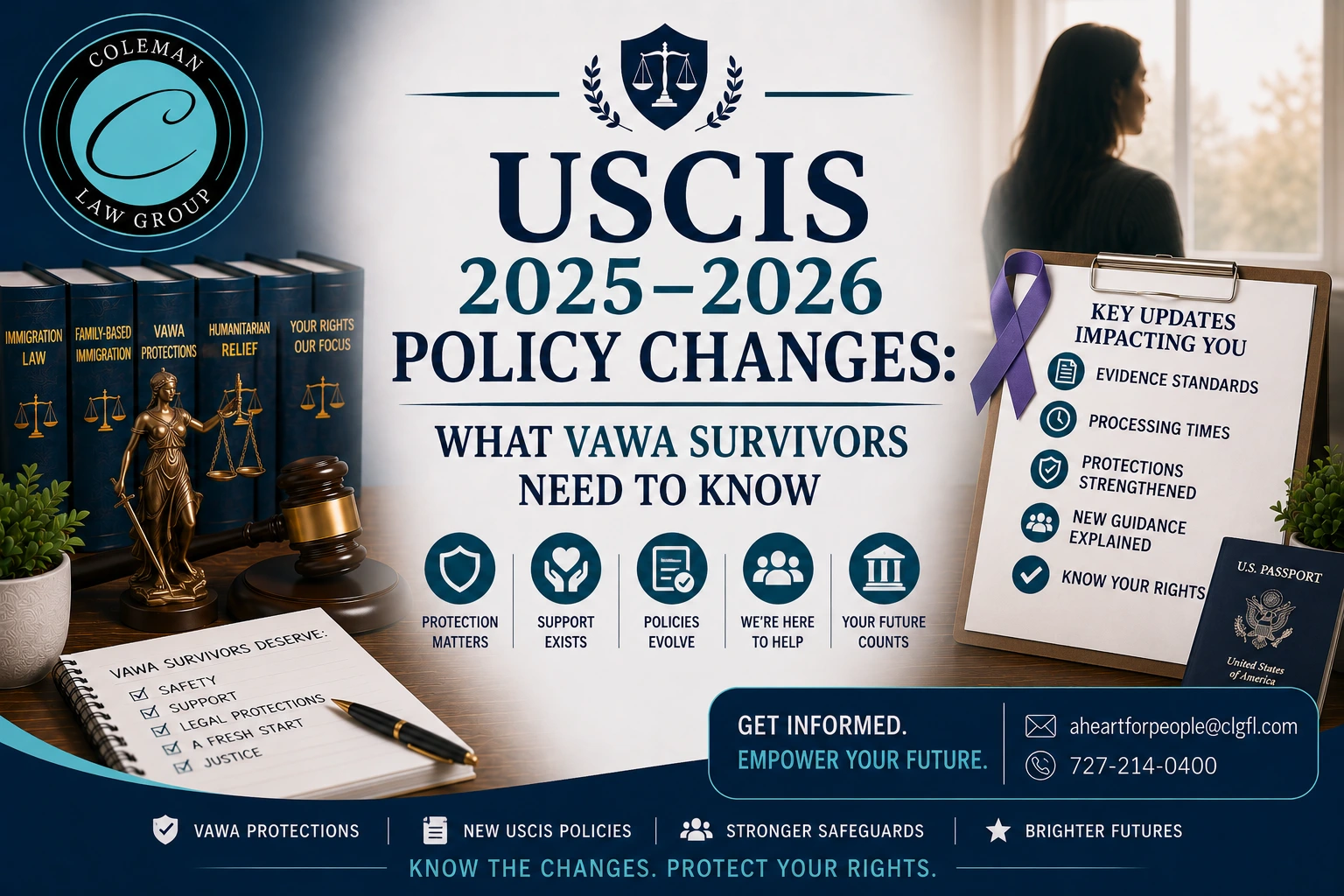
At present, the laws governing humanitarian immigration cases are changing rapidly. The U.S. Citizenship and Immigration Services recently released a major update in Volume 3 of its USCIS policy manual. This change relates to the process of self-petitioning through VAWA. Starting right away, every new or pending petition under the VAWA process will be subject to stricter evidentiary requirements, clear definitions of eligibility, and expanded discretion by immigration adjudicators.
If you are still waiting for your case to be approved, you should learn about these administrative changes. The details that follow below should be what you are looking for.
What is VAWA Self-Petition?
VAWA self-petition (form I-360) is one way of gaining legal status in the United States for those who have been battered and subjected to cruel treatment by a U.S. citizen or lawful permanent resident (LPR) family member.
In the regular immigration process, when there is family sponsorship, a citizen or LPR family member usually sponsors the petitioner. However, in case of abuse, it provides the opportunity for the person who has engaged in the abuse to delay or even withdraw the petition or threaten deportation. VAWA eliminates this, since the abuser does not know anything about the petition or participate in the decision-making process.
To be qualified to use VAWA self-petitioning, they must fulfill:
- Qualifying relationship: You are the spouse, child, or parent of a U.S. citizen or the spouse or child of an LPR.
- Battery or extreme cruelty: You have suffered from physical battery or extreme mental, emotional, or financial pressure in your relationship.
- Shared living quarters: At least once, you had to live with the abusing family member.
- Good moral character: You possess the good moral character that is desired of the members of the community.
- Good faith marriage (for spouses): You married the individual in good faith and not simply for any immigration benefits.
Whereas the basic statutory elements have remained the same, USCIS has made considerable changes in how it evaluates them.
Overview of the Recent USCIS Policy Manual Overhaul
USCIS has introduced new guidelines on program integrity to ensure that evidence review standards are consistent among adjudicators.
One of the main points about the guidelines is that they apply not just to petitions that are currently being petitioned or to be made in the future, but also to petitions that are currently under review and are long-past cases.
This implies that even if you filed a petition under the Violence Against Women Act long ago and have been waiting for its outcome for a long time, the new guidelines will still apply.
Previously eligible cases might be denied as RFE or NOID because they fail to meet the evidentiary requirements.
Key Shifts in the Policy Guidelines
The precise details of the new manual will allow survivors and their allies to identify any possible loopholes in the required evidence early on.
-
Return to the Cohabitation & Residence Standard
Perhaps the most significant change in the new manual concerns the standards USCIS uses to judge the shared residence requirement.
For a case to be considered valid according to the provisions of VAWA, the self-petitioner has to establish the presence of cohabitation with the abuser. Under previous interpretations of the law, there was some flexibility regarding timing. The new manual reverts to the old standard before 2022: cohabitation must occur during the qualifying relationship.
Moreover, the USCIS explicitly states that brief visits at the abuser’s residence without residing at their place are not sufficient to establish shared residence. If, for example, two people dated but lived in separate residences and the non-citizen frequently visited their partner, this time cannot be taken into account if they did not cohabit after getting married.
-
Higher Requirements for Proving a “Bona Fide Marriage”
Individuals seeking self-petitioning status in a marriage to a United States citizen/LPR must show that this marriage is a good-faith marriage. USCIS, in its recent update, places greater emphasis on documentary evidence of the marriage’s credibility from the beginning.
This evidence may include:
- Joint utility bills, lease agreements, or mortgage documents.
- Financial lives are shown through joint bank accounts, tax returns, or credit records.
- Insurances that make each other beneficiaries.
- Documentary evidence, such as birth certificates for children born outside that marriage.
Even though the “any credible evidence” standard still applies according to the federal statute, the USCIS adjudicator should review the secondary evidence, such as affidavits or any letters from another party, with much higher caution. The application of personal statements will most probably be a reason for case denial.
-
Increase in Discretion of Adjudicator & Weight Given to Credibility
With the new guidance being put forward, the discretionary powers of individual USCIS adjudicators are once again highlighted. The officers have been asked to review each record with due regard to the credibility and weight of the submitted documents.
Under this policy, the officer may decide that, even though the document meets all legal requirements for acceptability, it carries little weight due to insufficient detail or supporting evidence. It makes it important for the documentation process to be complete and organized.
-
Requirements of Good Moral Character (GMC)
All adult VAWA applicants are required to prove their good moral character, which applies to the 3 years preceding the application.
As per the policy manual revision, while an applicant’s affidavit is considered the initial proof of good moral character, USCIS retains discretion to require local police clearance certificates or other proof in such cases.
Further, a statement in the old policy manual that USCIS will not reject a case for a lack of evidence of good moral character has been deleted. The burden of proof is strictly with the applicant himself. It needs to be ensured that there is proof of statutory exceptions in case of even minor arrests/civil violations/misunderstandings on the record.
-
Special Clarifications of Step-Relationship
The new policy offers clear guidance on self-petitioning for step-children or step-parents.
In particular, should the step-relationship be ended due to the death of a natural parent, it is necessary to prove the existence of a continued relationship between the two relatives. It stresses that there should have been a step-relationship before the incident of abuse.
How These Changes Impact a VAWA Survivor in Florida
Despite having thriving immigrant communities, immigrant survivors of domestic violence living in Florida encounter particularities related to filing immigration cases locally.
- Problems with Documentation: Victims are forced to escape from their homes. Getting hold of leases, utility bills, and bills for a common dwelling can be problematic.
- Records from State and Municipal Courts: Law enforcement agencies and courts in Florida consider applications for protection (restraining orders) in accordance with Florida law. Thus, it is critical to provide all necessary documents for your case in accordance with USCIS requirements.
- Delays with Employment Authorization Document Application: The Employment Authorization Document provides victims with opportunities to become economically independent of their abusive spouses. Any procedural delay of the process of obtaining this card as a result of a new system of RFE’s will hinder your attempts to start a new life on your own.
Working with an immigration attorney with expertise in human rights visa cases in the USA, especially in Florida, will help you provide sufficient local evidence to USCIS.
The Importance of Working with a Humanitarian Visa Lawyer
The Violence Against Women Act continues to be an essential act for immigrant victims, although the process for obtaining such protection becomes increasingly formalized and difficult. Policy guidelines established by USCIS demand precision, documentation, and knowledge of evidence evaluation.
Taking the risk and trying to deal with this formal process without any support after experiencing trauma may turn out to be hazardous.
The humanitarian visa lawyer will analyze your case and provide all the required documentation to the USCIS.
Contact Coleman Law Group for Help
If you are going through the VAWA process by yourself in Florida or have a humanitarian immigration case that requires some assistance, you don’t have to go through it alone.
Our team at Coleman Law Group knows the many difficulties that come with being a victim-survivor. We are familiar with USCIS policy changes and use that knowledge to build strong cases for our clients.
Get back in charge of your life in a safe and confidential setting. Call Coleman Law Group now at 727-214-0400 or aheartforpeople@clgfl.com to book your appointment.