


Fighting for time with your kids can make you feel like you’re just invisible in an uncaring legal system. You aren’t just filing forms; you’re setting the ground rules for how your children live their lives for years to come. This is easily the toughest, most draining obstacle any parent ever deals with. It is the moment where your family’s future seems to hinge on court dates and rigid statutes, leaving you feeling entirely out of control.
Florida courts technically operate under the “best interests of the child” standard. Knowing the law isn’t the win. You need an advocate who can take your raw dedication as a parent and turn it into the cold, hard evidence judges actually respond to. Find someone who lives in the local trenches, knows the players, and can build a case that won’t fold under pressure.
At the Coleman Law Group, we do things differently. We don’t view you as a source of billable hours or a folder in a cabinet. We’re here to be your partner, combining smart, tough legal tactics with a focus on what matters: your family. Whether your situation is a straightforward co-parenting setup or a high-conflict disaster, we’ll give you the strategy you need to defend your relationship with your kids.
What Does the Best Interests of the Child Standard Mean?
In Florida child custody cases, the court’s focus is the best interests of the child. Rather than automatically favoring one parent, the court evaluates the circumstances of the family and the factors relevant to the child’s well-being. Judges look at one thing: the “best interests of the child.” It’s a standard that sounds clear until you’re under oath. Most people walk in thinking their parenting track record is obvious, but without the right proof, it’s talk.
The Misconception of Automatic Custody
Forget everything you’ve heard about “maternal preference” or “father’s rights” as automatic advantages. Florida law does not start with a bias toward either parent. Judges are looking for the parent who best facilitates a continuing relationship with the other, provides a stable routine, and puts the child’s needs ahead of their own personal grievances. If you spend your time in court attacking the other parent’s character instead of highlighting your own stability, you are actively hurting your case.
What Florida Judges Consider in Child Custody Cases
Guessing what a judge wants is a recipe for disaster. You need a child custody lawyer who knows the local landscape, so you can stop wondering and start producing the proof that actually gets results.
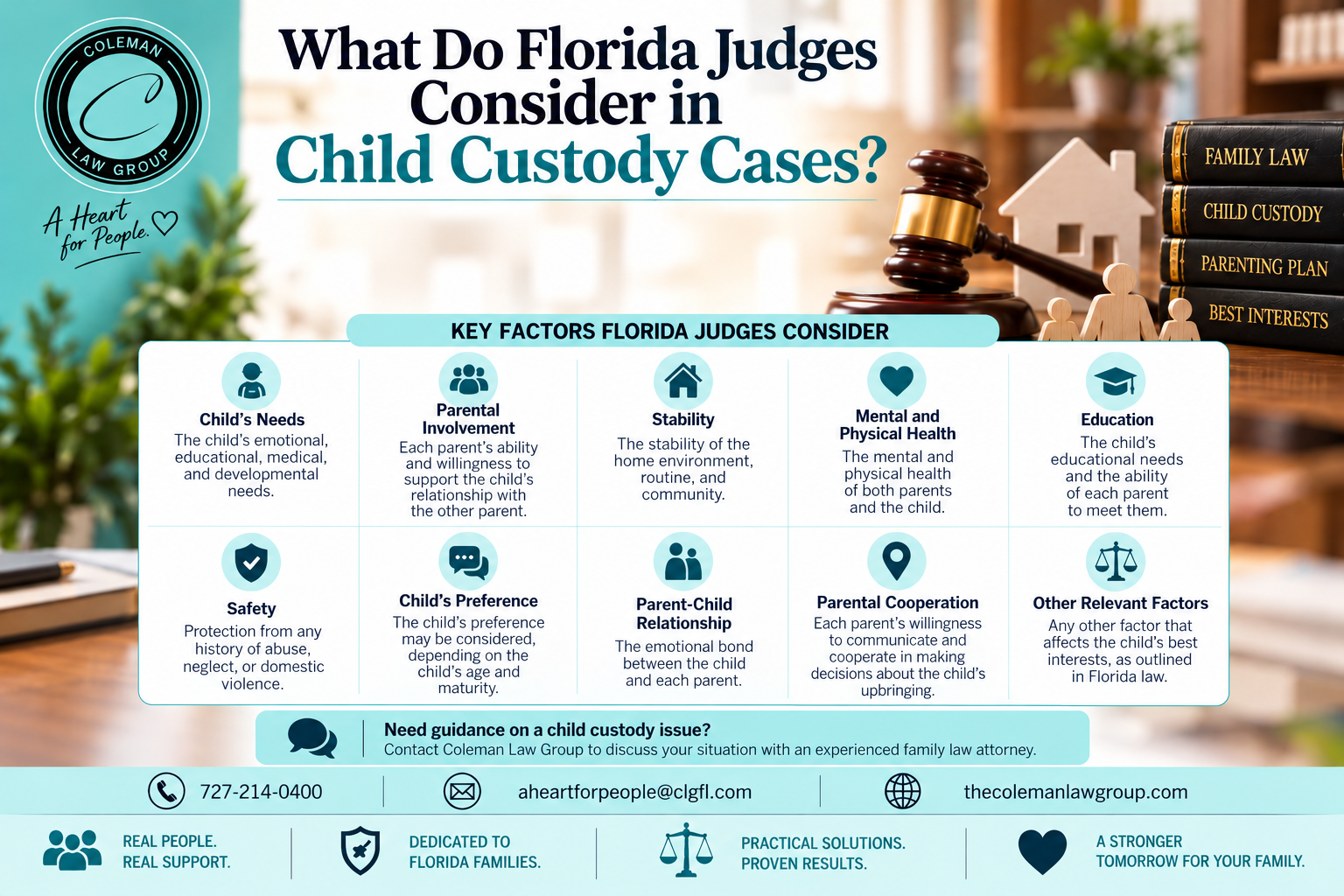
The judge will be looking at a concrete list of factors to decide the outcome, including:
1. Parental Cooperation:
Are you a partner trying to make this work, or a roadblock creating unnecessary drama? When you make things difficult for the other parent, you aren’t just winning a petty point. You’re actively handing the judge a reason to rule against you.
2. Consistency:
Anyone can call themselves the primary parent, but the court wants to see the work. If you haven’t been keeping a clear record of your daily involvement, you’re missing the ammo you need. You won’t convince a judge by just telling them you’re involved; you have to show them the proof of every school’s drop-off and doctor’s visit.
3. Stability:
This isn’t just about money; it’s about having a predictable, safe home environment where the child can thrive.
4. Needs of the Child:
How well do you know your child’s emotional and educational requirements?
Bridging the Gap
At Coleman Law Group, we help you translate your parenting reality into a legal narrative. We don’t just tell the court you are a “good parent”; we show them through documented history and specific, actionable plans. If you are struggling to communicate with your co-parent, we can identify a strategy to help you avoid appearing to be the “difficult” one in the court’s eyes. The goal is to make it incredibly easy for the judge to see that your plan is the most stable and beneficial option for your child’s future.
1. Managing High-Conflict Custody Disputes
Some cases move past simple disagreements. In such cases, stop trying to fix the relationship. You’re in a cycle of hostility, and it won’t end by being the bigger person. If they treat court orders like suggestions and your kids like bargaining chips, you are beyond negotiation. It’s the only language they’ll understand. Shift your focus entirely to enforcement and legal protection, as it’s the only language they’ll understand.
2. The Reality of the Conflict
High-conflict cases rarely revolve around the kids. They turn into a war of egos: schedule changes at the eleventh hour, “forgetting” crucial dates, and subtle digs designed to get under your skin. Stay out of it. If you stoop to their level and start fighting fire with fire, you’re just damaging your own credibility in the eyes of the judge. The moment you start arguing back in a text or raising your voice at an exchange, you’re handing the court proof that both of you are the problem.
3. The Evidence Strategy
Avoid labeling the other party as “difficult” during proceedings. A judge is indifferent to personal assessments and will not base a ruling on subjective claims. Your narrative must be discarded in favor of a strictly evidence-based presentation. Labels are irrelevant; documented facts are final.
4. Keep a precise log.
Date, time, and exactly what happened. If they show up two hours late to a visitation, write it down.
5. Stick to neutral language.
Don’t write, “They were being a jerk.” Write, “The other parent arrived at 4:30 PM for a 2:30 PM exchange and refused to discuss why.”
6. Treat record-keeping as your primary defense.
You must save every text, email, and transaction in an external file system. Deleting correspondence is a critical error. Once you establish a comprehensive, verified timeline, you remove the ambiguity inherent in competing claims, anchoring the proceedings firmly in documented reality.
7. Getting Outside Help
Sometimes, your own voice isn’t enough. If the situation is spiraling, we look to third-party professionals. Parenting coordinators or forensic evaluators can step in to provide the court with an objective view of the family. They don’t have a horse in the race. When they report back to the judge about what’s actually happening, it cuts through the drama faster than any argument you could make on your own.
Our objective is firm: we secure your rights. We block the chaos from spilling over onto your children and force the court to confront the reality of who is compliant and who is not. You require a tactical approach that maintains your composure, regardless of the other party’s attempts to provoke a reaction.
How Parenting Plans Relate to the Child’s Best Interests
In Florida, a parenting plan isn’t just a formality; it is a binding court order. It dictates how you will share daily tasks, where your child will sleep, and who gets the final say on everything from medical procedures to school enrollment. A lot of parents make the mistake of pulling a generic template off the internet and signing it to “get the divorce over with”. That is a massive mistake. When your plan is vague, you are essentially buying a future filled with arguments.
The Danger of Vague Language
If your plan says something like, “The parents will share holidays reasonably,” you have already lost. “Reasonable” is a subjective word. When you and your ex-spouse disagree on whether Thanksgiving includes the Wednesday night before or the Sunday night after, you’ll be right back in front of a judge, paying thousands in legal fees to resolve a definition.
A court-ready plan needs to be obsessively specific. You want to spell out:
- Exchange logistics: Exact times and locations for drop-offs.
- Holiday rotations: Who gets the child for each major holiday, and when the exchange happens.
- Communication rules: How you will handle messages, what apps you’ll use, and how you’ll talk to the kids when they’re at the other parent’s home.
Avoid adopting a parenting schedule that ignores the reality of your professional life. If your career requires night shifts or travel, do not concede to a generic, template-based arrangement. Designing a plan that fails to align with your actual availability is a precursor to non-compliance. That will lead to missed visits and constant requests for last-minute changes. We help clients look at their actual lives, such as their work schedules, their child’s school requirements, and their own capacity, to draft a plan that works in the real world, not just on paper.
Why We Focus on Enforcement
Enforcement defines the strength of your legal position. A plan that ignores the reality of rule violations leaves you vulnerable and without recourse. We mandate clear, escalation-based dispute resolution steps that permit intervention without immediate, costly court filings. This rigorous attention to detail eliminates future operational headaches and creates a reliable, structured framework for your family.
1. Modification: When Life Circumstances Change
Life in Florida doesn’t stay static. Jobs change, parents relocate, and children grow up, meaning the parenting plan you signed two years ago might be completely unworkable today. When the agreement no longer fits your family’s reality, you can’t just ignore it or make “informal” verbal tweaks—that’s a recipe for a contempt of court charge. You need a formal modification, and you need a child custody lawyer who knows how to prove that a “substantial change in circumstances” has occurred.
2. Proving Substantial and Material Change
The court doesn’t just change orders because it’s inconvenient for you. To get a judge to sign off on a new plan, you have to meet a specific legal threshold. You have to prove that there has been a significant, permanent, and material change in your life or your child’s needs since the original order was filed.
Whether you’ve received a job offer in a new city or your teenager is begging for a different time-sharing schedule to match their school activities, the court’s focus remains the same: the best interests of the child. Having an experienced child custody lawyer by your side is vital here. We know how to draft the petition and present the evidence (whether it’s employment contracts or school records) that turns a “life change” into a legally recognized reason to update your order.
Why Our Approach Actually Matters
Most law firms treat you like a case file. You walk in, they open a folder, and you’re just another billable hour to be processed. That might work for some industries, but it’s a disaster when you’re dealing with your kids. Custody isn’t some cold, clinical puzzle. It’s messy, it’s loud, and it’s deeply personal.
Forget the Billable Hour Mindset
At Coleman Law Group, we work on a “Heart for People” philosophy. We aren’t here to inflate our hours by over-complicating your life. When you call us, you’re looking for a way to keep your family from falling apart. We talk to you like a partner, not a client. You won’t be left in the dark wondering what’s happening with your case, and we don’t hide behind jargon to justify the process. We tell you the “why” behind every move we make.
We Filter the Noise
Custody battles are exhausting. Between the court calendar, the endless bickering with your co-parent, and the constant, nagging stress of what’s coming next, it’s no wonder you feel buried. Let us step in. We manage the messy, complicated legwork so you can focus on just being a parent. We take over the document gathering, the scheduling, and the technical headaches of the court system. When we take that off your plate, you can actually show up for your kids instead of spending your weekends fighting with a printer or trying to interpret a confusing court notice.
Strategy That Fits Your Life
There is no such thing as a “standard” custody case. We don’t pull a template off a shelf and try to force your family into it. Facts dictate our strategy, not ego. We look at your schedule, your child’s situation, and the reality of your co-parenting relationship. Sometimes you need to go for the throat in court; other times, you need a smart, quiet negotiation. We’re not looking to start a war, but we’re sure not going to let you or your kid get bullied.
Secure Your Child’s Future
Many parents try to handle custody agreements or modifications through casual texts or verbal promises. The problem? If the other parent changes their mind or emotions flare up, those “agreements” carry zero weight in court. A handshake isn’t a legal defense.
When you work with our child custody lawyer, we will ensure that your every detail is properly filed, stamped by the clerk, and signed by a judge. This closes the loop. It protects you from being accused of violating old orders and gives you an enforceable blueprint that actually fits your life.
At the Coleman Law Group, we provide the tactical protection you need while ensuring you feel supported, not just like a case number. Call us at 727-214-0400 or email us at aheartforpeople@clgfl.com to schedule your consultation.