


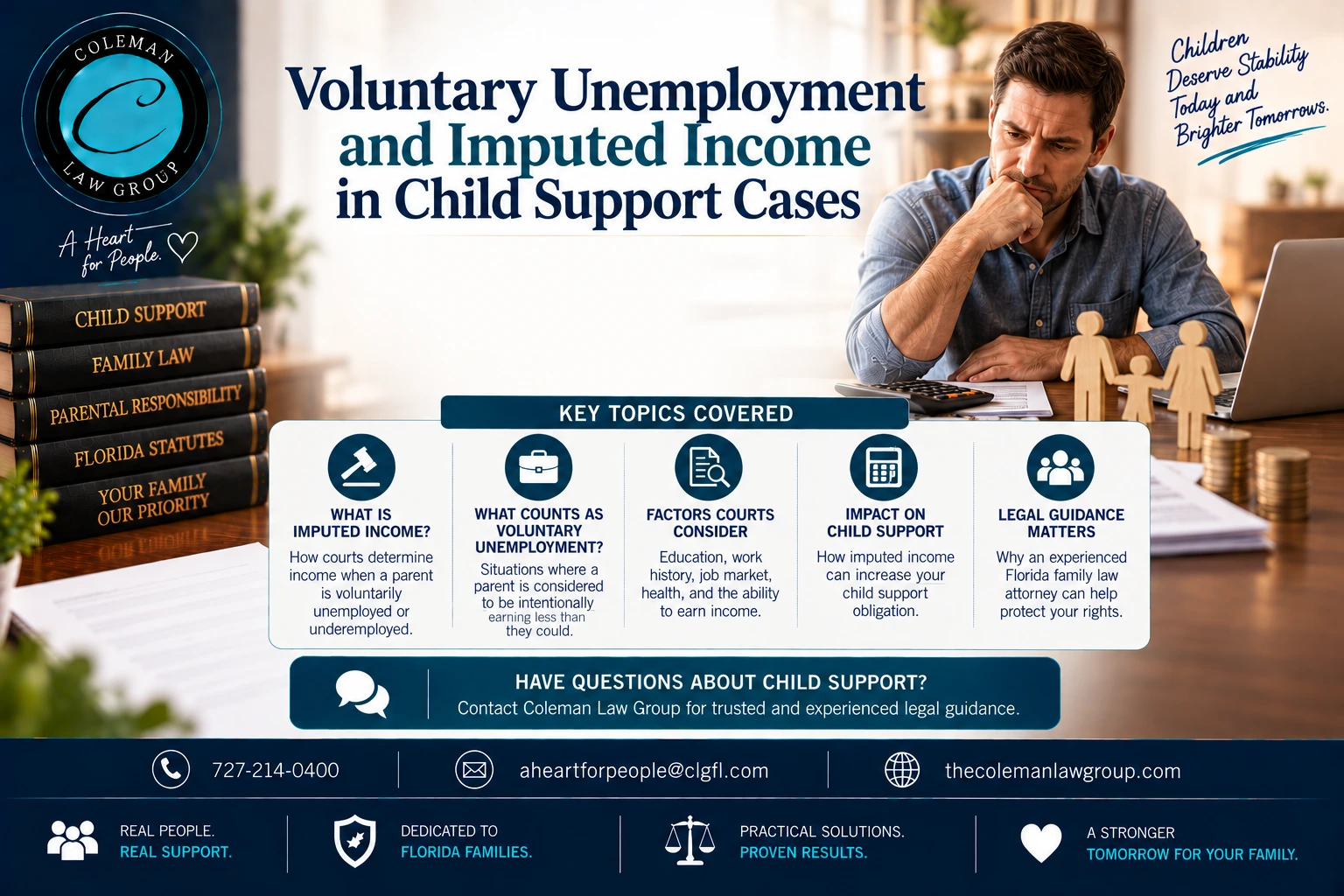
The income of both parents determines the amount of child support. However, if one parent is not working or is working but earning far less than they could reasonably expect, then what?
A parent could become unemployed, work fewer hours, or switch occupations or jobs. Then, the other parent can say that the decision was made voluntarily, and the court should consider what the parent was earning instead of just what the parent reports as income. Hiring the best child support lawyer can help you understand the rules that apply to your situation.
What is Imputed Income in Florida Child Support Cases?
Income that a court considers to be earned by a parent for the child support determination, but the parent is not actually receiving the considered income.
For instance, if a parent’s salary was $80,000 per year and they choose to leave and work part-time at $35,000 annually, then the salary change is the parents’ choice and should be reported. The other parent could say it was a conscious decision to reduce earnings, and the parent could still earn more.
When determining support, if it is found that the unemployment or underemployment is voluntary, then the court may consider the parent’s earning potential. Florida Statute §61.30 outlines rules for when an unemployed or underemployed parent acts as a substitute for a parent providing for their child.
When Can Income Be Imputed?
Not all unemployment spells are considered “voluntary” in Florida. The court shall determine if the parent has control over the circumstances that led to the lack of employment or underemployment.
For example, a parent may have a legitimate reason for earning less because of:
- A layoff
- A serious health condition
- A physical or mental incapacity
- A major change in the local job market
- A legitimate career change
- Parenting responsibilities
- Other circumstances outside the parents’ control
Who Has to Prove Voluntary Underemployment?
This is an important part of an imputed-income dispute. The parent seeking an imputed income generally bears the burden of presenting competent, substantial evidence that the other parent’s unemployment or underemployment is voluntary.
That party must also identify the amount and source of the proposed income.
What Evidence Can the Court Consider?
One of the most significant aspects of an income-imputation case is your employment history. The court may examine why the parent left the previous occupation and whether comparable work is reasonably available.
Evidence can include:
- Recent tax returns
- W-2 forms
- Pay stubs
- Employment records
- Job applications
- Job offers
- Professional licenses
- Certifications
- Résumés
- Employment listings
- Business records
- Evidence of education and training
The more specific the evidence, the easier it may be for the court to evaluate the parent’s actual earning capacity.
Florida Has Limits on Imputed Income
Florida law also placed limits on how income can be imputed. For example, income generally cannot be imputed from income records more than 5 years old at the time of the hearing or trial. There is also a general restriction against imputing income at a level the parent has never earned unless the parent recently became qualified for that level of employment through a degree, license, certification, relicensing, or recertification.
This can be important when one parent argues that the other should be earning a much higher salary.
What If a Parent Voluntarily Quits a Job?
Quitting a job does not automatically mean income will be imputed: the reason for leaving the job matters.
Consider two different situations:
Situation 1 – A parent leaves a position because the employer closes the business. The parent immediately begins looking for similar work but cannot find a competitive position.
Situation 2 – A parent voluntarily leaves a high-paying position shortly before a child support hearing and makes little effort to find better employment.
The first parent may have strong evidence that the loss of income was beyond their control. The second parent may face a claim that the reduction was voluntary.
A child support lawyer can help gather the documents needed to explain why the parents’ income changed.
What Happens If the Parent Does Not Provide Financial Information?
Florida’s child support law also addresses situations in which a parent’s income information is unavailable, or the parent fails to participate in the child support proceeding or to provide adequate financial information. In those circumstances, income may be imputed under the statutory rules, including a rebuttable presumption based on the median income of year-round, full-time workers when the applicable requirements are met.
Both parents should take requests for financial information seriously.
What to Do If the Other Parent is Hiding Income?
Income imputation and hidden income are related but different in some aspects. A parent may report very little income while maintaining a lifestyle that appears inconsistent with those earnings. This situation may require a closer look at financial records. The goal is to determine the parents’ actual financial circumstances.
Evidence may include:
- Bank statements
- Tax returns
- Business records
- Investment accounts
- Property records
- Payment records
- Employment information
- Other financial documents
A parent should not automatically accuse the other side of hiding income based only on lifestyle. Financial evidence is much stronger than speculation.
What Should You Do If You Are Facing an Imputation Claim?
If the other parent is asking the court to impute your income, do not ignore the issue. Start collecting records that explain your current financial situation.
You should be prepared to show:
- Why did your income change?
- What employment do you currently have?
- What income do those jobs realistically offer?
- How your parenting schedule affects your work options.
- Any health or other circumstances affecting your ability to work.
The same preparation applies if you believe the other parent is intentionally earning less.
Instead of simply saying that the other parent “could make more,” identify evidence showing what work is actually available and why the parent is qualified for it.
Can an Existing Child Support Order Be Changed?
Child support orders can sometimes be modified when circumstances change, and the legal requirements for modification are met.
A change in employment or income may become relevant, but the specific facts and applicable Florida law determine whether modification is appropriate.
Parents should not assume that an informal change in income automatically changes an existing court order. Until a court enters a new order, the existing obligation generally remains important.
Why Legal Guidance Can Matter?
Income disputes can look simple at first.
One parent says, “They are choosing not to work.”
The other says, “I cannot find a job.”
A child support lawyer can help you present the facts clearly and challenge an income figure that is not supported by the evidence.
Get Help From Coleman Law Group for a Child Support Dispute
An income dispute can directly affect the amount of child support a parent pays or receives. Whether you are defending against an imputation claim or believe the other parent is intentionally earning less, the facts and financial evidence matter.
The Coleman Law Group handles child support matters for families in Florida, including support calculations, modifications, and enforcement issues.
If you need help understanding how Florida’s child support rules apply to your situation, contact Coleman Law Group at +1 (7272140400) or send an email to aheartforpeople@clgfl.com to discuss your case and your legal options.
Frequently Asked Questions
- Can Florida impute income to an unemployed parent?
Yes, Florida law allows income to be imputed when unemployment or underemployment is voluntary, subject to the requirements and limitations in Florida Statute §61.30.
- Can a parent be forced to take a higher-paying job?
The issue is generally whether the court should use an appropriate earning capacity when calculating support. The court considers qualifications, available employment, work history, location, and other statutory factors.
- Can old income records be used?
Florida law generally limits income imputation to income records more than five years old, subject to statutory exceptions.
- What if I lost my job through no fault of my own?
You should be prepared to document the reason for the job loss and your efforts to find suitable employment. Florida law recognizes circumstances outside a parent’s control when determining whether unemployment is voluntary.
- Can parenting responsibilities affect an income-imputation decision?
Florida law directs courts to consider the parties’ time-sharing schedule and their historical exercise of that schedule when determining an appropriate imputed income amount.