


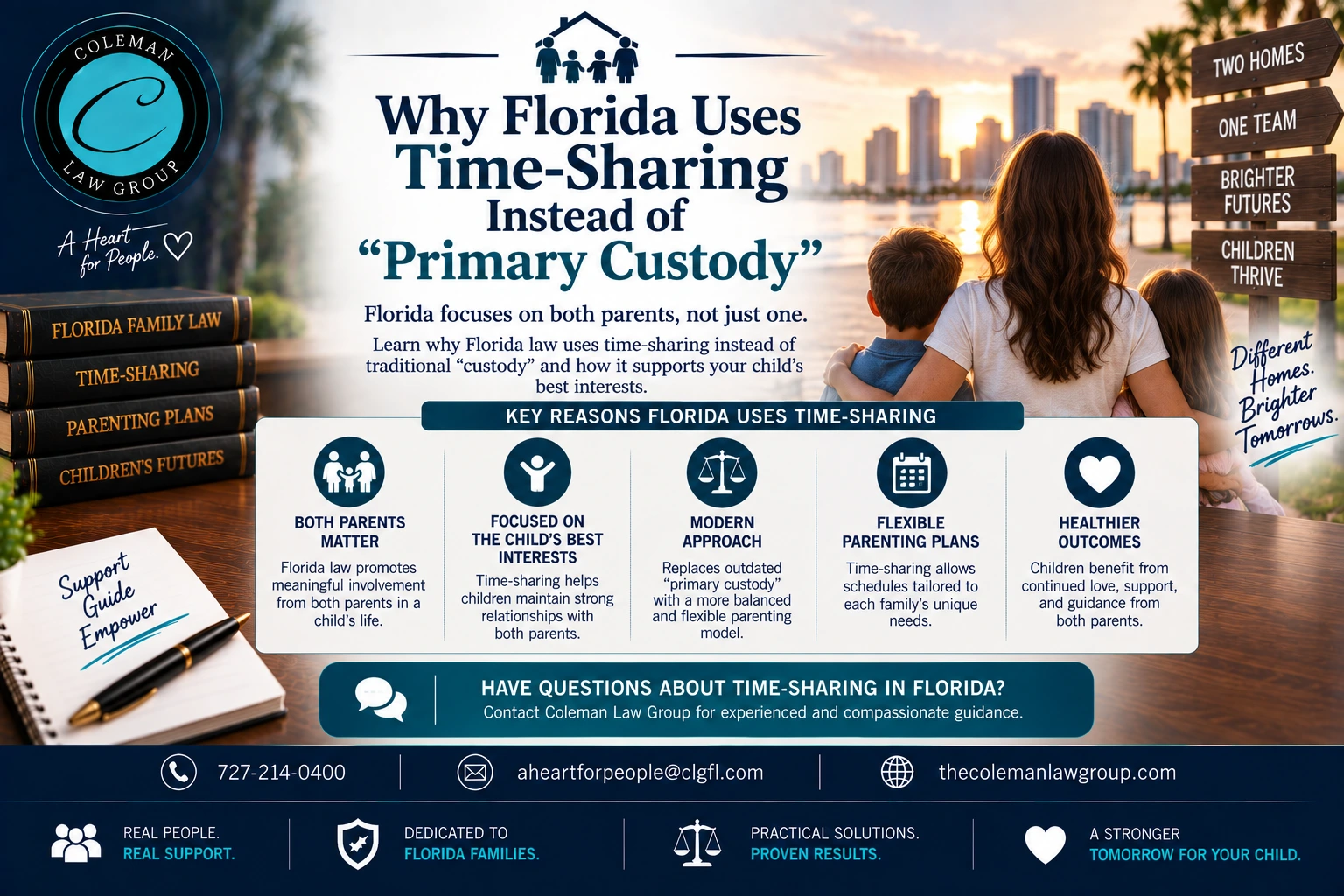
When parents in the state of Florida undergo a divorce or legal separation, they may come across terms such as custody or primary residential parent. However, the Florida statutes have removed those terms and replaced them with other parenting arrangements. The new laws were implemented to ensure that conflicts between parents over who has more rights to their child are based on what is best for the child. A child custody lawyer can also help parents understand their rights and legal options.
Therefore, in Florida, there is a rebuttable presumption of equal time-sharing. Knowing the definitions of the terms used in the statutes may help parents understand what to anticipate when developing a parenting plan or when they are challenging the opposing party’s requests in court.
This blog will discuss the legal definition of time-sharing in Florida, explain why the term “primary residential parent” was abolished, describe how the court determines time-sharing schedules, detail the elements of a parenting plan, and identify the conditions under which a parenting plan may be modified.
What is Time-Sharing Under Florida Law?
Time-sharing in Florida refers to the allocation of a child’s time between the two parents. It is one of the most vital aspects of the court-approved parenting plan and thus must always be present in any time-sharing case.
Florida Statute 61.13 states that the judge should adopt or approve the time-sharing parenting plan that is in the children’s best interests. The court’s order should state how the parents will share parenting responsibilities and how much time the children will spend with each parent.
Why Did Florida Abolish the Term “Primary Residential Parent”?
The state has stopped using the term “primary residential parent” in the Florida Statute § 61.13 to ensure that there are no more fights about custody and no gender discrimination in such cases.
The statutes have changed the conventional terms for a Parenting Plan and a Time-Sharing Schedule. The latter includes all daily responsibilities and overnight schedules.
There is a mandatory joint parental responsibility by default, and parents are expected to make major decisions regarding the child’s education and health together. Florida law also assumes that 50/50 time-sharing is in the child’s best interest.
What’s the Difference Between Time-Sharing, Parental Responsibility, and a Parenting Plan?
This is a common question that parents ask on forums such as Avvo when trying to understand Florida custody arrangements. These terms have different meanings under Florida Statutes § 61.13.
- The time-sharing schedule determines the amount of time the child spends with each parent. Under Florida law, there is a presumption in favor of time sharing that is rebuttable only if the presumption is overcome.
- Parental responsibility concerns decision-making for the child. The court generally orders shared parental responsibility unless it finds that doing so would be detrimental to the child. In appropriate cases, the court may order sole parental responsibility.
- A Parenting plan in Florida is a document that details how the children will be raised after divorce or separation. This covers the timesharing schedule and other daily activities related to schooling and communication with the children.
Most of the parents are unsure about these terms. A child custody and visitation attorney can explain how they may apply to their situation.
Does Time-Sharing Automatically Mean a 50/50 Split in Florida?
Equal time-sharing is not an automatic assumption in all instances in Florida. The state of Florida passed a law regarding time-sharing in July 2023. It is assumed that 50/50 parenting time is in the child’s best interests. This statute came into force on July 1, 2023, based on Florida Statute §61.13.
It implies that 50/50 parenting time will be the standard practice if the parents fail to reach an agreement. However, it can be rebutted. The parent should present a majority of evidence to prove that equal time-sharing would not be in the child’s best interests. Then the court must consider what is best for the child and make specific written findings for the time-sharing schedule.
What Must a Florida Parenting Plan Include?
Under Florida Statutes § 61.13(2)(b), a parenting plan must address several important areas concerning the child’s care and the parents’ responsibilities. These include:
- How the parents will share and handle the daily tasks involved in raising the child.
- When the child spends time with each parent, including the schedule for regular days and other periods.
- The plan needs to outline who will take care of the kid’s education and where the kid will enroll.
- The plan needs to include communication channels through which the kid will reach his parents.
The above requirements ensure that parents know their duties after divorce. The court also needs to consider what is best for the child during planning.
How Does a Florida Court Decide a Time-Sharing Schedule?
Under Florida Statutes § 61.13(3), the child’s best interests are the primary consideration when a court creates or modifies a parenting plan or time-sharing schedule. Unless the parents agree to a schedule approved by the court, the court must evaluate the statutory factors and make specific written findings.
The court considers factors including:
- Parent-child relationship: Each parent’s ability to encourage a close and continuing relationship with the child.
- Parental responsibilities: How responsibilities will be divided after the divorce.
- Distance and travel: Whether the proposed schedule is practical, especially for school-age children.
- Health and fitness: The parents’ moral fitness and mental and physical health.
- School and community: The child’s school and community record.
- Child’s preference: If the child is mature enough to express a reasonable preference.
- Communication: Each parent’s ability to effectively communicate with the other parent.
- Safety: Factors such as domestic violence, sexual violence, abuse, or neglect by one parent towards the other.
- Routine: Each parent’s ability to establish and maintain a stable routine for the child, including school and extracurricular activities.
- Other factors: Any other relevant factors that the court deems appropriate in considering the best interests of the child.
Even though Florida has a rebuttable presumption in favor of equal time-sharing, the final schedule must be carefully crafted according to the child’s needs.
Can a Florida Parenting Plan Be Modified After the Divorce?
Modifications to a parenting plan in Florida may occur even after the divorce process. However, certain conditions must be met for a person to modify a parenting plan. According to Florida Statutes § 61.13(2)(c) and (3), modifications involve a substantial and material change of circumstances, as well as being in the best interest of the child.
Examples of circumstances that may support a modification can include:
- Major changes in the child’s needs or circumstances.
- Significant changes in a parent’s circumstances that affect the existing plan.
- Moves by the parents regarding residence, especially if distance makes the existing arrangement difficult to enforce.
- Issues of safety in the form of threats of domestic violence, abuse, neglect, or abandonment.
- Any change related to the schooling or general stability of a child.
The courts do not amend an agreement simply because the parent wants a different schedule. They must first consider the child’s best interests.
How Can Coleman Law Group Help With Your Child Custody Case?
Child custody issues can impact your child’s future. Coleman Law Group will guide you through the laws relating to various legal matters, such as:
- Parental responsibilities
- Time-sharing
- Parenting plans
- Custody & Support modification.
Legal representation by a child custody lawyer would assist you in understanding your rights when you are facing a custody case for the first time or seeking a modification.
Contact Coleman Law Group at +1727-214-0400 or aheartforpeople@clgfl.com today to discuss your child custody case and consult a Florida family law attorney.