

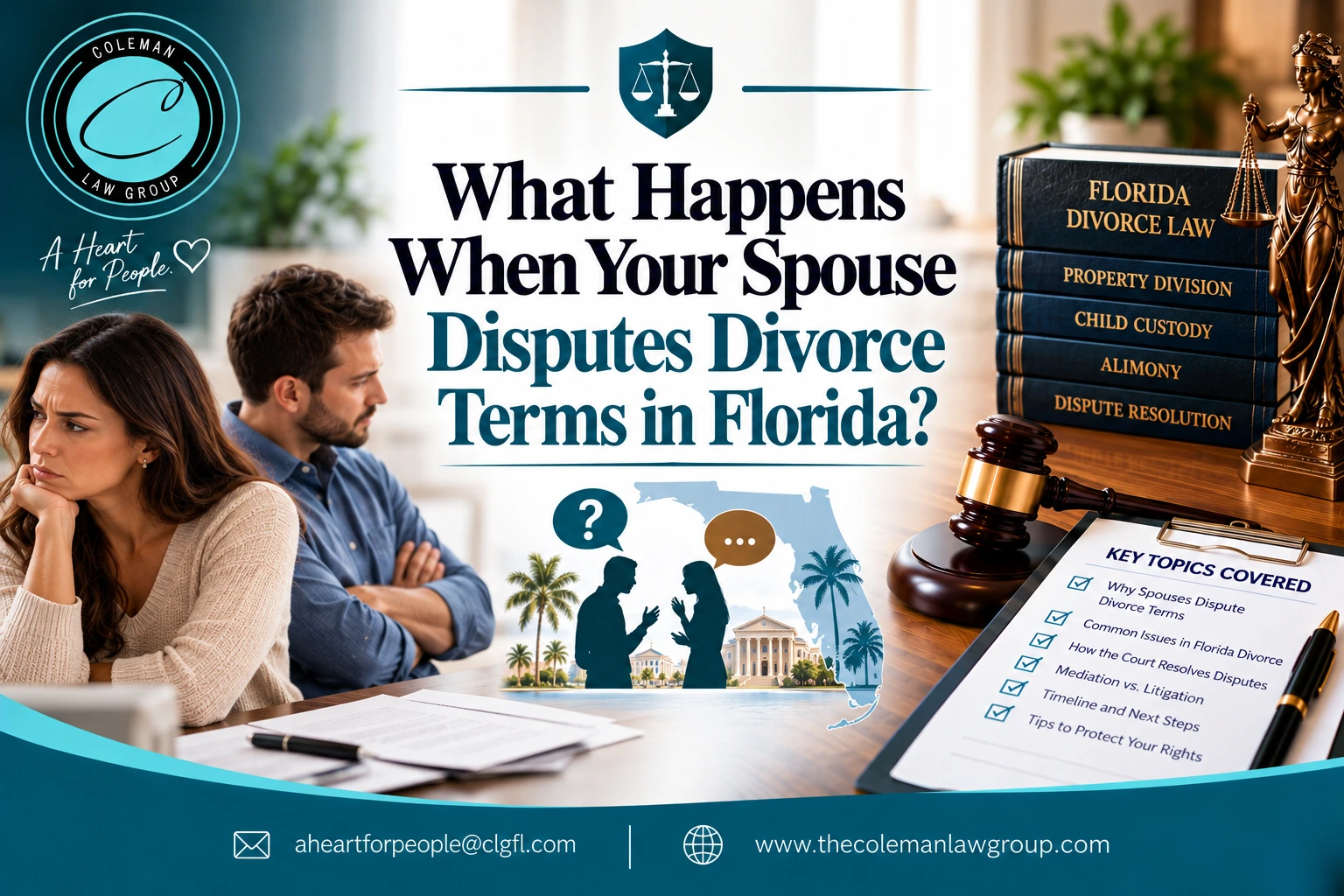
Even if both spouses agree to end their marriage, it’s important to understand the legal and emotional implications involved. Divorce is not just the separation of 2 people; it’s the partition of all the living and non-living things that were part of their marriage. This includes home, properties, digital assets, bank balances & accounts, and childcare arrangements. If the spouses don’t agree peacefully on the partition of these assets, a conflict arises. This conflict will complicate and challenge the divorce process, and Florida law steps in to resolve the problems.
What is a Contested Divorce in Florida?
A divorce is “contested” when the two parties are unable to agree on one or more of the matters to be addressed in the divorce.
- Dividing marital assets and debts
- Alimony
- Parenting and time-sharing
- Child support
- The marital home
- Retirement and Pension plans
- Business matters
- Other financial issues
Even with mutual consent of both spouses to terminate a marriage, there may still be disagreements over property division or child support.
They may proceed with mediation in these situations or seek the court’s assistance to consider the remaining issues.
Can mediation help in resolving divorce disputes?
Mediation is a process of intervening between two parties to resolve divorce disputes. It is an attempt by a third party, called a mediator. The mediator is neutral towards both parties. Mediators do not render a judgment but facilitate the resolution of disagreements or disputes between the parties.
Open communication is maintained between the parties so that both can clear up their doubts and misunderstandings and reach a common conclusion. Many people prefer to go with mediation first. Anyone can request mediation by providing advance written notice.
It can also reduce the likelihood of a court visit for a decision.
The mediation will not guarantee an agreement. The judge may still be required to resolve some or all of the marital differences if spouses are unable to reach an agreement.
What if we have children and my spouse will not cooperate?
There can be differences between parents over decisions, such as where children should live and who should make key decisions about the school and their health care.
The parenting plan and child support are governed by Florida Statute § 61.13, which considers the best interests of the child. Parents can discuss and agree upon a parenting plan that best looks after their children. If they are unable to agree, the court will decide on parenting arrangements based on the child’s best interests.
However, child support is typically calculated under Florida law and based on the parents’ and child’s circumstances. Disagreements regarding parenting or child support do not necessarily mean the desired parenting or child support arrangement will be accepted. The court will consider all of the information before making a ruling.
What Happens If Your Spouse Refuses Division of Property during a Divorce Dispute?
One of the areas that can cause differences in a divorce is property division. One spouse may wish to retain the family residence; the other may wish to dispose of it. They may also have different opinions on saving, borrowing, investing, or other financial matters.
In Florida, the equitable distribution approach is applied.
According to Florida Statutes § 61.075, Florida generally starts with the premise that marital assets and liabilities should be divided equally. The court may order an unequal distribution when supported by the statutory factors.
The court reviews the property and other relevant circumstances if the spouses cannot agree. The judge then decides how to divide the marital assets and liabilities under Florida law.
What if my spouse refuses to agree on alimony?
Disputes may arise concerning alimony as well. The court reviews the requesting spouse’s need for alimony and the other spouse’s ability to pay alimony in accordance with the guidelines outlined in Florida Statutes § 61.08.
During a Florida divorce, if spouses dispute alimony, the judge will ultimately decide the amount to be paid under strict rules.
Permanent alimony payments are no longer allowed under Florida law and are limited strictly by the length of the marriage and income disparity. If the spouse cannot be persuaded to accept a fair settlement, the other partner could end up paying the other spouse’s legal fees.
What If My Spouse Disagrees Over the Marital Home?
The family’s home can be hard to split up, both monetarily and emotionally. One spouse may wish to stay in the home, while the other spouse may wish to sell it and split the proceeds.
Under certain conditions, the spouses might agree to purchase the other spouse’s share, or the land might be sold. They may also want to look at another option that is agreeable to both parties.
If they don’t agree, the court can consider the home as part of the property division. The available choices vary based on who owns it, whether it is mortgage-free, and their finances, among other factors.
Can a Spouse Delay a Divorce by Refusing to Cooperate?
During a divorce dispute, another major factor in delay is when the other spouse does not want a divorce or refuses to cooperate. They don’t file discovery motions or appear for required document production.
However, noncooperation does not mean one can stop the case altogether. In such situations, court procedures must be adhered to. Depending on your situation, the courts can make certain orders. If a party violates court rules, a judge will impose sanctions. They also punish those who do not obey commands.
The steps that must be taken depend on what you refuse to do and on the lawsuit’s process.
Should I Hire a Divorce Lawyer If My Spouse Disagrees with the Divorce Terms?
An experienced divorce lawyer will be helpful in the following divorce disputes:
- Property
- Business interests
- Alimony payments
- Retirement plans
- Parent-child relations
These concerns may impact your financial and liability obligations well beyond the divorce settlement.
Your attorney will be able to look at your financial details and assist you in negotiating with your partner. Your lawyer can also visit the court and advocate for you in case there is no solution.
Before any agreement is made in a divorce dispute, ensure you are aware of your rights and obligations. An attorney’s advice can assist you in making informed decisions about your future.
How Can a Florida Divorce Lawyer Help in a Contested Divorce?
A specialized contested divorce lawyer in Florida will be able to identify the issues and find ways of addressing them.
Depending on the particular situation, it may involve:
- Filing the appropriate divorce paperwork
- Service of process
- Dealing with an uncooperative spouse
- Obtaining financial documentation and evidence
- Engaging in negotiations and arriving at a settlement
- Property and debt issues
- Gathering financial information relevant to money
- Parenting issues and child support disputes
Is Your Husband or Wife Refusing to Cooperate with Your Divorce?
Disagreements over divorce terms can make an already difficult time more stressful. You may be unsure what is fair or how to protect your financial and parental interests. Contact Coleman Law Group for wise advice on your rights under Florida law.
One does not necessarily require one’s spouse’s consent to initiate a divorce proceeding. If you would like to talk to a divorce lawyer in Florida about your case, reach out to Coleman Law Group at 7272140400 or send an email to aheartforpeople@clgfl.com