

Divorce in Florida rarely goes the way you expect. Between the financial stress and the emotional toll, you are often forced into a settlement conference by the court long before you ever see a trial date. If you aren’t prepared, you risk handing over control of your family’s future to a process you don’t fully understand. Learning the mediation pros and cons in Florida about following rules—it’s about protecting your rights before you walk into that conference room.
There is a lot of talk about how these sessions save time, but they aren’t the right answer for every couple. Before you commit to a deal, you need to know the real mediation benefits for divorce structures and where they can go wrong. Let’s look at what actually happens behind those closed doors so you can walk away with an agreement that works for your life, not just one that ends the fight.
Why Your Divorce May Require Mediation
If you file for divorce in Florida, you might expect to head to court and have a judge settle the score quickly. That rarely happens. Florida’s family court system is constantly backed up, and judges don’t have the time to address every detail of your separation.
Mediation serves as a necessary filter. In Pinellas County and across the state, the court mandates that you attend a settlement session before it will even clear a spot on the trial calendar. It is a procedural requirement intended to shift decision-making back onto you and your spouse.
This step becomes vital when communication has completely broken down. When you can’t speak to your spouse without an argument erupting, you cannot negotiate complex financial or parenting issues. Mediation forces the conversation into a neutral, structured environment. You don’t have to be in the same room, and you don’t have to be friends: you have to be willing to treat the end of your marriage like the final business transaction it is.
The Benefits of Choosing Mediation
When you consider the divorce mediation, you realize this is more than just a formality to get through. It is often the only way to keep your business private and actually protect your family’s future.
-
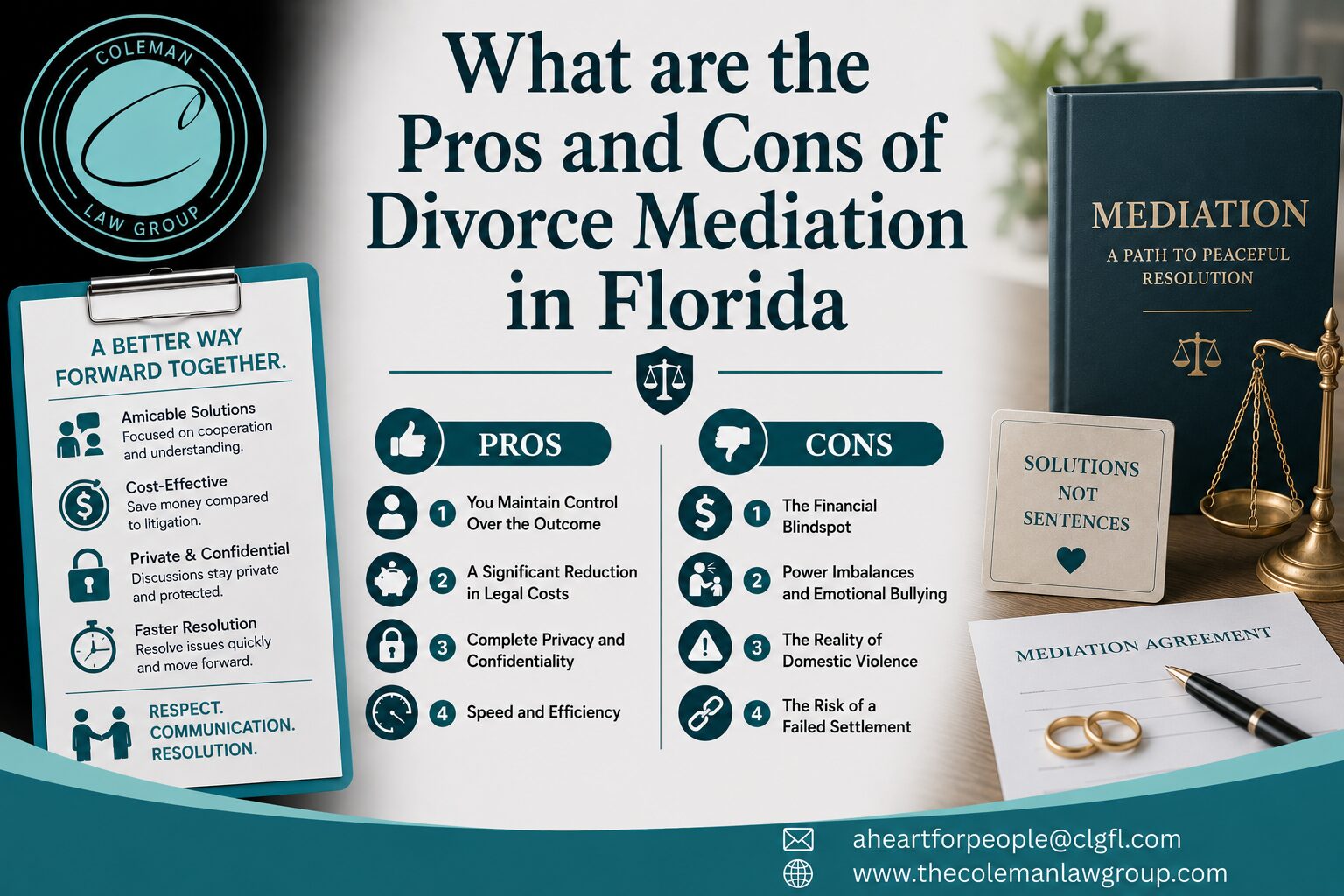
You Maintain Control Over the Outcome
When you take a divorce to trial, you are essentially gambling. You are handing your financial future, your retirement, and the time you spend with your kids over to a judge who doesn’t know your family. That judge will make permanent decisions based on strict legal codes rather than on what you actually need. Mediation works differently. You and your spouse call the shots. You build an agreement tailored to your actual life, and the judge makes it official by signing the order.
-
A Significant Reduction in Legal Costs
Litigation is a money pit. Every hour you spend in a courtroom, and every motion your lawyer has to file, burns through the marital savings you are trying to protect. Mediation changes the math. Instead of paying two legal teams to fight over every single item for months, you split the cost of a neutral mediator to help you settle a matter in a matter of hours. The money you save is capital you need to start your life over on the other side.
-
Complete Privacy and Confidentiality
Public courtrooms are just that: public. Any document filed, any financial error discussed, and any personal argument becomes part of the public record that anyone can look up. Mediation changes the environment entirely. It is a strictly confidential process protected by law.
Negotiations don’t always work, but you’re protected. Any proposals or concessions made during mediation cannot be mentioned or used later. This gives you the breathing room to hash out a deal without the fear that your words will be used against you down the road.
-
Speed and Efficiency
The court system in Florida is slow. Getting a date on a judge’s calendar can take months, keeping you in a state of limbo where you cannot make major decisions about your home or your finances. Mediation bypasses the backlog. As soon as you complete your mandatory financial disclosures, you can schedule a session. It lets you move the finish line much closer, so you can resolve the dispute and get on with your life rather than letting the stress of an open divorce case dictate your household for another year.
The Risks and Cons of Mediation
While the mediation benefits for divorce are clear, it isn’t a magic fix. If you treat it like a simple administrative hurdle that will naturally resolve itself, you might find yourself in a position you can’t back out of.
Understanding the pros and cons of mediation in the Florida landscape means being just as aware of the risks as you are of the rewards.
- The Financial Blindspot
Mediation relies entirely on honesty. If your spouse is hiding assets, underreporting income, or running a side business under the table, a mediator isn’t going to help you. Their role is to keep the conversation moving so you can reach a deal—they aren’t there to play detective. A mediator has no authority to subpoena bank records or force your spouse to be honest under oath. If you suspect money is being concealed, mediation is usually just a waste of your time. You need the formal discovery process of a courtroom trial to demand documentation, depose witnesses, and uncover the truth. Without that, you’re just guessing at the value of your own marital estate.
-
Power Imbalances and Emotional Bullying
The mediator is neutral. That means they will not step in if your spouse is a master manipulator or an emotional bully. If you have spent years yielding to your spouse’s demands to keep the peace, you will likely do the same thing in that conference room. Without an aggressive advocate standing between you to ensure a fair deal, it is easy to “give in” just to end the stress of the meeting. You might trade away your retirement savings or accept an unfair parenting schedule just because you feel pressured to wrap things up. Dealing with a bully in mediation is a trap. They aren’t looking for facts or logic. They want to intimidate you into taking a bad deal.
-
The Reality of Domestic Violence
If abuse or intimidation is happening, mediation is a bad idea. A productive negotiation requires both sides to feel secure, and that’s not the reality of your situation. Forget about reaching a “fair deal” in a room with them. You need to get an attorney involved immediately to file for a protective injunction. Protecting yourself is the only goal that matters here; trying to work things out with an abuser just isn’t realistic.
-
The Risk of a Failed Settlement
Don’t be fooled into thinking mediation is a guaranteed win. You can pay a mediator for a full day’s work and walk away empty-handed. If your spouse pulls the plug at the last minute or you get deadlocked over a minor point in the custody agreement, the session is a bust. You’re still out the money for the mediator, and you’ve wasted your own time—and your lawyer’s—preparing for a trial you were trying to avoid in the first place. You essentially paid to confirm that you cannot agree. It’s a bitter pill to swallow, and it’s why understanding the mediation pros and cons in Florida is vital—it helps you decide if the risk of a total impasse is worth the gamble, or if your case is headed straight for a judge from day one.
Preparing for a Successful Mediation Session
You cannot walk into mediation blind. If you show up without a clear picture of your assets, your debts, and your bottom line, you are essentially asking to be taken advantage of. The mediator is not your lawyer; they are not there to help you find the money your spouse might be hiding. That responsibility falls squarely on your shoulders and your legal team. If you want to leave that conference room with a fair deal, you have to do the work beforehand.
-
Organize Your Financial Inventory
This is the most tedious, boring, and absolutely vital part of the process. You need a complete, updated list of everything you own and everything you owe. Do not rely on memory. You need bank statements, retirement account valuations, property appraisals, and credit card balances.
If you’re fighting for alimony or trying to keep the house, you need to know the numbers inside and out. When your spouse throws out a figure across the table, you shouldn’t have to guess whether they’re being straight with you. You need the documentation in your briefcase to prove the truth. Without that, you have zero leverage. Negotiating from a position of weakness is exactly how you end up losing ground in a high-conflict divorce.
-
Define Your Non-Negotiables
Mediations get loud. You need to know what you’re fighting for: the house, the kids’ schedule, or your financial future? Don’t go in blind. Take the time to talk through your “walk-away” points with your attorney before you sit down. Having a firm sense of what you won’t sacrifice is the only way to keep your head when the pressure is on.
Don’t let the emotional stress of the day push you into a corner. You might be tempted to hand over the house to end the mediation, but that choice has a shelf life. You don’t want to wake up a week later and realize you have nowhere to go and the rent money just isn’t there. Decide on your priorities when you are calm and at home, not when you are tired and stressed in a lawyer’s office. If your spouse isn’t willing to meet you on your non-negotiables, you have to be ready to walk out.
The Importance of Legal Counsel
The mediator isn’t taking sides, but your lawyer is. They are your primary defense against the emotional maneuvering and legal posturing your spouse might throw your way during the session. If your spouse is a bully, your lawyer is the one who steps in to shut down intimidation. If the mediator pushes you too hard to “just sign something” to get the day over with, your lawyer is the one who reminds you that you are making a binding, long-term decision.
Never walk into mediation without your lawyer by your side. You need someone who can spot a bad deal from a mile away, cut through the legal jargon, and keep your long-term future in focus when the stress of the day makes you want to pack up and leave.
What to Expect on Mediation Day
You aren’t heading to court. There’s no judge, and there’s no gavel. You’re just going to a conference room, but don’t underestimate it. It’s a long, draining day that’s going to test your patience way more than it tests your knowledge of the law. Here is the reality of how the day actually unfolds:
- The Shuttle System: You and your lawyer stay in one room, and your spouse stays in another. The mediator acts as a liaison, walking offers back and forth between you two. You probably won’t even see your spouse, which is great for keeping things calm, but know there’s going to be a lot of sitting around and waiting.
- The Endurance Test: Mediation is exhausting. It can take two hours or ten. That said, come prepared by bringing water, food, and a charger. If you’re hungry or worn out, you may likely settle for a bad deal to get out of the room. If you’re losing focus, tell your lawyer you need a break. Walk out, breathe, and reset before you decide anything.
- The Impasse: Spending eight hours in an office without a deal happens. Hitting an impasse isn’t a failure. It just means you didn’t find the right terms today. Never sacrifice your future to finish the session. It is always better to walk out without a deal than to sign something you will regret.
- The Final Signature: If you strike a deal, you draft the Marital Settlement Agreement on the spot. This is the most dangerous moment because you’ll be tired. Read every line twice. Once you sign and the judge approves it, it is a court order and is incredibly hard to change. If something looks wrong, stop and fix it before you pick up the pen.
Secure Your Future on Your Own Terms
Mediation is more than just a box you have to check in your Florida divorce. It’s your chance to skip the courtroom and keep your business private. Don’t forget that a good result comes from real preparation. Don’t let yourself get worn down to the point where you sign something you’ll regret to get out of the room.
If you’re filing for a divorce in Florida: Tampa, Clearwater, or St. Petersburg, you don’t have to do this alone. Our legal team at The Coleman Law Group is here to act as your shield. We handle the pressure so you don’t get forced into a bad agreement. We know how the Florida courts operate, and we’ll make sure you come out of this in a good spot. Call us at 727-214-0400 to talk it through, and we can help you finish this chapter with the results you deserve.