

Deciding to end a marriage is rarely a sudden choice. It is usually the result of a long period and many difficult realizations. Once you reach the point of looking up the actual filing requirements in Florida, the emotional part of the journey is likely already behind you. What you need now is not a lecture on relationships but a practical look at the steps, the costs, and the local rules that will govern your future.
If you live in the Tampa Bay area, your experience will be shaped by whether you file in Hillsborough or Pinellas County. While the state laws remain the same, the way the local courthouses handle their dockets can be very different. Our guide is designed to help you understand the actual path forward so you can manage your expectations from day one.
Before You File: Know What Kind of Divorce You’re Dealing With
Florida law doesn’t require you to prove fault to end a marriage. The state operates on a no-fault basis, meaning “irreconcilable differences” is enough. What matters more than why the marriage ended is whether you and your spouse can agree on what happens next.
An uncontested divorce means both of you are aligned — on property, on debt, on any alimony arrangement, and if kids are involved, on custody and support. When that alignment exists and holds, the process is faster and considerably cheaper.
A contested divorce is essentially everything else. Maybe one spouse wants the family home, or there’s a real fight over how to split up retirement accounts. Once trust starts to fray and you suspect you’re not getting the full truth, everything feels a lot more urgent. You shouldn’t have to worry about missing a tiny detail in a contract or losing what you’ve worked for. Having a solid attorney ensures the paperwork is bulletproof and your future is actually looked after.
Most people can’t anticipate that an uncontested divorce can shift to a contested one. Once you’re already talking about fees and numbers are on the table, positions sometimes change. At this point, optimism won’t cut it. You need to be honest with yourself about how your spouse would likely behave once the stakes are clear.
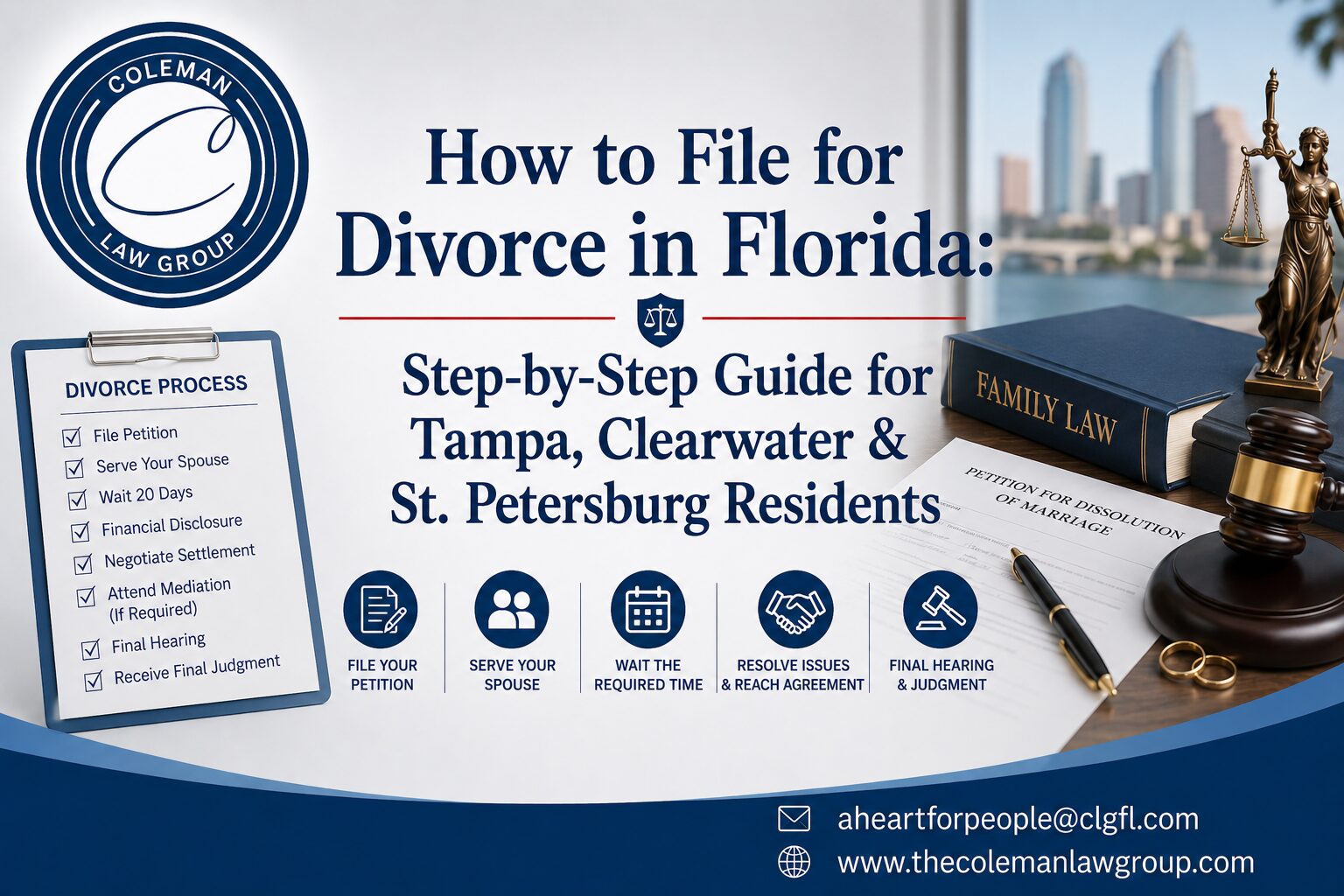
How to File for Divorce in Florida: Step-by-Step Guide
Step 1: Confirm You Meet Florida’s Residency Requirement
To file for divorce in Florida, the law is pretty specific about residency. At least one spouse has to have lived in the state for the six months or roughly 180 days, immediately leading up to the moment you file the petition. It’s a non-negotiable first step before the court will even look at the case.
When it comes to proof, you can use:
- Florida driver’s license
- Voter’s registration
- Utility bills with your name on them
- Lease and mortgage documents
Any of these, or a combination, generally satisfies the requirement.
Where you file depends on your address. Tampa residents go through Hillsborough County and the Hillsborough County Clerk of Courts. If you are in Clearwater or St. Pete, your filing belongs in Pinellas County. Using the wrong county won’t end your case, but it definitely causes annoying delays while the courts sort out the mess.
Step 2: Gather Your Financial Documents
Preparing financial documents before a legal battle begins is often the step that catches people off guard.
Florida doesn’t do “secret” finances in a divorce. Under Rule 12.285, you are legally required to show your bank account. It isn’t a suggestion nor something you can gloss over to save time; it’s a formal exchange of your entire financial life.
Think of it as a deep-dive audit. You’ll need to start digging through your files for:
- The Tax Trail: The court wants to see your last three years of tax returns. If you haven’t filed, now is the time to catch up.
- Income Proof: Gather your pay stubs from at least the last three months to show exactly what’s hitting your bank account.
- Every Account You Own: This includes bank and credit union statements, but also the “long-term” stuff like retirement funds and investment portfolios.
- The Debt Side: You have to be honest about what you owe, too—from credit cards to car loans.
- Business Interests: If you or your spouse owns even a fraction of a business, those financial records have to be on the table.
It can be tedious work, but cutting corners here is the fastest way to lose a judge’s trust before your case even really starts.
It is much easier to collect these records now than to try to hunt them down while you’re in the middle of a legal battle. Incomplete disclosures are the number one reason cases grind to a halt in Florida. Worse, if you leave a gap in your financial history, you’re essentially handing the other side leverage to use against you in court.
Step 3: Complete the Florida Divorce Forms
The Florida Court system uses standardized “self-help” forms, which you can find online, but don’t let the availability fool you—the paperwork is a bit of a maze. The specific stack of documents you need depends entirely on the moving parts of your life: whether you’re co-parenting, how much property you own, and whether you and your spouse are actually on the same page.
For most cases in the Tampa Bay area, you’ll be dealing with these core documents:
- The Petition for Dissolution of Marriage: Your formal “opening move” that tells the court exactly what you want.
- Family Law Financial Affidavit: You are essentially testifying on paper about your income, debts, and assets. Because it’s a sworn statement, the court expects total transparency. Any inconsistencies here can damage your credibility for the rest of the case.
- Parenting Plan and Child Support Worksheet: When kids are part of the equation, Florida requires a specific plan covering everything from school runs to health insurance. This document lays out the logistics clearly so you don’t have to fight over the small details later on.
- Marital Settlement Agreement: In an uncontested divorce, this document acts as the final contract between you and your spouse. It details how you’ve chosen to split your life, covering property division and alimony so that there are no lingering questions once the judge signs the final decree.
Filling these out isn’t just about “checking boxes.” It’s about making sure your future is legally protected in a way that a judge will actually sign off on.
That last document deserves real attention. Vague language in a settlement agreement — who gets the car if it breaks down before the title transfers, what happens during school holidays, who carries the health insurance — has a way of generating conflict long after the divorce is finalized. Specificity in these agreements isn’t difficult. It’s just being practical.
The clerk’s office in Hillsborough or Pinellas can help you identify the right form packet. What they won’t do is advise you on how to fill them out. That distinction matters.
Step 4: File with Your County Clerk
Once the paperwork is finished, you’ll take it to the Circuit Court clerk. If you’re based in Tampa, that means going to the George Edgecomb Courthouse downtown. If you are over in Pinellas, you will likely handle everything at the Justice Center in Clearwater.
Plan for about $400 in filing fees, though it can be slightly less depending on the county and whether you have children. Since these costs can change, check the clerk’s website for the most current rates before you go. If the fee is out of reach, Florida allows you to apply for a waiver. You have to submit an application to be declared indigent, which the court decides based on your current income and expenses.
Once the clerk processes your documents and accepts the fee, they will assign you a case number. Consider your number as the “ID tag” for your divorce; you will need to include it on every single document or letter you send to the court moving forward.
Step 5: Serve Your Spouse
Getting your documents to the clerk is only the start of the process. In Florida, your spouse has to be formally notified through a specific legal channel before the court will even look at your file. A lot of people assume they can just drop the papers off, but that does not count in a judge’s eyes. You have to use an authorized third party to prove the documents actually changed hands.
Usually, this involves paying a process server or the sheriff to deliver the summons. Once that happens, your spouse has 20 days to file their response. If they ignore the notice and that window closes, you can ask the court for a default. It’s a necessary rule that prevents one person from stalling the whole divorce by simply refusing to show up.
If you are lucky enough to be on decent terms with your spouse, you can skip the formal delivery altogether. They can just sign a document known as a Waiver of Service to show they already have the copies. It is a much faster way to get through the early stages of the case, and it prevents someone from having to deliver court papers to their front door personally. Use this option whenever possible to keep the momentum going without the extra fees.
Step 6: The Timeline and the 20-Day Waiting Period
Florida law requires you to wait at least 20 days after serving your spouse before the court can finalize anything. However, you should not expect the process to end the second that the twenty-day timer expires. The length of your case depends almost entirely on how much property you own and whether you and your spouse are on speaking terms.
- The Timeline for Amicable Filings
The uncontested divorce process is usually the most efficient route. For residents in the Tampa Bay area, these cases often wrap up within one to three months. Such speed is only possible when both people are proactive about their paperwork, and the local judge has an open slot for a final hearing. It is a straightforward path, but it requires total cooperation from day one.
- Why Some Cases Take Over a Year
The Florida step-by-step divorce process becomes a much longer journey when assets or children are involved. When a Divorce lawyer in Florida has to spend time investigating retirement accounts, business values, or custody schedules, the calendar fills up quickly. It is very common for these contested cases to last six months or even a year because of the amount of evidence that needs to be gathered.
Step 7: Finding a Resolution Through Mediation
Florida usually makes you try mediation before you can even walk into a courtroom for a trial. It is basically a formal sit-down where both spouses work with a neutral third party to negotiate a deal. The idea is to settle things yourselves instead of letting a judge make all the final decisions for you. In the Tampa Bay area, this is often the point where the majority of cases actually resolve. It is a chance to control your own outcome rather than leaving your future entirely to a judge.
A skilled mediator does not take sides or force you to agree to anything you find unfair. Their job is to help you and your spouse talk through the actual trade-offs required to reach a middle ground. If you are working with a Divorce lawyer in Florida, they will typically be right there with you to provide advice and ensure your interests are protected during the negotiation. Anything you agree on in mediation gets written into a formal document. Once the judge signs off, it becomes a legally binding part of your final judgment.
If your case is a contested divorce, mediation is often the most important hurdle you will face. It is much less expensive and far less stressful than a full trial. Settling here is the fastest way to save yourself from months of expensive litigation. If you can agree on the big issues, that settlement is written up and signed, eventually becoming a permanent part of your final court order.
When Mediation Fails
If mediation fails to resolve every issue, your remaining disputes will end up in front of a judge. The court then gets the final say on the parts of your life you and your spouse couldn’t work out. Having a specific plan in place before you ever sit down for these meetings is essential for that reason. Even if you are still weighing whether to hire a lawyer for a Florida divorce, you need a strategy for these talks to look out for your future interests. A St. Petersburg divorce attorney can help you prepare so you know your “must-haves” before you ever walk through the door.
Step 8: The Final Hearing and Your Judgment
The final hearing marks the official end of the Florida divorce process. If you are lucky enough to have a full agreement, you will likely spend less than twenty minutes in front of the judge. The court mostly wants to see that the paperwork is in order and that no one was forced to sign the settlement. As soon as the judge puts a pen to the Final Judgment of Dissolution of Marriage, the divorce process is officially behind you. That piece of paper is your legal proof that you are single again.
Things are much more intense if you are navigating a contested divorce in Florida. At this point, you are essentially in a trial in which the judge expects a formal presentation of evidence and testimony. Having your records organized and your arguments ready is what determines the outcome here. It is the one time in the case where being thoroughly prepared is the only way to avoid a result you did not anticipate. Whether you have an attorney or are standing on your own, the goal is to provide the court with the facts needed to close the file for good.
The Coleman Law Group: Here When You’re Ready
Getting to the final stage of a divorce is usually a lot more draining than people expect at the start. It is never just about getting the paperwork right. It is about a real person trying to handle a major life shift while ensuring they do not lose their peace of mind or their assets in the process.
Our legal team at Coleman Law Group helps people in Tampa, Clearwater, and St. Petersburg navigate these exact pressures. Every case is different. Some are a clean break, while the others are quite complicated, but the way we handle them doesn’t change. Our goal is to keep you in the loop throughout the process so you can focus on what matters most.
You do not have to solve every legal puzzle on your own. If you are looking for someone who sees you as a person and not just another file on a desk, reach out to us. You can call 727-214-0400 or email aheartforpeople@clgfl.com. We are ready to help you move toward a fresh start whenever you are prepared to take that step