



When a Florida family court enters a parenting plan, it is based on the facts and circumstances that exist at that moment. Nobody in that courtroom can predict what your life or your child’s life will look like three years down the line. Unforeseen circumstances like job changes, residential relocations, children growing up, shifting kids’ needs, a new partner entering the picture, and sometimes, things go wrong in ways nobody anticipated. Florida law does not lock parents into an arrangement that has stopped working for a child.
Under Florida Statute §61.13, either parent can go back to court and ask a judge to revisit a parenting plan or time-sharing schedule when something significant has changed since the original order was signed.
A scheduling inconvenience does not get you back into the courtroom. Neither does personal frustration with your co-parent. What Florida courts look for is a substantial, material, and unanticipated change in circumstances, combined with a clear reason why the modification you are asking for serves your child better than what is currently in place. At The Coleman Law Group, we have guided parents through exactly this process across Florida. The six situations below are the ones that genuinely move the needle in a Florida modification proceeding.
Florida Modification at a Glance
Before walking through each ground, the table below summarizes the legal standard Florida courts apply when evaluating a petition to modify child custody or visitation arrangements.
| Legal Element | What Florida Courts Require | Governing Statute |
| Substantial Change in Circumstances | The change must be permanent, material, and not reasonably contemplated at the time of the original order | Fla. Stat. §61.13(3) |
| Best Interests of the Child | The proposed modification must affirmatively serve the child’s welfare, not just the requesting parent’s convenience | Fla. Stat. §61.13(3)(a) |
| Parental Relocation | Any move of more than 50 miles for 60 or more consecutive days requires court approval or written agreement | Fla. Stat. §61.13001 |
| Domestic Violence History | Creates a rebuttable presumption against awarding sole or shared custody to the abusive parent | Fla. Stat. §741.30, §61.13(2)(b) |
| Filing Process | A Supplemental Petition for Modification of Parenting Plan must be filed in the circuit court that issued the original order | Florida Family Law Rules of Procedure, Rule 12.905 |
Most Common Reasons Parents File a Modify Child Custody Petition in Florida (Approximate Frequency)

Source: Based on Florida family court case trends and attorney-reported data. Figures are illustrative.
1. One Parent Is Relocating to a New City or State: Does the Parenting Plan Still Work?
Of all the modification cases we handle at The Coleman Law Group, relocation disputes are among the most contentious. And for a good reason. When the parent who holds the majority of time-sharing decides to pack up and move to another city or another state, the entire foundation of the existing parenting plan gets pulled out from under the other parent and the child.
Florida does not treat relocation as a personal decision that one parent gets to make unilaterally. Once a parenting plan is in place, any move of more than 50 miles from the parent’s current primary residence that lasts for 60 consecutive days or longer is a legal event that requires either a written, notarized agreement from every person who holds time-sharing rights or a court order approving the move.
Florida Statute §61.13001 governs parental relocation. Parents who move without satisfying these requirements do not simply face a legal inconvenience. A judge can order the child to return.
A job offer in Atlanta and a military reassignment to North Carolina are treated differently, and a judge looks at the full picture.
We see a steady flow of these petitions filed through courts in Sarasota, Clearwater, St. Petersburg, and Tampa every year. Parents on both sides of a relocation dispute need counsel. Procedural guidance is available at www.flcourts.gov, but the strategy and substance of a contested relocation case is not something to approach without a modification lawyer by your side.
2. A Significant Change in Either Parent’s Work Schedule or Employment: Can You Modify Visitation Arrangements?
The parent who worked on a weekly desk job, Monday through Friday, when the original order was signed, may now be covering overnight hospital shifts three times a week. The parents who traveled occasionally may now be out of town twenty days a month. Similarly, a parent who had steady employment in the past may have lost their job entirely due to the recession.
Under such scenarios, the Florida court may ask some simple questions to either of the parents (whose employment status changed), like:
a) Is your employment change permanent or temporary for a short period of time?
b) Is it voluntary or forced on the parent?
c) whether it genuinely disrupts the child’s routine and daily care in a material way?
As per the past cases, our team of attorneys has noticed that the parent who was working from home when the original order was entered is now working outside the home or from the office. Under such circumstances, the original plan didn’t hold good as the scenario changed. That kind of change is worth bringing a family lawyer before it creates bigger problems at home or at school.
If the schedule that was written into your parenting plan no longer matches the reality of who is there to care for your child, a child custody modification lawyer can assess whether your employment change meets the legal threshold for filing a petition to modify visitation arrangements.
| Employment Change Scenario | Likely Court Response in Florida | Strength as Grounds for Modification |
| Involuntary job loss with no immediate replacement | May support temporary modification; court monitors situation | Moderate |
| New job requiring regular overnight or out-of-state travel | Strong grounds if child’s current schedule becomes unworkable | Strong |
| Parent voluntarily quits to avoid obligations | Court will not reward deliberate income reduction | Weak |
| Receiving parent now works full-time after prior stay-at-home status | May warrant rebalancing time-sharing to reflect new availability | Moderate to Strong |
| New career requiring relocation over 50 miles | Triggers separate relocation statute alongside modification | Strong |
3. Evidence of Domestic Violence, Abuse, or Misuse: When is the Child’s Safety a Priority?
If a child is in immediate danger:You should seek an emergency motion for temporary modification through the Florida circuit court. Also, do contact the hotline of DCF (Florida Department of Children and Families Abuse). Available 24 hours a day at 1-800-962-2873 or at www.myflfamilies.com.
When the original custody order was signed, maybe a year or three years ago, everything looked different. Mom (or Dad) was clean. No drugs, no alcohol issues. They showed up to court sober, calm, and stable.
But now something has changed. And not in a small way.
Maybe they’ve started drinking heavily. Maybe there’s a new temper, a hand that slams the door a little too hard. Maybe the kids come home with stories that make your stomach turn.
Here’s what I tell parents in Sarasota, Clearwater, Tampa, and St. Petersburg: Florida courts do not require a child to be physically harmed before they will step in.
You read that right.
If a parent has gone from stable to scary, if addiction or aggression has replaced the person they used to be, the court wants to know. Judges here understand that waiting for proof of physical harm means waiting until it might be too late.
A knowledgeable and experienced lawyer should document & present a modification of child custody petition showing instances that a parent is now abusive and indulged in domestic violence. This shifts the legal burden to the rightful parent.
As per our attorney’s experience, judges look past the label and focus on the impact that matters:
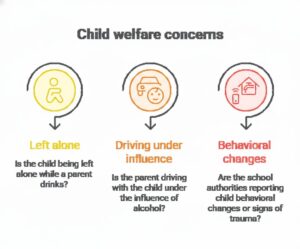
Evidence that carries weight in such a modification petition includes:
- Arrest records or DUI convictions (only those that occur after the original order).
- Reports filed with DCF (Florida Department of Children and Families Abuse) or police, including investigation findings
- Statements from the schoolteachers, pediatricians, or counselors who are directly linked with your child.
- Results from court-ordered drug or alcohol testing
- Findings from a GAL as guardian ad litem appointed to represent the child’s interests
Based on the above evidence and its impact on the child’s welfare, the judge may order supervised visitation. This requires the parent to complete a substance abuse treatment program that includes a condition of retaining time-sharing. In case of some edge cases, a judge may suspend the visitation benefit of the parent if they sense immediate danger to the child.
4. The Child’s Own Evolving Needs, Preferences, and Best Interests: When the Original Plan No Longer Fits?
A parenting plan drafted when your child was four years old probably makes no sense now when they are eleven or twelve. Their world has changed. They are in a different school, have different community ties and friends. Their daily schedule shifted to accommodate study time, extra classes, and other curricular activities, including 5 sports sessions per week. Their medical requirements change.
A judge does not care about winning or losing. They care about one thing: is your child okay? Emotionally and physically.
So, when your current time-sharing arrangement conflicts with your child’s real needs, like a new diagnosis, failing grades, or a move that makes school drop-offs a nightmare, your lawyer can and should ask the court to look again.
Under Florida Statute §61.13(3)(a), the following are the various factors that courts will consider as part of the modification of child custody:
- a) Parent meets the child’s current developmental, emotional, and educational needs.
- b) School location for the pick and drop-off.
- c) Child’s home and school adjustment.
- d) Everyone’s physical and mental health in the household.
- e) Documented domestic violence or abuse.
A child custody modification lawyer can help you turn them into a petition a Florida court will actually take seriously.
5. Parental Remarriage or a New Significant Partner Movinginto the Home: What Does Florida Law Say?
Let us be direct about something: our team of family law attorneys tells parents during consultations. Remarriage alone is not going to move a judge to modify a parenting plan. A parent who remarries as a stable, employed, law-abiding person and creates a healthy blended household is not going to lose time with their child because the other parent is uncomfortable with the new arrangement.
The legal picture changes when the new person in the home carries a background that directly threatens the child’s safety. A new partner with a documented history of domestic violence, a prior sex offense conviction, a recent arrest for drug-related crimes, or a pattern of behavior that has already unsettled the child in observable ways is a different situation.
Remarriage also becomes legally relevant when it directly triggers relocation. A parent who remarries and then wants to move to follow their new spouse to another city or state is subject to Florida’s relocation statute under §61.13001, regardless of the reason for the move.
And on the other side of this, a parent who has turned their financial situation around significantly following a remarriage and can now offer the child meaningfully better stability, schooling options, or healthcare access may have grounds to request a review of time-sharing in their favor. Florida courts are not in the business of ignoring genuine improvements in a child’s circumstances.
| Scenario | Does It Support a Modification Petition? |
| Remarriage alone, stable household, no criminal history | Generally, no. Courts do not penalize parents for remarrying. |
| New partner has documented history of domestic violence or sex offenses | Yes. Florida courts prioritize child safety over adult relationships. |
| Remarriage triggers a relocation over 50 miles | Yes. Relocation statute applies regardless of reason for the move. |
| New blended household creates documented emotional distress for the child | Possible. Requires credible evidence such as therapist records or school reports. |
| Remarried parent now has substantially greater financial stability benefiting the child | Possible basis for adjusting time-sharing in that parent’s favor. |
6. Consistent Violation of the Existing Visitation Order: When Is Enough?
A court-ordered parenting plan is a binding legal instrument in Florida. When one parent repeatedly fails to comply with its terms, whether by denying the other parent their scheduled time-sharing, consistently returning the child late, failing to appear for scheduled exchanges, or unilaterally altering the schedule without consent, those violations are documentable, actionable, and in serious cases, grounds for modifying the custody arrangement itself.
Florida courts can respond to violations through a Motion for Civil Contempt or a modification petition, where the pattern of noncompliance has been sustained and documented. Courts look unfavorably at parents who interfere with the other parent’s court-ordered time-sharing. Under Florida Statute §61.13(2)(c), the court considers each parent’s willingness to honor and facilitate the other parent’s relationship with the child as a factor when making any custody of determination.
Courts respond to patterns, and those require proof. Screenshot every relevant message. Keep a simple, dated log. Please don’t rely on memory six months from now when you are sitting in a courtroom. If your co-parent has been consistently denying your court-ordered time with your child, a modification lawyer at The Coleman Law Group can assess whether what you have documented rises to the level that supports a contempt motion, a modification petition, or both.
All 6 Grounds: A Side-by-Side Reference
| # | Ground for Modification | Florida Statute Reference | Emergency Petition Available? |
| 1 | Parental relocation over 50 miles | §61.13001 | Yes, if non-compliant relocation occurs |
| 2 | Work schedule or employment change | §61.13(3) | No — standard petition process |
| 3 | Domestic violence, abuse, substance misuse | §741.30, §61.13(2)(b) | Yes — emergency motion available |
| 4 | Child’s evolving needs and best interests | §61.13(3)(a) | No — standard petition process |
| 5 | Remarriage or new partner moving in | §61.13(3) | Depends on accompanying safety risk |
| 6 | Consistent violation of time-sharing order | §61.13(2)(c) | Contempt motion alongside petition |
What Should You Do If Your Circumstances Have Changed?
Reading through all six grounds, if even one of them mirrors what you are living right now, do not sit on it. Delay rarely helps in family court.
Modification petitions are not filed on emotion. They are built on documented facts, legal thresholds, and a clear argument that the change serves your child. That is exactly the kind of case assessment The Coleman Law Group handles family law cases across Florida, especially Tampa, St. Petersburg, Sarasota, and Clearwater.
Our family law attorneys will look at your existing order, weigh the evidence you have in hand, and give you a straight answer on where your case stands, no guesswork.
Call +1 727-214-0400, reach us through our Contact Us page, or book your consultation here.