

You have a parent overseas who is getting older. Or you married someone who is stuck in another country while you live here alone. Or maybe you just got your green card, and you are wondering if you can finally bring your daughter over.
We hear this every day at The Coleman Law Group. Here is what we tell people.
Family‑based immigration is one of the most powerful tools, but at the same time, it’s the slowest process. This type of immigration involves a lot of paperwork, and people often mess it up if it is not done correctly.
The good news? It works. Thousands of families go through this process every year. You just need to know what you are walking into.
Who Can Actually Sponsor a Family Member?
Half the people who call us have this wrong.
If you are a U.S. citizen, you can sponsor the following:
- Your spouse
- Your unmarried children under 21
- Your parents
- Your unmarried adult children (21 and older)
- Your married children (any age)
- Your siblings
If you are a lawful permanent resident (green card holder), you can sponsor the following:
- Your spouse
- Your unmarried children (any age)
That is it. Unfortunately, green card holders cannot sponsor parents, children, or siblings unless they become citizens. We understand this is disappointing, but it is the law.
How Long Does Family‑Based Immigration Actually Take?
This is where people get frustrated. Fair enough.
For immediate relatives of U.S. citizens (spouses, parents, unmarried children under 21), there is no waiting line for a visa number. Once their I‑130 petition is approved, they move to the next step. But the I‑130 itself still takes time.
For everyone else (the “preference categories”), there is a backlog. And it is brutal.
Here are the actual numbers from the June 2026 Visa Bulletin for family preference categories. This is the waiting time just to get a visa number after your I‑130 is approved.
| Preference Category | Who It Covers | Final Action Date (June 2026) |
| F2A | Spouses and minor children of green card holders | August 1, 2024 |
| F2B | Unmarried adult children of green card holders | September 22, 2017 |
| F4 | Siblings of U.S. citizens | November 8, 2008 |
That F4 date means: if you are a U.S. citizen trying to bring your brother or sister, the priority date must be before November 8, 2008. People who filed their I‑130 petitions nearly eighteen years ago are just now getting visa numbers. That is not a typo.
And that is just the visa number. The I‑130 processing time is in addition to that.
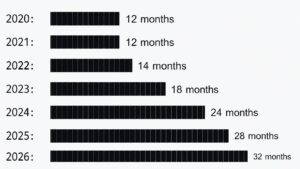
Here is a simple chart showing how USCIS processing times have changed for a U.S. citizen filing for a spouse. These are median months from filing to decision at the Potomac Service Center.
For a green card holder filing an I‑130 for a spouse, current processing times range from 50 to 154 months, depending on the service center. That is four to nearly thirteen years. Just for the first form.
The Step-by-Step Process (No Fluff)
Here is how it actually works. We have guided hundreds of families through this at The Coleman Law Group, so we know where people stumble.
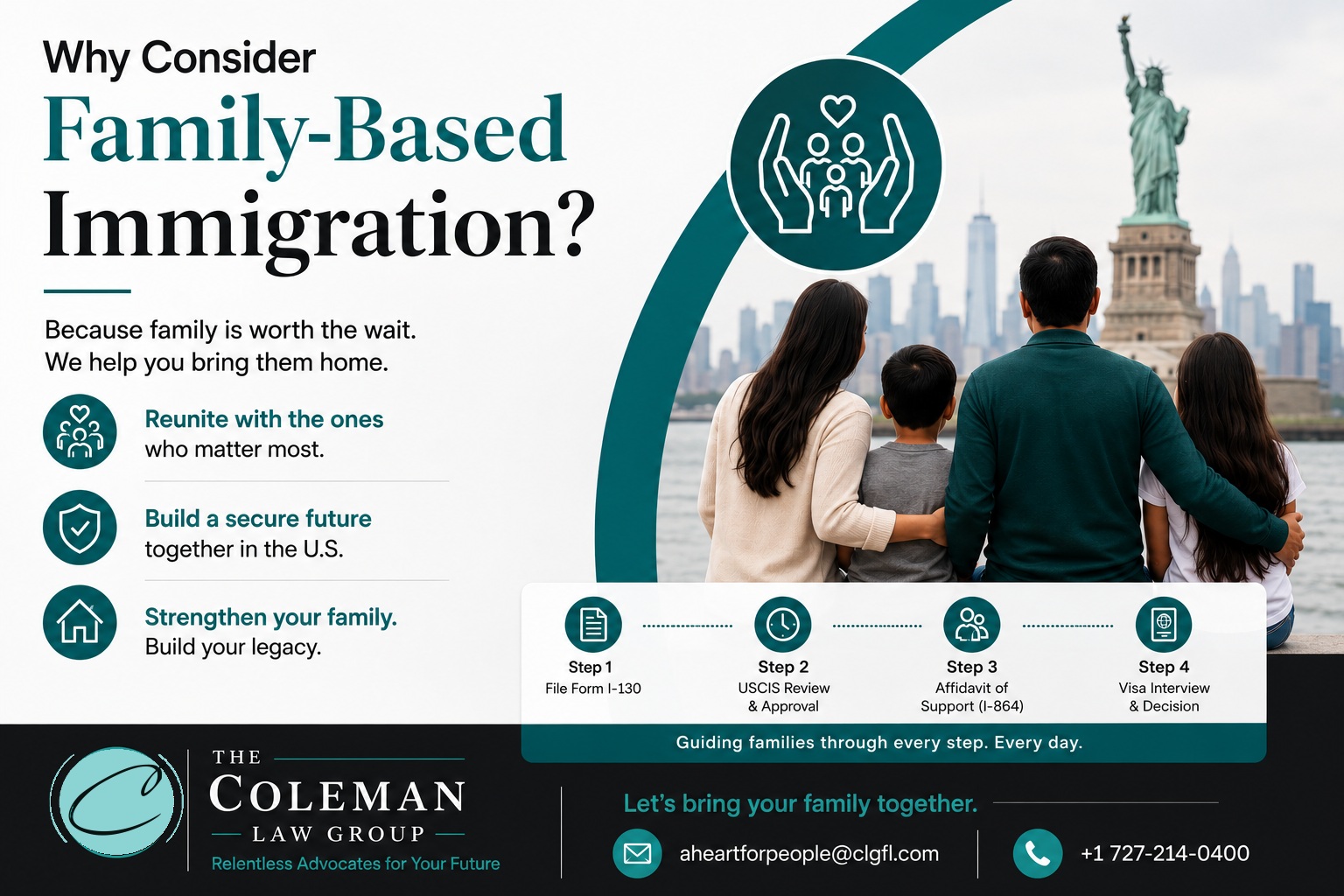
Step One – File Form I‑130
is the petition that says, “This person is my relative, I swear.” You need real proof. Birth certificates, marriage licenses, photos from over the years, and affidavits from people who have known you both. Our advice: assume USCIS is skeptical and prove everything.
The filing fee is $625 if you file online and $675 if you file by paper.
Step Two – Wait for USCIS Approval
How long? It depends on your relationship and your service center. For a U.S. citizen sponsoring a spouse, the median processing time was around 12 months in early 2023. By early 2026, it had climbed to about 17.5 months. For a sibling petition, we have seen cases take five years or more just for the I‑130.
Step Three – Affidavit of Support (Form I‑864)
This is where we see people fall apart. You have to prove your household income is at least 125% of the federal poverty guidelines for your household size. If you do not meet that threshold, you will need a joint sponsor – someone else who signs a legally binding contract saying they will support your relative if necessary.
The 2026 poverty guidelines are already in effect. A joint sponsor has to mean it. The government can actually go after their wages if your relative uses welfare.
Step Four – Visa Interview
If your relative is already in the U.S. legally, they go through “adjustment of status” (Form I‑485). Current processing for family‑based I‑485s is running about 9 to 22 months.
If they are outside the U.S., they go through consular processing at a U.S. embassy. Both paths involve medical exams, background checks, and an interview, during which an officer decides whether they believe your relationship is real.
Why a Family‑Based Immigration Lawyer Makes All the Difference
You do not legally need an family-based immigration attorney. The forms are free online. Plenty of people file their own I‑130, and it works fine.
But here is what we see in our office week after week. A family comes to us after USCIS denied their petition. Why? They used an outdated version of a form. Or they did not correctly translate a foreign birth certificate. Or they miscalculated their household size on the I‑864, and their income did not meet the requirement.
Those mistakes cost months and sometimes years to fix.
A good family‑based immigration lawyer does more than fill out boxes. Here is what we actually do at The Coleman Law Group.
- We spot problems before they become denials. USCIS issues a Request for Evidence (RFE) when something is missing or unclear. Each RFE adds months to your case. We catch those issues before you file.
- We handle the I‑864 correctly. Income calculations, household size, assets, joint sponsors – one wrong number and your affidavit of support gets rejected.
- We flag inadmissibility issues early. Prior visa overstays, criminal history, and previous marriage problems – these can kill your case. An experienced immigration attorney flags these before you file, not after.
- We know which service center processes faster. Not all USCIS offices handle cases the same way. We know where to file and how to frame your case for the best outcome.
- We communicate with USCIS and the NVC. When something stalls, we file service requests, contact congressional offices, and push your case forward. You cannot do that effectively on your own.
- We reduce your stress. Immigration is emotional. Having someone who knows the system lets you focus on your family instead of drowning in paperwork.
If your case is straightforward – U.S. citizen spouse, no criminal history, plenty of income. you might be fine on your own. But if there is anything complicated (prior deportation, visa overstay, criminal record, or tricky relationship proof), get a lawyer.
Family Based vs Employment Based: A Quick Look
We get this question a lot. Employment-based green cards are usually faster if you have a rare skill or an advanced degree. The U.S. wants to attract in‑demand workers quickly.
But most people do not have those qualifications. Here is the breakdown of green cards issued annually in the U.S.
|
Category |
Percentage of Total Green Cards |
| Family‑based (immediate relatives) |
about 66% |
| Family‑based (preference categories) |
about 19% |
| Employment‑based |
about 12% |
| Other (diversity visa, refugees, etc.) |
about 3% |
So about 85% of all green cards are family‑based. Employment‑based is only about 12%. Family petitions are slower, but for most families, they are the only realistic path.
Common Pitfalls to Avoid
We see these every week in our Florida office, and our clients in Texas, New York, California, and New Jersey deal with the same headaches.
- Missing or expired forms. USCIS updates forms regularly. File the wrong version, and your case gets rejected outright.
- Weak relationship evidence. A marriage certificate is no longer enough. USCIS wants photos from different years, joint bank accounts, lease agreements, and affidavits from people who know you both.
- The affidavit of support. People assume it is just a formality. It is not. It is a legally binding contract. If you do not meet the income requirement and you do not have a joint sponsor, your case dies.
- Wrong filing address. Yes, people send their I‑130 to the wrong USCIS lockbox all the time. That adds weeks or months.
- Not checking the Visa Bulletin. For preference categories, your priority date has to be current before you can take the next step. Some people wait years and then file their adjustment of status too early. That is a denial.
About The Coleman Law Group
We have been doing this for a long time. Constance D. Coleman, our founder, attended law school, worked in the public defender’s and prosecutor’s offices, and learned how the system works from every angle. Then she lost her brother in a motorcycle accident and turned that grief into a purpose – fighting for people who need real help.
At The Coleman Law Group, we handle family‑based immigration every day. We file I‑130 petitions, guide families through the immediate relative and preference systems, and help people adjust status or go through consular processing without losing their minds.
We serve clients across Florida, Texas, New York, California, and New Jersey – plus clients all over the country through our virtual practice. Our approach is simple: straight advice, caring advocacy, and no fluff.
The Bottom Line
Family‑based immigration is not glamorous. It is slow. The forms are ugly. The wait times can break your heart. We have sat across from clients who waited five, ten, or even fifteen years to hold their child or sibling again.
But when that visa finally comes through? Worth every single day of waiting.
If you are thinking about starting the process, do this first. Gather all documents that prove your relationship. And if you get stuck or want to make sure you get it right the first time, reach out to The Coleman Law Group.
Ready to Start Your Family‑Based Immigration Case?
Call The Coleman Law Group today at 727‑214‑0400.
Or visit our website at https://thecolemanlawgroup.com/ to schedule a confidential case review.
We proudly serve clients in Florida, Texas, New York, California, and New Jersey.