

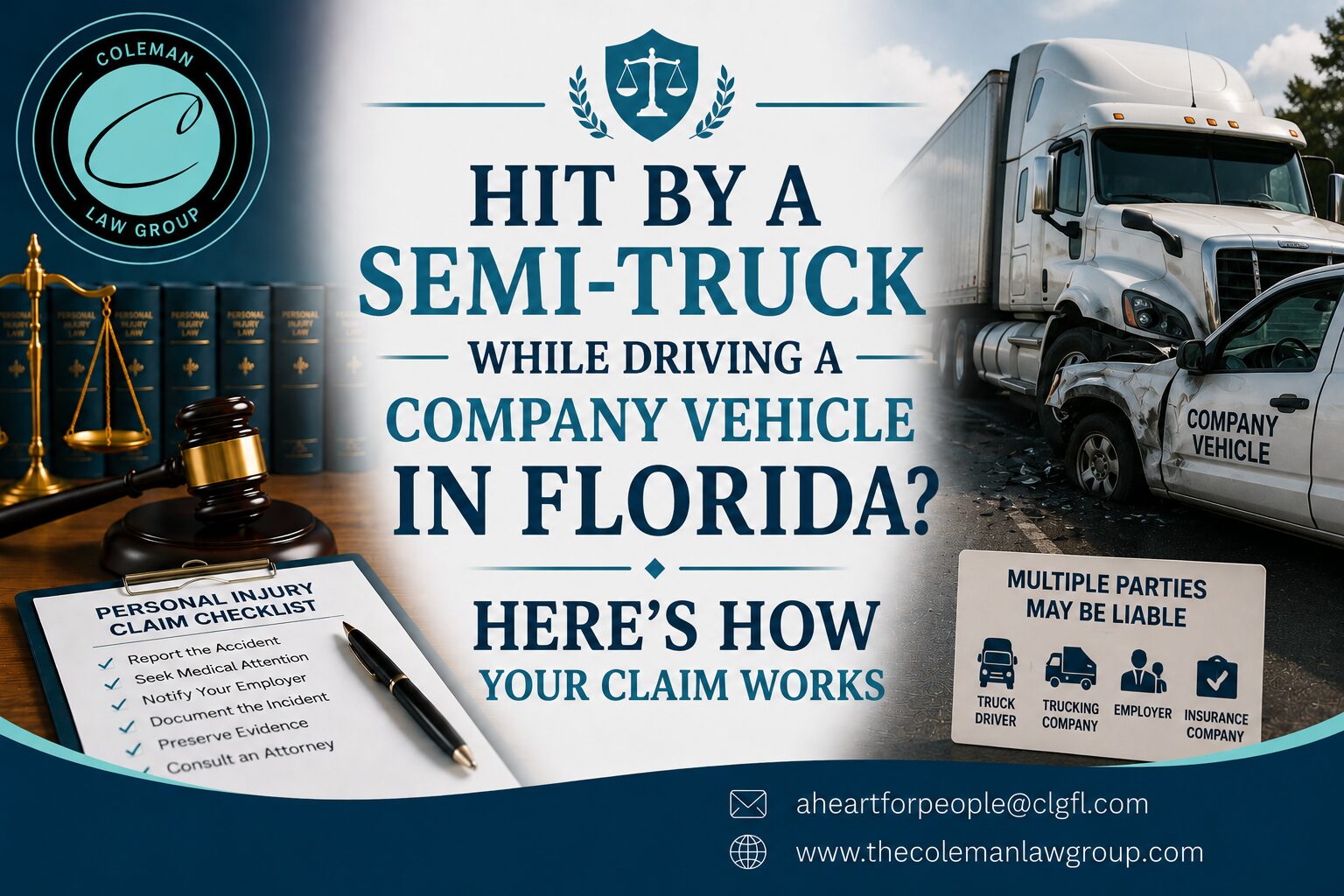
There is a specific kind of panic that hits when an eighteen-wheeler completely wrecks a normal workday. Driving a company car means you are tied to your employer, but a commercial truck crashing into you completely erases the boundary between a standard job and a major injury case. Before you even have time to process the physical pain, you are dragged into a high-stakes puzzle of company HR red tape, aggressive commercial insurers, and strict federal trucking standards.
Because multiple legal systems collide at once, figuring out your next move can feel entirely overwhelming. You need to know who is actually responsible for your medical expenses and whether your employment status changes your right to hold the trucking company accountable. Navigating these overlapping claims requires specialized guidance, making it vital to partner with a knowledgeable work-vehicle accident lawyer in St. Petersburg, FL, or a trusted commercial-vehicle injury attorney near me who knows how to fight corporate legal teams.
Immediate Steps and Medical Financial Realities
The moments immediately after a collision with a semi-truck while driving a work vehicle are chaotic, but your actions during this window heavily influence what follows. Above all else, focus on getting medically checked out. Even if the pain hasn’t fully set in because of the adrenaline, you need a doctor to look you over right now. Serious issues like internal trauma, whiplash, or brain injuries love to hide for the first couple of days.
If you wait to see a physician, you’re just handing the commercial insurers an easy out to argue the crash didn’t cause your injuries.
-
Untangling Your Medical Expenses
One of the most stressful parts of a commercial vehicle crash is figuring out who will pay the mounting medical bills. When you are injured while performing job duties, multiple financial safety nets may apply, but none of them make the process straightforward.
- Workers’ Compensation: Your employer’s workers’ comp policy should kick in to cover authorized medical treatment related to the workplace accident.
- Automobile Insurance: Depending on whether your employer’s vehicle policy carries Personal Injury Protection or commercial liability coverage, auto insurance may cover initial medical expenses.
- Personal Health Insurance: Your private health insurance or group plan may pay for care upfront, but it will likely assert a lien to recover those costs once you receive a settlement.
Navigating who pays medical bills if hit by a truck while working requires careful tracking of every document, diagnosis, and bill.
-
Protecting Your Paper Trail
Insurance companies and corporate legal teams look for any inconsistency to minimize your payout. From day one, you need to create a rock-solid paper trail. Keep a folder for all your doctor visits, therapy sessions, medication costs, and any communication with your company or the insurance reps. Above all, don’t agree to a recorded statement with the trucking company’s adjuster without legal counsel. They’ll twist your words to protect their finances. Establishing this clear, undeniable record early is the bedrock of both your employment injury claim and your future financial recovery.
-
The Dual Track: Workers’ Compensation and Third-Party Claims
If a commercial truck crashes into your company car, your recovery path divides into two entirely distinct routes. Missing out on either one means walking away with way less compensation than you deserve. Being on the clock grants you automatic access to employer-backed protections, but a negligent outside driver also opens the door to a standard personal injury suit. Navigating these two separate systems side by side requires careful tactical planning to ensure you get every last dollar you’re owed.
-
The Workers’ Compensation Safety Net
Your first layer of financial relief comes from your employer. Because the crash happened while you were performing job duties, you qualify for workers’ compensation benefits. This system is designed to provide immediate relief without requiring you to prove that your employer was at fault.
- Authorized Medical Care: Workers’ comp covers 100 percent of your necessary and approved medical treatments, surgeries, and rehabilitation costs.
- Wage Replacement: If you’re sidelined at home healing up rather than earning a living, partial disability checks step up to cover a portion of your missing income.
- No-Fault Protection: There’s no need to prove fault or negligence on the part of your employer; you only have to establish that the crash took place while you were working within the scope of your employment.
That said, relying solely on workers’ compensation leaves a lot on the table. It operates as an exclusive remedy against your employer, which blocks you from suing your company for negligence—even when they neglected basic vehicle upkeep. Furthermore, workers’ comp excludes non-economic damages completely. You aren’t going to receive financial recovery for physical discomfort, emotional trauma, or the deep disruption to your overall quality of life.
-
Unlocking the Third-Party Personal Injury Claim
This is where the distinction between a standard job-related injury and a trucking accident becomes vital. While workers’ comp handles your baseline needs, the at-fault truck driver and the trucking company are considered third parties. You have a legal right to file a personal injury lawsuit directly against them.
Unlike workers’ comp, a third-party claim lets you go after every single dollar of your damages. You can pull back 100 percent of your lost wages instead of dealing with the caps enforced by workers’ compensation. Even bigger, filing a third-party lawsuit is the only way on earth to get compensated for the actual misery, stress, and permanent scars the wreck left behind.
How Does a Third-Party Personal Injury Claim Work With Workers’ Compensation?
Getting workers’ comp benefits comes with a catch: the insurance carrier drops a legal lien on any future settlement you pull from the trucking company. This boils down to the fact that if you win cash from a third-party claim, your employer’s insurance gets first dibs on reimbursement for all the medical bills and wage support they covered.
This process, known as subrogation, requires precise legal negotiation. An experienced attorney can negotiate to reduce these liens, ensuring that the money you win from the third-party lawsuit actually stays in your pocket rather than going straight back to insurance conglomerates. Handling both of these tracks side by side ensures your urgent medical expenses are taken care of while you aggressively pursue the major long-term payout you actually deserve.
Establishing Liability: Can You Sue the Trucking Carrier?
When an eighteen-wheeler wrecks your company car, sorting out who’s actually responsible is a lot messier than your average two-car accident. You are not just dealing with the individual, but squaring off against a massive corporate entity bound by strict federal safety mandates. To secure maximum financial recovery, your case must uncover every layer of negligence involved in the crash.
-
Suing From a Company Car
A common point of confusion for injured workers is whether driving an employer-owned automobile restricts their ability to seek justice. The short answer is no. Even though you were behind the wheel of a company vehicle, your legal standing to hold an outside party accountable remains entirely intact. You possess the same personal injury rights against a negligent third party as you would if you were driving your own personal car. The fact that your employer owns the vehicle adds another layer of insurance documentation to untangle. Still, it does not strip away your right to pursue a lawsuit against the trucking company.
-
Direct Driver Negligence
The most immediate source of liability rests with the person operating the semi-truck. There’s massive pressure on commercial drivers to meet tight delivery windows, which forces many of them to take dangerous risks behind the wheel. When investigators step in, they look closely for direct proof of driver negligence, including:
- Severe Fatigue: Violating federal limits on driving hours to push through exhaustion.
- Distracted Driving: Controlling a huge truck while distracted by text messages, dispatch updates, or cab technology.
- Blind-Spot Violations: Failing to check mirrors or clear lanes before executing a lane change or wide turn in your company vehicle.
- Impairment: Operating under the influence of alcohol, illicit substances, or even over-the-counter medications that cause drowsiness.
-
Corporate and Vicarious Liability
When there’s a commercial truck wreck, the driver is rarely the sole issue. Legal rules around vicarious liability mean trucking companies often shoulder the blame for employee mistakes made during a shift. You can also bypass that and go straight after the trucking company itself for its own independent negligence.
Transport companies frequently sacrifice safety to cut costs. Digging into the carrier often uncovers careless hiring, like handing keys to someone with a history of safety violations. It can also expose maintenance issues, such as bald tires or bad brakes, that directly caused the crash. If management pressured the driver into breaking federal rest rules, the company is completely on the hook for the wreck.
-
Leveraging Federal Safety Regulations
Commercial trucking is subject to heavy oversight by the Federal Motor Carrier Safety Administration. These federal rules dictate everything from maximum driving hours in a row to mandatory mechanical safety checks for every semi on the road. When a trucking company or its driver breaks these federal rules, that violation serves as powerful evidence of negligence.
Showing that a federal safety rule was broken makes it way harder for the trucking company’s lawyers to deny they’re at fault. Finding these violations requires aggressive legal legwork, ensuring that when you file a lawsuit against trucking carrier networks, you’ve got the hard proof needed to tear down their defenses.
Why Commercial Trucking Cases Demand Specialized Legal Representation
When you are injured while driving a company vehicle, the case cannot be handled like a routine car accident. Commercial trucking corporations and their insurers operate entirely differently from standard auto insurance companies. The moment a semi-truck collides with a work vehicle, a rapid-response team of corporate adjusters and defense lawyers springs into action. Their sole objective is to protect the carrier’s profits, minimize payouts, and shift blame away from the driver. Facing this level of corporate defense requires a specific type of legal advocacy.
-
Work Vehicle Accident vs. Semi-Truck Crash
There is a massive chasm between a standard multi-car accident and a commercial trucking collision. In a typical crash, you deal with a personal auto policy and basic negligence principles. When a semi-truck is involved, you enter a web of complex corporate structures, freight brokers, shipping contractors, and layered commercial insurance policies that often total millions of dollars in coverage. A standard work vehicle accident claim focuses strictly on your employer and workers’ compensation. A semi-truck crash expands that battlefield exponentially, requiring an attorney who understands how to bridge workplace injury law with interstate commercial liability.
-
The Race to Preserve Critical Evidence
In trucking lawsuits, evidence vanishes fast. The trucking company usually controls all critical data, and without swift legal action, vital evidence can be overwritten, lost, or erased. A seasoned legal team moves fast to lock down essential items, like:
- Electronic Logging Device Data: Digital records tracking the driver’s hours, speed, and operational status leading up to the impact.
- Black Box Telemetry: Onboard computer data capturing braking patterns, force of impact, and throttle position.
- Maintenance and Inspection Logs: Records revealing whether the truck had known mechanical defects or deferred repairs.
Driver Qualification Files: Background checks, medical certifications, and historical safety violations show whether the company should ever have allowed that driver on the road.
Trying to take on a commercial trucking conglomerate by yourself is a losing battle. When you hire a lawyer for a work vehicle accident vs. a semi truck, you are equipping yourself with the investigative resources, financial backing, and courtroom muscle needed to level the playing field against corporate legal teams.
-
Secure Your Future and Protect Your Rights
You cannot afford to treat a catastrophic commercial vehicle collision like a minor inconvenience or let corporate insurance adjusters dictate the value of your recovery. Handling a complex claim involving both workplace injuries and a commercial semi-truck requires aggressive advocacy and a deep understanding of Florida law. At the Coleman Law Group, we know that behind every case file is a hardworking person fighting to regain their health, stability, and financial future. We specialize in cutting through corporate red tape, handling workers’ compensation liens, and holding careless trucking companies completely responsible.
Do not navigate the overlapping hurdles of a commercial truck wreck and workplace injury on your own. Our team at the Coleman Law Group stands ready to investigate your collision, protect crucial black-box and electronic log files, and build a hard-hitting case for top-dollar recovery. If you need a relentless work-vehicle accident lawyer right here in St. Petersburg, FL, to face down big corporate defense lawyers, call us at 727-214-0400 or drop us a line at aheartforpeople@clgfl.com today to schedule your consultation and reclaim your peace of mind.
Frequently Asked Questions
Who pays my medical bills if I were hit by a semi-truck while driving a company vehicle?
If you were driving for work when the crash happened, your employer’s workers’ comp policy should pick up the tab for approved medical care. Your personal health insurance or the company’s commercial vehicle policy might also cover your initial bills upfront, but keep in mind that your health insurer will slap a lien on any future settlement to get their money back.
Can I sue the trucking company if I was injured in a company vehicle?
Yes. Driving an employer-owned vehicle does not restrict your legal right to pursue a personal injury lawsuit against the at-fault truck driver and the trucking company, as they are considered third parties. This allows you to recover full economic damages, including 100 percent of your lost wages.
What separates workers’ compensation from a third-party claim after a truck wreck?
Workers’ comp takes care of your medical bills and a chunk of lost wages right out of the gate without anyone arguing over fault. Still, it completely blocks you from suing your employer or seeking damages for pain and suffering.
How does subrogation work in a truck accident workers’ compensation case in Florida?
When you recover a settlement from the at-fault trucking company, your employer’s workers’ comp carrier has a legal right to be reimbursed for the medical costs and wage payments it advanced. Your health insurer places a lien against your final settlement to recover what they spent on your care. Bringing in an experienced attorney gives you someone who can negotiate with them to lower those liens and put more cash back in your hands.
What evidence is most critical to preserve after a semi-truck accident in Florida?
Vital proof hides in electronic logging device outputs, powertrain telemetry, repair histories, and driver files. Because trucking outfits can erase or toss out these digital and physical records overnight, your attorney needs to step in right away with spoliation letters to preserve everything.
What role do FMCSA rules play in a Florida truck accident case?
Commercial truck drivers must adhere closely to federal regulations, including required rest periods and daily driving limits. When these safety guidelines are violated, it constitutes compelling evidence of negligence that will significantly strengthen your position in court proceedings.