


Marriage termination is one of the biggest life changes one can experience. In addition to the emotional divorce, couples will have to make decisions about property, money, support, and parenting. The consequences of your actions on these decisions can affect your future. Court isn’t the only alternative for couples in Pinellas County. The conventional divorce litigation procedure is costly and time-consuming.
Collaborative divorce and divorce mediation in St. Petersburg are two other popular choices for couples in Florida. Both methods are designed to involve spouses in reaching agreements without going to court. But the two methods are not identical. A good understanding of legal matters can help you decide which of these processes might suit you best.
What is a divorce mediation?
Divorce mediation is a peaceful method of resolving a divorce, in which a mediator or other neutral third party guides the spouses in resolving their issues and agreeing on a settlement. The mediator is not a spouse’s lawyer. They are expected to maintain the discussion, find points of conflict, and assist both parties in finding potential solutions.
The mediator does not assume the role of a judge. Mediation may be attempted before filing a divorce case or in a case already underway. It can be a highly beneficial process for both parties to be willing to communicate and negotiate in good faith.
How mediation works in St. Petersburg?
Divorce mediation in St. Petersburg can take place in a neutral environment. Spouses can meet in the same room or attend separately, depending upon the situation. There are several simple steps involved in the process:
- Neutral Discussion: The mediator establishes a format for both parties to present their issues and priorities.
- Identify the Issues: The couple processes issues that should be addressed. This can involve financial or parenting issues.
- Explore Solutions: The mediator guides the couples in considering alternative options and any compromises they can make.
- Reach an Understanding: When the couple can understand each other on all key issues, those understandings can be drafted into a written settlement agreement.
- Legal Review: Both parties can have an attorney review the proposed agreement before signing. This provides everyone a chance to be familiar with their rights and duties.
The Role of an Attorney in Mediation
It is not necessarily mandatory to have your lawyer present at each mediation. But it can be beneficial to have independent legal advice. A mediation attorney will be able to account for the application of the Florida law under your specific circumstances, and you will be able to understand whether a proposed mediation settlement is fair. They can also review documents and identify words that may cause future difficulties. The mediator will not be your personal legal counsel and does not represent both spouses.
What is Collaborative Divorce?
Collaborative divorce is another option for couples who would like to settle their divorce without going to court. It’s more of a formal mediation process, though. In a collaborative divorce, each spouse will hire their own specially trained collaborative attorney. The lawyers can also assist the spouses in resolving their legal issues through negotiation.
All participants must sign a Collaborative Practice Agreement before initiating the process. This agreement confirms a commitment to resolving the divorce outside of court.
Key Differences Between Collaborative Divorce and Mediation
Both methods seek to prevent the traditional courtroom battle; there are significant differences between the two:
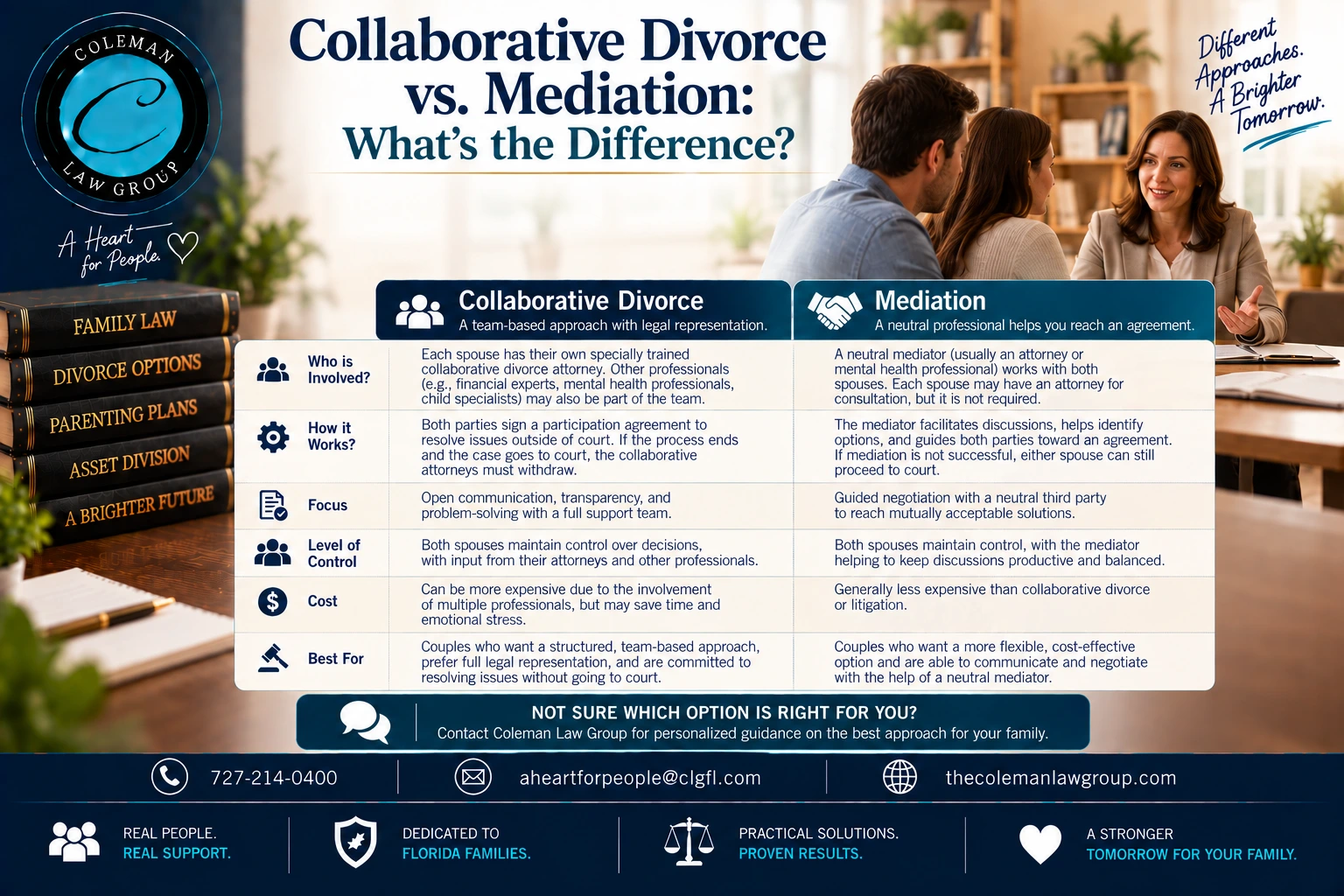
| Feature | Divorce Mediation | Collaborative Divorce |
| Neutral Professional | One neutral mediator guides discussions. | Neutral financial and communication professionals may be part of the team. |
| Legal Counsel | Attorneys may attend mediation or review the agreement separately. | Each spouse has a dedicated attorney throughout the process. |
| Decision-Making | The spouses make the final decisions with help from the mediator. | The spouses make decisions with support from a full team of professionals. |
| If the Process Fails | The same attorneys may generally continue with the case if permitted. | Collaborative attorneys must withdraw if the case moves to litigation. |
| Financial Support | Usually handled by the spouses and their attorneys, depending on the case. | A neutral financial professional may help analyze complex financial matters. |
| Communication Support | The mediator manages the discussion. | A facilitator may provide more structured communication support. |
| Cost | Often less expensive because fewer professionals are involved. | It can cost more than basic mediation because several professionals may participate. |
| Best For | Couples who can communicate and have relatively manageable disputes. | Couples who want a structured process for complex financial or parenting issues. |
Benefits of Alternative Dispute Resolution in Pinellas County
There are several benefits that mediation or collaborative divorce can offer over a protracted court battle.
1. More Privacy
The actions and documents in court may be made public. Mediation and collaborative negotiations provide a more private forum to discuss personal financial and family issues.
2. More Control of the Outcome
When the judge makes a decision, they limit the effects over which the couple has control. Alternative dispute resolution offers the chance for the spouses to create their own solutions. They will be able to discuss plans for parenting, property, and other financial matters, depending on the family’s situation.
This doesn’t imply that each spouse will receive all that they desire. In many cases, you may need to accomplish what is possible. But the final agreement is created by the people who will be living by it.
3. Potentially Faster Resolution
There could be additional delays with the court schedule that could be added to a divorce. Occasionally, hearings need to be scheduled based on the availability of the court, attorneys, and other participants. There’s flexibility in mediation and collaborative negotiations. The participants can meet each other as per their availability and discuss the problems to be solved.
The exact amount of time will depend on the complexity of the case and how cooperative both parties are in reaching an agreement.
4. Potentially Lower Costs
Mediation may also cost less than lengthy litigation, as fewer professional services and fewer court appearances are required. Since each of the divorcing parties has lawyers and other professionals involved, collaborative divorce may be more expensive than basic mediation. It can still prove more cost-effective, however, than a prolonged battle in court.
What option is right for you?
This will include your relationship with the other parent, financial concerns, parenting needs, and communication abilities.
You feel mediation may be a suitable choice for you if:
- You and your spouse can communicate with respect for each other.
- You both are willing to compromise.
- Your finances are fairly simple.
- You desire a more direct and possibly less expensive procedure.
- You don’t want an entire professional team; you need assistance in specific disagreements.
- You would like the uncontested divorce attorneys to work on the last documentation after an agreement has been reached.
Mediation may be effective when the basic paperwork for both spouses’ finances is settled and both parties need assistance in reaching an agreement.
Collaborative divorce may be a good choice if:
- You have complex financial interests and/or debts.
- You have a business or complex property valuation issue in your divorce.
- Other monetary interests, such as retirement accounts, should be carefully reviewed.
- You need legal counsel in the negotiations.
- You and your spouse can communicate, but it’s hard.
- You need to seek professional help to develop a parenting plan.
- You think that financial and emotional assistance might help to make negotiations easier.
Collaborative divorce can provide a more structured environment when several issues need to be addressed simultaneously.
Choosing the Right Path for Your Divorce
Don’t base the decision on fees alone when deciding between mediation and collaborative divorce. It is also crucial to consider the complexity of your situation and the quality of your communication with your spouse.
For a fairly simple divorce, where you can talk about issues rationally, mediation can be a successful means of agreement. Collaborative divorce might be right for you if your divorce case has complex assets or challenging parenting issues.
Consult with a capable lawyer who knows what you are facing. Knowing what you must and may do before discussing a deal can help you make the right decisions.
Protecting Your Future with Coleman Law Group
Although divorce is a difficult procedure, it doesn’t have to be handled by yourself. If you choose the right dispute resolution approach, it can be smoother and allow you to focus on your future. At Coleman Law Group, we are here to educate our clients on their choices and help them achieve a viable solution in Pinellas County.
A mediation attorney will come in handy in case you need a review of any terms that are offered within a settlement, and legal counsel will help you if you are filing an uncontested divorce.
It is dependent on the person and what would be appropriate for each person. Take time to educate yourself on what you can do before you make a decision. Call Coleman Law Group at 7272140400 or send an email to aheartforpeople@clgfl.com to schedule a consultation to discuss if mediation, collaborative divorce, or another option is right for you.