

There is a specific kind of silence that follows the decision to end a marriage. It isn’t the peaceful kind, but the heavy, vibrating quiet of a thousand unanswered questions. You’re likely wondering about the house in Tampa, how the kids will handle the change, and perhaps most pressingly how much of your private life is about to become public records.
In Florida, the legal system provides two primary exits for ending a marriage: contested and uncontested. While the names sound technical, they represent vastly different experiences. One is a collaborative closing of a chapter; the other is often a defensive stand to protect your future. Choosing between them isn’t simply a legal checkbox you have to tick. Crucially, it’s the first major decision of your new life.
The Question Nobody Tells You to Ask First
Before you call an attorney or Google anything else, there’s one thing worth knowing about yourself: how much agreement exists between you and your spouse right now?
It’s not about how much you like each other, nor how the marriage ended. Rather, it’s simply this one little question: can the two of you sit down, study your life together on paper, and actually agree on just how to manage it separately?
That one question is what differentiates a contested divorce from an uncontested divorce here in Florida. Your answer will pretty much shape all that follows thereafter.
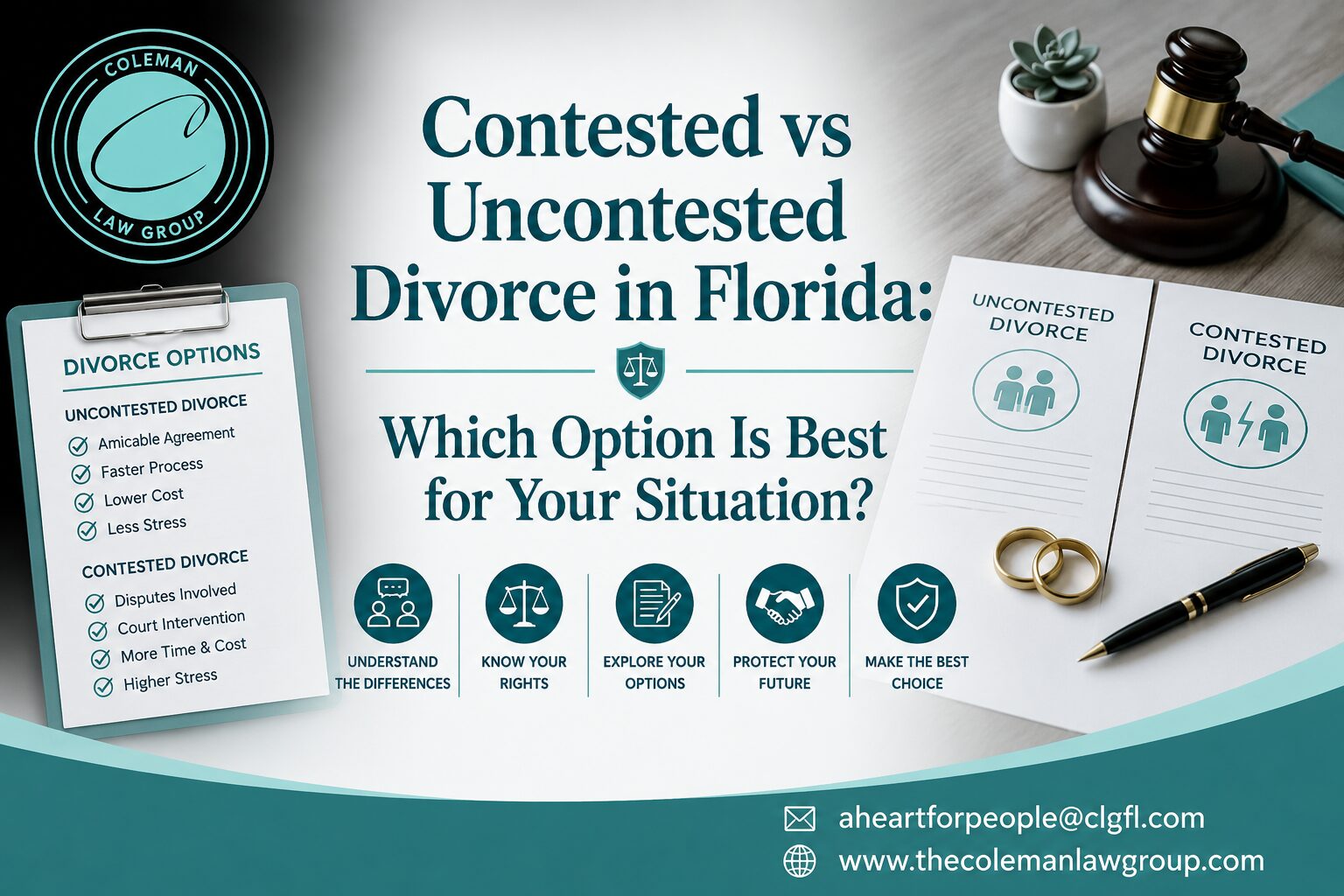
Contested Vs Uncontested Divorce in Florida
At its simplest, an uncontested divorce in Florida occurs when there’s mutual agreement. You and your spouse are on the same page about which property goes to whom, where the children will be every Tuesday night, and whether spousal support will be part of the deal. You present the court with a completed puzzle, and the judge then verifies that all the pieces do fit together. It is efficient, private, and generally keeps divorce costs to a minimum because you aren’t paying us to argue for you—you’re paying us to protect the agreement you’ve already reached.
A contested divorce, however, doesn’t always mean a “war.” It simply means the puzzle is incomplete. Maybe you agree on the house but can’t agree on the retirement accounts. Perhaps the parenting plan may be the most difficult aspect of conflict. If you cannot come to an agreement, the case will be considered contested, and we will act as your family law attorney navigating the discovery process, mediation, and, if necessary, a trial to ensure that the final result is truly fair.
The “Simplified” Path (And Why It’s Rare)
Florida has a specific track called a Simplified Dissolution of Marriage. It sounds like the dream scenario because there are no lawyers, no drama; just a quick trip to the courthouse. But here’s the catch: you can’t have any minor children; you can’t be asking for alimony, and you both have to show up together to sign up the papers.
Life is a bit more complicated than that. You likely have a mortgage, a car payment, or a toddler who needs a stable schedule. This is where a standard uncontested divorce in Florida comes into play. You still agree on everything, but because your life has moving parts, you need a professional to draft a Marital Settlement Agreement. This document is the “why” behind the uncontested divorce in Florida costs. You’re paying for a legal insurance policy that ensures your spouse can’t come back two years from now and try to claim your 401(k) because a DIY form was filled out wrong.
When a Contested Divorce Becomes Your Only Shield
Nobody wakes up and hopes for a courtroom battle. But sometimes, being “reasonable” on your own just doesn’t work. If your spouse is hiding bank statements or refusing to let you see the kids on weekends, the “contested” label isn’t something to fear—it’s your protection.
In a contested case, your family law attorney in Florida uses a process called discovery. This is the legal version of turning over every rock. We look at tax returns, credit card statements, and property valuations. While this takes longer than an uncontested split, it prevents you from being bullied into a lopsided deal. If you’re worried about how you’ll survive post-divorce, a family lawyer is there to make sure “equitable distribution” actually feels equitable.
Understanding the Procedural Timeline
Timing is quite often many people’s biggest concern, though it’s the hardest to forecast with complete accuracy. Under ideal conditions, an uncontested divorce really can wrap up fairly fast – usually within 30 to 60 days after you’ve filed. Such quickness is possible because the court’s involvement is very limited; the judge simply reviews your agreement to ensure it meets legal requirements and then signs off on the final judgment.
When a case is contested, the calendar shifts significantly. You are no longer just on your own schedule; you are on the court’s schedule. Between mandatory financial disclosures, the discovery process, and the required mediation sessions, a contested matter can span several months or even over a year. While the wait is frustrating, rushing into a contested case often means leaving money—or rights—on the table. As your family law attorney in Florida, our priority is accuracy over speed, ensuring that when the case does close, it stays closed.
The Financial Fork in the Road: Assets and Alimony
Money is rarely just about numbers; it’s about the security you’ve worked on years to build. This is frequently where “agreement” falls apart. Florida operates under the rule of equitable distribution, which assumes a 50/50 split of marital assets is the starting point, but it doesn’t always end there.
Factors that complicate the split:
- The Marital Home: Deciding whether to sell the property or have one spouse buy out the other’s interest.
- Retirement and Pensions: These are often the largest assets and require specialized court orders (QDROs) to divide without massive tax penalties.
- Business Interests: If you or your spouse owns a business, a professional valuation is usually necessary to determine its worth.
If you can reach a consensus on these points, your uncontested divorce in Florida costs will remain low. However, when there’s a disagreement over the “need and ability” aspects concerning alimony, the case moves into a contested phase. This is where our team of lawyers will advocate for a fair lifestyle changeover, ensuring that the lower-income spouse isn’t left high and dry and that the higher-income spouse isn’t unfairly burdened.
Children and the Florida Parenting Plan
In Florida, the term “custody” is not used anymore. Now, we focus on time-sharing and parental responsibility. For an uncontested divorce, you’ll need to submit a highly detailed Parenting Plan. This document covers everything from where the children spend Thanksgiving to who makes decisions about their healthcare.
If both parents agree that the children’s needs come before their own grievances, you can trust that the process will be seamless. But if there is a disagreement about what is in the “best interests of the child,” a family lawyer must step in. In these contested situations, a judge may appoint a social investigator or a Guardian ad Litem to assist in determining the schedule. It is a more invasive process, but it serves to protect the most vulnerable members of your family when a mutual agreement isn’t possible.
Navigating Your Choices: Which Path Fits Your Life?
Deciding on the right approach requires a cold, hard look at your current relationship dynamic. It isn’t just about how much money you have in the bank. While that is definitely a factor, it’s more about the level of trust remaining between you and your spouse. While everyone hopes for a smooth transition, Florida law provides different avenues to ensure that every citizen has a path to resolution, regardless of how much they disagree with their partner.
Evaluating the Two Main Divorce Types in Florida
When we sit down with a new client, we look at the specific friction points of their marriage. The choice between a contested vs uncontested divorce in Florida often boils down to a single question: Are you fighting over a principle or a person?
When Uncontested is the Goal
An uncontested filing is ideal for couples who have already done the heavy lifting of negotiation. If you have sat down, looked at your debts, and mapped out a schedule for the kids that actually works, you are halfway there. In these cases, a family lawyer acts more like a legal architect—taking your verbal agreements and building them into a binding structure that the Florida courts will accept without hesitation.
When a Contested Filing is a Necessity
There is a common misconception that choosing a contested path means you want to be “difficult.” In reality, it’s often about protection. You might need a family law attorney in Florida to file a contested petition if:
- There is a history of domestic violence or an extreme power imbalance.
- One spouse is completely non-responsive to legal inquiries.
- The division of complex assets, like a family-owned business, requires a neutral third-party appraisal.
Moving from Conflict to Resolution
A case doesn’t have to stay in the category where it started. Many cases begin as contested because emotions are high and communication is broken. However, as the legal process moves forward and “discovery” brings all the financial facts to light, many couples find they can settle their differences during mediation.
The Role of Mediation in Florida
In almost every Florida county, including those around Tampa and Clearwater, judges demand mediation before they will schedule a trial date. It’s a very organized meeting where a completely impartial third person assists both parties in discovering common ground. When you reach an understanding here, your case actually becomes uncontested. This shift is quite beneficial to everyone involved, since it lets you control the outcome rather than leaving your entire future up to a judge who only knows you through a case file.
Preparing for Your Florida Divorce Case
Regardless of whether you are pursuing a contested vs uncontested divorce in Florida, your success depends on the quality of your preparation. Florida is a mandatory disclosure state. This means the court expects a level of radical financial honesty that can be jarring for many people. If you start hiding assets or “forgetting” about a secondary savings account, you risk turning a simple agreement into a long, expensive legal battle.
Gathering Your Financial Paperwork
To streamline the process, start organizing your papers ahead of time. We suggest getting at least three years of tax returns ready, the last six months of bank statements, and current appraisals for any real estate or business holdings. Having these documents ready doesn’t just save time, but also prevents the “he-said, she-said” arguments that often cause a divorce to become contested.
The Importance of a Secure Communication Plan
Privacy is easily compromised in this digital age. If you share a phone plan, a cloud storage account, or even a home computer with your spouse, your legal strategy could be at risk. We often advise clients to set up a new, private email address specifically for communications with their family law attorney in Florida. It’s a small step that prevents unnecessary friction and keeps your legal advice confidential.
Common Pitfalls That Can Derail Your Case
It’s easy to be optimistic when you and your spouse are on speaking terms, but the Florida legal system has a way of complicating even the best intentions. Knowing the different types of divorce recognized by Florida is only half the battle. The real challenge is navigating all the very specific procedural oddities of the courts – whether that’s in Pinellas County or Hillsborough. We see a lot of people trying to take the easiest route, only to find themselves stuck in a bureaucratic loop because they missed just one tiny detail.
The Hidden Dangers of “Downloadable” Divorces
There’s a huge temptation to use expedited online divorce sites. They promise a fast track for a few hundred dollars, but these divorce mills usually hand out generic templates that haven’t been updated to match current Florida statutes.
Think about it this way: a poorly constructed parenting plan is a ticking time bomb. If your paperwork doesn’t explicitly state who is responsible for the kids during a hurricane evacuation or how a mid-week doctor’s appointment is handled, you aren’t saving money—you’re just delaying a massive argument. Usually, we see these clients come back to us a year later to file a modification, which ends up costing significantly more in legal fees than if a family law attorney in Florida had just done it right the first time.
Thinking About “Now” Instead of “Next Year”
When you are right in the midst of a separation, the desire to just sign and go is very hard to resist. This emotional exhaustion is exactly how people end up with a raw deal. For instance, fighting to keep the family’s home feels like a win in the moment, but if you haven’t factored in the skyrocketing property taxes and insurance on a single income, that “win” can quickly become a financial anchor.
The same logic applies to your long-term support. Waiving your right to alimony might seem like a way to keep the peace during a divorce in Florida, but if you’ve spent the last decade out of the workforce, you might be signing away your ability to get back on your feet. Our job as your family lawyer is to step back and look at the big picture for you. We want to make sure your final judgment is actually a fresh start, not just a temporary truce that leaves you broke in two years.
Your Future Deserves a Strong Advocate
Divorce can be really exhausting. In between the paperwork and the late-night worries, it really does feel like your life has been put on hold. Most of our clients really just want to know when the “what if” will finally stop. Whether you are walking through an uncontested divorce with a spouse who is cooperating, or you’re bracing for a fight because things have turned sour, you shouldn’t have to navigate this transition on your own.
At The Coleman Law Group, we take the heavy lifting off your shoulders so you can focus on just being a parent or getting through your workday. We’ve seen enough divorce cases to know that no two families are the same, and a “one-size-fits-all” approach usually ends in a headache.
The goal here is simple: we want to get you to the day when you aren’t waking up stressed about court dates or bank statements. If you’re ready to talk about what’s actually happening in your house, call us at 727-214-0400. Or, if you aren’t quite ready to pick up the phone, send a quick email to aheartforpeople@clgfl.com. We’ll listen to your story, explain how divorce types in Florida work for your specific situation, and help you start building a future that actually feels like yours again.