

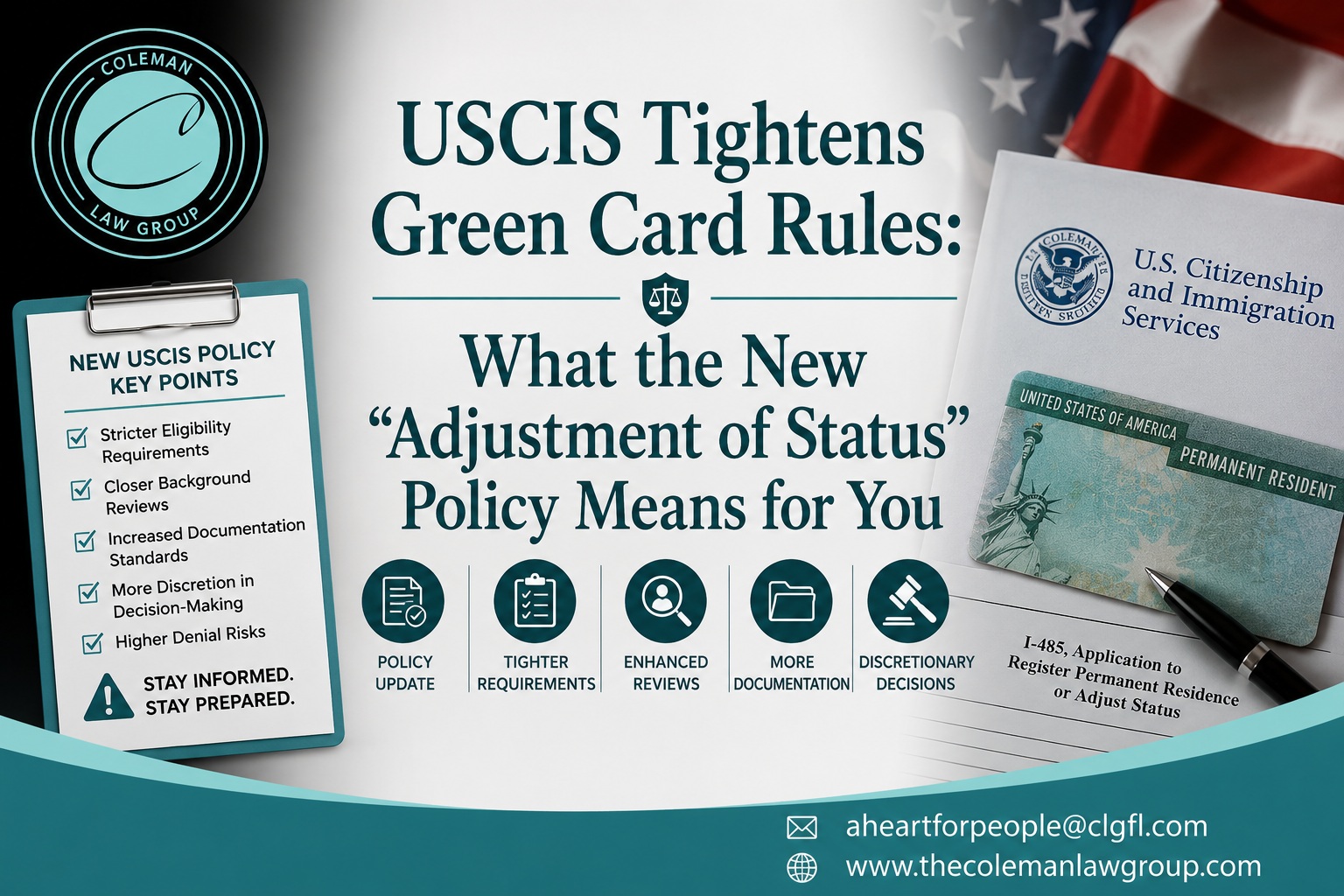
The U.S. Citizenship and Immigration Services (USCIS) just changed the rules on applying for a Green Card from inside the U.S. If you’re here on a temporary visa, say, as a student, a worker, or even a tourist, this shift matters a lot for your future.
Under the new guidelines, immigration officers have been told to stop cutting applicants any slack. The days of a somewhat flexible approach to these cases are over. Now, they are expected to take a much closer look at every application, digging deeper into the details before making a decision.
The Adjustment of Status Policy Shift Explained
For many years, people already in the U.S. on temporary visas could apply to change their status to become permanent residents. They did this without leaving their homes or jobs in the U.S. This new guidance ends that practice for most people. The government is telling its officers to return to the original wording of the law. This means that if you want a Green Card, the government expects you to apply from your home country. You will now be required to use the consular process through the Department of State. You can no longer rely on applying through a local office inside the U.S.
There’s one exception, but it comes with a catch. You might still change your status inside the U.S. if you can prove your situation involves “extraordinary circumstances.” The problem? The agency hasn’t given a clear list of what actually counts as extraordinary.
Instead of following a set of rules, officers will now review every case individually. They’ll dig into your entire history and facts to decide if you really need to stay to finish the process. If you can’t prove your situation is truly exceptional, you will likely be sent back home to apply through the standard consular process.
Why the Agency Is Changing Its Approach
On May 21, 2026, USCIS released new guidance that changes the game for “adjustment of status“—the process that lets people apply for a Green Card while still inside the U.S. The agency is now focusing on two big reasons for this shift.
Returning to the Standard Consular Process
The government is emphasizing that Green Card applicants are expected, by default, to apply through the standard consular process in their home country. The agency describes adjustment of status not as a right, but as an “extraordinary act of administrative grace.” By instructing officers to treat in-country adjustment as a rare exception, the government aims to steer more applicants back to U.S. consulates abroad. Officials state this is necessary to ensure that temporary visas, such as those for students or tourists, are used only for their intended short-term visits and not as a primary vehicle for permanent immigration.
Operational Goals and Resource Allocation
There’s a practical reason behind this shift: USCIS is drowning in a backlog of cases. Moving more residency applications to consulates overseas finally lightens the load at domestic offices.
Domestic officers can now stop sifting through routine files to focus on work that actually can’t wait. Time gets redirected toward processing citizenship applications, helping victims of violent crimes or trafficking, and handling urgent humanitarian cases that simply can’t be done from abroad.
Action Steps for Your Application
Even if you check all the boxes for a Green Card, officers now have more power to deny you based on their own judgment. Meeting the basic rules won’t get you approved anymore. If you’re waiting on a decision or planning to file, do these to build a stronger case:
- Prove your life is actually rooted here. Don’t just provide the bare minimum paperwork. You need to show that you have built a real life in the U.S. Gather your tax returns, your work history, family ties, and proof of your community involvement. Convince the officer that your life is here and that moving back home would be a massive disruption.
- Look closely at your own history. Officers are digging into the very first day you entered the country. Any old gaps in your status, unauthorized work, or legal trouble will count against you. If your record isn’t spotless, talk to a lawyer immediately. Hiding issues is a bad gamble; it is always better to fix them before an officer finds them.
- Get ready for more questions. You should expect more requests for evidence or detailed inquiries about your case. Since the agency wants to push people toward consulates, they might grill you on whether your original reason for coming here aligns with your goal of staying permanently.
- Ask about interfiling. If your case is already moving forward, ask your lawyer to add updated documents to your file right now. It’s a smart way to showcase your positive contributions and ties to the country.
How The Coleman Law Group Can Help
These new rules create a lot of uncertainty, and we know how much pressure that puts on you. We don’t just fill out forms; our goal is to build a strategy that actually reflects your life. Our team of lawyers wants the officer to see the real person behind the paperwork, not just another file number. From family Green Cards to keeping a pending case alive or working toward citizenship, we are with you at every step. Reach out to us at 727-214-0400 or aheartforpeople@clgfl.com to discuss your case privately.
Source – Policy Memo by USCIS