

There’s no shortcut to building a life in the U.S, it’s a grind. You’ve worked for your career, your community, and that quiet comfort of a daily routine. It feels like home. When you’re ready to take the step toward a green card, finally, the last thing you want is a legal process that forces you to tear all of that down to earn the right to stay. That looming fear of separation is real. It’s the constant worry that a single mistake on a form or a misunderstood rule could keep you from coming back to the people you love.
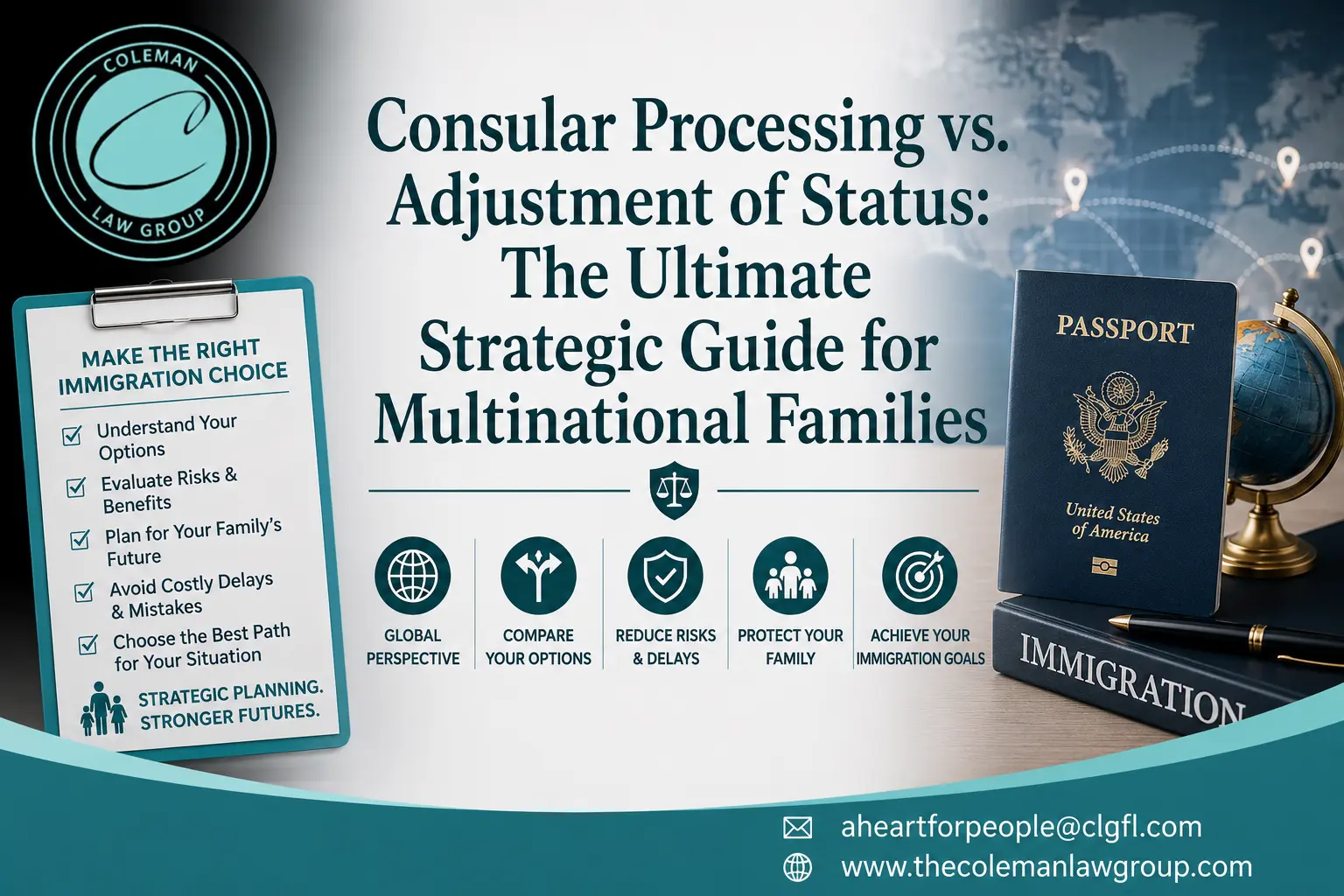
The decision whether to stay and finalize your status or head back to an embassy abroad is the critical choice between consular processing vs adjustment of status.
If you’ve spent any time in the immigration forums, you’ve seen them: the posts claiming to have the “secret shortcut.” Those internet loopholes are often nothing more than ticking time bombs. One wrong turn here doesn’t just result in a few extra weeks of waiting; it can lead to travel bans or a total denial that forces you to start your entire journey from zero.
Adjustment of Status (AOS): The “Stay-at-Home” Strategy
If you are already living in the U.S., you can apply for your green card without ever setting foot outside the border. This path is called Adjustment of Status. Rather than flying overseas to sit in a consulate, you file your paperwork with immigration right here in the U.S. and wait for the outcome without ever leaving your home.
Why In-Country Filing is the Preferred Route – h3
When you file from inside the U.S., your life doesn’t hit the pause button. You don’t have to quit your job, uproot your kids from their schools, or say goodbye to your spouse to wait for an answer in a foreign country. You get to keep your routine, your stability, and your family together while the paperwork sorts itself out. For families trying to balance a budget and stay grounded, keeping everyone under one roof is an enormous relief.
The Reality of the 90-Day Rule Trap
Navigating this process, however, isn’t just about collecting forms; it requires navigating a minefield of hidden intent rules. If you entered the United States on a standard tourist visa or another temporary status, you have to be incredibly careful about your timing.
Immigration officials look closely for what they call “preconceived intent.” If an officer suspects that you used a temporary visitor visa as a deceptive stepping stone to slip into the country and file a green card application, they can hit you with a permanent fraud charge. Under the standard rules, filing your paperwork or getting married within three months of passing through border control creates an automatic presumption of misrepresentation. The 90-day rule immigration violation consequences are severe—it turns a straightforward application into an immediate legal disaster that can permanently bar you from the country.
The Game-Changing 2026 USCIS Policy Shift
To make matters much more complex, a major policy memorandum issued by USCIS on May 21, 2026, has fundamentally altered the playing field. The government has officially declared that Adjustment of Status is an “extraordinary discretionary benefit” and an act of administrative grace rather than an automatic right.
Officers are now instructed to scrutinize applicants who bypass consular processing abroad closely. They aren’t just checking your forms; they’re looking at your whole history. A small gap in status? A past job you weren’t authorized to take? A timeline that moved too fast? Those aren’t just footnotes anymore—they’re reasons to deny your case immediately.
Staying in the U.S. still has huge advantages, but the rules in 2026 now demand an ironclad strategy. You must thoroughly document your history to show your choices were made in good faith after you arrived, not planned before you boarded the plane. Navigating these aggressive new discretionary reviews is exactly why having a dedicated family and immigration lawyer by your side is no longer optional. It is the only way to safeguard your home and your family before your file hits a reviewer’s desk.
Consular Processing: The Embassy Path
If applying for a green card inside the U.S. looks too risky under the new discretionary rules, your alternative is Consular Processing. This is the traditional method. Instead of working with domestic offices, your entire file travels to the Department of State. You then leave the country to attend an interview at a U.S. embassy or consulate in your home nation.
Do not treat this like a quick vacation to pick up a visa stamp. It is a completely separate bureaucratic entity with its own bottlenecks, personality quirks, and rigid enforcement patterns.
What Makes the Embassy Route Work
The advantage of taking this path is certainty for people with clean records. For specific family categories, going through a consulate can sometimes bypass the deep, unpredictable scrutiny that local domestic field offices are currently handing out.
If you are already living outside the U.S., this is your mandatory starting point anyway. It lets you wait out the early paperwork stages from your home base without trying to force your way into the country on short-term visitor visas.
The High-Stakes Reality of Leaving
For families currently in the U.S., leaving the country to attend an interview is a massive risk. The moment you cross the border, you lose the legal protections you have here.
The outcome depends entirely on the consular officer. If they misunderstand an old police record, have a bad day, or decide your sponsor’s income isn’t high enough, they can deny your visa immediately. You cannot simply buy a plane ticket back to Florida to fix the mistake. You are stuck outside the border, separated from your spouse and kids, while your legal team tries to file emergency waivers to undo the damage.
Navigating the Indefinite Processing Halts
Going abroad means your case is at the mercy of shifting political crosswinds. Right now, embassies worldwide are struggling with severe staffing shortages, resulting in incredibly long interview lines. Worse, a massive policy shift took effect on January 21, 2026. The State Department issued an indefinite pause on printing immigrant visas for nationals from 75 specific countries, citing public charge concerns. One stroke of a pen essentially locked millions of applicants out of the system overnight.
If you are a national of an affected country, such as Colombia, Bangladesh, or Nigeria, your consular case is frozen at the embassy level. No visas are being issued, regardless of your personal financial stability.
Stepping into an international visa pipeline right now requires navigating an active minefield. A single blind spot can trap you overseas for a year or more. This is why having a veteran citizenship immigration lawyer review your country’s specific embassy conditions and your entry history before you book a flight is the only realistic way to protect your future.
Form I-485 vs NVC Processing Times
If you ask ten different people online whether domestic filing or going through an embassy is faster, you will get ten completely conflicting answers. That is because “speed” in the immigration world is a moving target.
To make an educated choice, you have to look closely at the math behind Form I-485 vs NVC processing times. You are dealing with two completely separate government entities, and their workloads fluctuate constantly.
The Timeline if You Stay in the U.S.
Filing an I-485 to adjust status within the United States means your paperwork goes through a multi-stage gauntlet. First, it is sent to a USCIS National Benefits Center before being routed to your local regional field office for the final decision.
Right now, if you look at family-based adjustments, the actual wait times are hovering between 9 months and 21.5 months, depending on your location or zip code.
Some local field offices chew through files fast, while others are drowning in regional backlogs. The real perk of the domestic route isn’t that the finish line arrives quicker. The perk is that while those months tick away, you are legally allowed to stay right here in the U.S. with your family, keeping your job and your life moving forward.
The Hidden Bottlenecks of Processing Abroad
Consular processing flips the script completely. Once your initial underlying petition is approved, the National Visa Center (NVC) takes the wheel. You upload your tax forms, financial sponsorships, and civil documents to their online CEAC portal.
The NVC’s internal document review stage is actually pretty efficient, usually wrapping up in 1 to 3 months to stamp you as “documentarily complete.”
But that is where the speed ends and the real bottleneck kicks in.
The NVC cannot give you an interview date until your home country’s U.S. embassy has a slot available for you. Depending upon your consulate, the local wait can add 3 to 12 months more to your journey. If your interview is at a high-volume post, the international route can easily drag out far longer than filing domestically.
The Risk of Fast-Track Pitfalls and RFE Delays
Basing your entire legal strategy on a forum tracker that claims one path saves you 60 days is an incredibly dangerous gamble. A fast timeline means absolutely nothing if your personal history makes you a terrible fit for that specific track.
One missing financial document, an outdated tax transcript, or an unexpected answer during an interview will trigger a Request for Evidence (RFE). That single automated notification instantly freezes your file and adds another 4 to 8 months of processing delays to your case, anyway.
Instead of chasing the illusionz of speed, you need an objective evaluation of your entry history, financial sponsorships, and current status to see which path is structurally safer for your family.
Legal Rights and Safety Inside vs. Outside the U.S.
Choosing a path involves more than comparing calendar dates. Your basic legal rights change completely depending on whether your case stays in the U.S. or goes to an embassy.
The Safety Net of U.S. Law
Filing an adjustment of status application inside the country protects domestic administrative laws. If a local field officer flags a mistake in the paperwork or questions the initial entry timeline, an applicant cannot be dismissed outright from the United States. The legal framework allows for the presentation of real-time counterarguments, the filing of formal motions to reopen, or the escalation to agency supervisors. Even in the case of an outright denial, applicants typically retain the right to defend their history before an immigration judge in a courtroom setting. Throughout this administrative process, individuals are permitted to remain inside their homes with their families while the legal technicalities are resolved.
The Finality of Embassy Decisions
The second you step onto foreign soil for consular processing, that legal safety net completely vanishes. International embassies operate under a brutal rule called consular non-reviewability. Essentially, that single consular officer standing behind the glass window has total, unchecked authority over your visa. If they deny you because of a minor misunderstanding or an old status glitch, you cannot appeal their decision to a U.S. judge. No courtroom trial exists to fix their mistake. Your application is instantly frozen, and you are stuck outside the border—separated from your home and kids, while your legal team back home tries to piece together emergency waivers from thousands of miles away.
Keeping Your Family Together
Choosing between consular processing and adjustment of status isn’t a game of guesswork. You can’t rely on forum rumors or average wait times. The current system is unforgiving; a single mistake in your strategy can destroy a life you’ve spent years building. When seeking the safest, most predictable path forward for a spouse, parent, or child, an immigration strategy must be tailored to each individual’s unique entry records and long-term goals.
At The Coleman Law Group, our team of attorneys specializes in cutting through the bureaucratic noise to deliver clear, honest, and robust immigration roadmaps for families throughout Florida, New York, New Jersey, California, and Texas. We understand that you are dealing with real lives, not just paperwork, and we actively take the stress of the complex visa system off your shoulders to protect your family’s future. We do not want you to guess with your family’s security or carry the weight of a pending file on your own. Contact our team of immigration lawyers at 727-214-0400 to schedule a comprehensive, confidential review of your case and let us help keep your loved ones right where they belong.