

If you are a citizen or a permanent resident of the U.S. who plans to bring your family member to the United States, your first step towards accomplishing this goal is filing the I-130 petition. Most people lack proper knowledge of the I-130 petition, which forms the basis of family immigration. This form serves as the application that helps establish the relationship between the permanent resident and their foreign relative.
Let’s take a look at a few I-130 filing requirements. Understanding the process thoroughly will make things easier for you.
What is Form I-130?
The Form “I-130”, also known as the “Petition for Alien Relatives”, is a form used to prove the existence of your relationship with a relative who wishes to become an immigrant to the United States. It is one of the numerous USCIS immigration forms. Form I-130 is a mandatory step required for the immigration process. The approval of the petition does not confirm the applicant’s permanent residency.
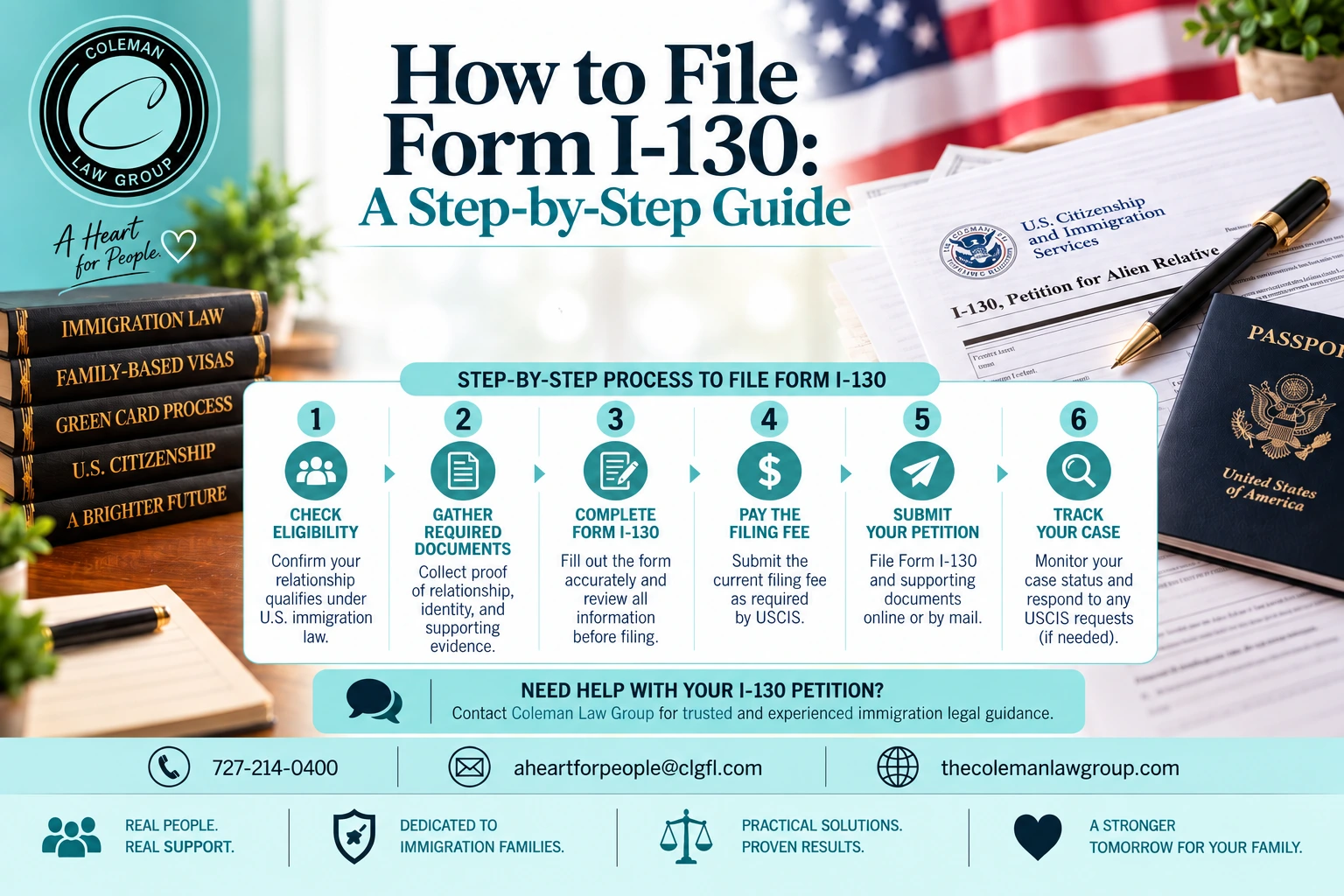
Step 1: Confirm You Are Eligible to File Form I-130
The petitioner must be a U.S. citizen or a lawful permanent resident. Your relative’s relationship must match your immigration status to meet the eligibility requirements.
If you are a U.S. citizen
You can sponsor:
- Spouse
- Unmarried children under the age of 21 years
- Parents
- Adult Son and Daughter (21 years or older)
- Brothers or Sisters
If you are a lawful permanent resident:
You can sponsor:
- Husband or wife
- Unmarried children
Green card holders cannot sponsor parents or married children.
Step 2: Determine Which Relative You Are Sponsoring
Not all family members qualify for a family green card. Immediate relatives face fewer restrictions because there is no yearly cap on visas for this category. Immediate relatives include parents and unmarried children under 21. Other family-based preference categories include unmarried and married children, and siblings of U.S. citizens.
The category type will influence the number of immigrant visas offered and the waiting periods.
Step 3: Gather Your I-130 Documents
The I-130 preparation process will involve collecting the necessary paperwork. You will need to gather all the documents that should have:
- A filled and signed Form I-130.
- Documentation that proves U.S. Citizenship / Residency of the petitioner.
- Evidence of a qualifying family relationship.
- Photographs of passport size (if applicable).
- Payment receipt of filing fee.
Step 4: Complete Form I-130
Make sure to complete all the crucial steps in the form before filing the petition. Enter details of the petitioner and the beneficiary.
Make sure to meet the criteria below for the form to be considered fully completed:
- Every mandatory field should be filled out.
- The form should be signed by the petitioner, either in person or digitally.
- The fee should be paid
- All required primary evidence is attached.
- The form should also be completed and signed.
Incomplete information can create unnecessary issues with the I-130 application process.
Step 5: Determine Where to File Form I-130
It depends on how you intend to file Form I-130.
When filing the petition on your own, the easiest way to do so is through my.uscis.gov. If you prefer to mail paper forms, you must send your package to a specific USCIS Lockbox address.
This address is determined depending on your state, the mail service provider that you use, and whether you are sending Form I-130 alone or in combination with Form I-485 (green card). To get the exact address, always check uscis.gov/i-130.
Step 6: Pay the I-130 Filing Fee
This is the one-time fee for the petition only. It does not cover the full immigration process. It is cheaper and easier to apply online than by mail. Paper applications take longer to process and cost more. You must include the payment approval receipt with your application package.
Benefits of online filing:
- Immediate receipt confirmation
- Electronic document submission
- Lower cost
Prices for both methods are listed below:
| Filing Method | Fee |
| Online Filing | $625 |
| Paper Filing | $675 |
Step 7: Submit the I-130 Petition
Follow the instructions provided by USCIS while submitting the form electronically. Always print a copy of your petition and all supporting documents. When mailing, make sure to include all supporting documentation with your electronic mail to the appropriate USCIS filing address. Always make copies of any email correspondence that you make.
Before filing Form I-130, review it thoroughly to avoid any mistakes, such as the omission of a signature or incorrect calculation of fees, or any other filing errors that may render your filing ineligible to be processed.
Step 8: Receive Your USCIS Receipt Notice
Once USCIS accepts and receives your Petition for processing, you will be sent a receipt notice. The receipt notice will contain a receipt number. This number is vital because it will enable you to track your case and contact USCIS. The receipt number is the unique tracking number assigned to all applications and petitions. Keep the receipt handy if you ever need to follow up on your case online.
Step 9: Respond to an RFE if USCIS Requests More Evidence
There will be times when the information given by the petitioner may not be sufficient to make a decision. So if they are asking for evidence, it means USCIS is requesting additional information to take further action. Review the request and find out which documents the officer needs from you. Try to get back to them within the time frame you have been given.
Do not include any other random documents in your packet. Place the original RFE notice above all the documents in your packet.
Step 10: What Happens After I-130 Approval?
After approval, there are two situations. Each situation may vary depending on different conditions:
- The beneficiary is in the United States
- The beneficiary is outside the U.S.
The adjustment of status process will be used if the beneficiary is already in the U.S. Include your medical exam and financial paperwork with Form I-485. Attend the biometrics appointment and local interview. The beneficiary will receive their green card by mail after approval.
The I-130 will be sent to the National Visa Center if the beneficiary is not in the United States. The beneficiary must then complete their visa application and send all relevant paperwork to the NVC. The visa interview could be in a U.S. Embassy or consulate.
Coleman Law Group Can Help You
There are several steps in the I-130 petition process. You will need to meet the requirements and submit the petition as outlined by USCIS. Our experienced immigration attorney at Coleman Law Group will guide you through the I-130 filing process and minimize the risk of major mistakes.
Coleman Law Group will inform you of your options and assist you with filing your Form I-130. Call Coleman Law Group at +1 (7272140400) or send an email to aheartforpeople@clgfl.com to learn how we can help with your family’s immigration case.