

Family law issues in Florida often involve complicated disputes over children when the parents cannot agree on a parenting plan, time-sharing, communication, or other matters regarding their child, and these disputes are taken to court. The courts appoint a guardian ad litem or a parenting coordinator for such issues.
A Guardian ad litem & Parenting Coordinator are not judges. Their authority comes from the state of Florida through laws and court orders.
Understanding the difference between these two roles can help parents determine whether either official will represent their case if one is appointed in a custody case in Florida.
What is a Guardian ad Litem?
A Guardian ad Litem, or GAL, is appointed by the court to serve as an advisor for the family law matters and protect the best interests of the child. Guardian Ad Litem, an official person for making recommendations to the court regarding custody issues and decisions concerning the child’s safety, welfare, or living conditions.
A GAL is usually appointed in contentious divorces or custody matters where the court is concerned that the child may be exposed to or involved in dangerous or harmful activities. A GAL has the power to investigate the case by interviewing parents, teachers, counselors, and doctors, and, under certain circumstances, the child.
The GAL can make recommendations to the court in a written report on the issue before the court. The recommendations are not to be considered binding or absolute. These suggestions are given with the understanding that the judge may take them under advisement. A GAL has no authority over dispute resolution but has advisory powers.
What is a parenting coordinator in Florida Family Court?
Parenting coordination is a process that helps parents identify conflicts between them and consider ways to parent more effectively. A parent coordinator is an impartial mental health professional or a legal professional with mediation experience. The Parent coordinator educates parents about their children’s needs and how to meet them.
According to Florida Statute §61.125, parenting coordination is a child-focused dispute-resolution process that may be ordered by the court or agreed to by the parents.
Parenting coordination addresses practical disputes that may arise in connection with a parenting plan, including:
- Difficulty in communicating about the welfare of their children
- Cannot agree on substantive issues concerning their children
- Have complex child-related issues that may require intense case management.
The parenting coordinator has very limited decision-making authority.
When Can a Florida Court Appoint a Guardian ad Litem?
Florida Statute §61.401 allows a court to appoint a guardian ad litem in certain family law proceedings to protect and safeguard the best interests of the child.
The statute applies to actions involving the dissolution of marriage and the creation or modification of a parenting plan. A guardian ad litem may act as the child’s best friend or an evaluator.
The court may also appoint separate legal counsel for a child when appropriate. Florida law makes clear that the guardian ad litem and the child’s legal counsel cannot be the same person.
When Can a Parenting Coordinator Be Appointed/Hired?
Parents can engage or hire a parenting coordinator under section §61.125 if they already have a written agreement, such as a Parenting Plan.
A parenting coordinator generally assists the family every month. Each family has its own unique circumstances, so it might be appropriate for a family to attend a meeting with a coordinator more frequently at the beginning.
A parenting coordinator will conduct separate intake sessions with both parents to assess suitability. If the Parenting Coordinator is satisfied that the matter is suitable, both parents will enter into a Parenting Coordination Agreement, and joint sessions will commence. A parenting coordinator can review any documentation required, such as:
- Parenting Plan or Court Order
- Family Report
- Communications between the parents
- Any other documents relevant to the family’s circumstances and the dispute.
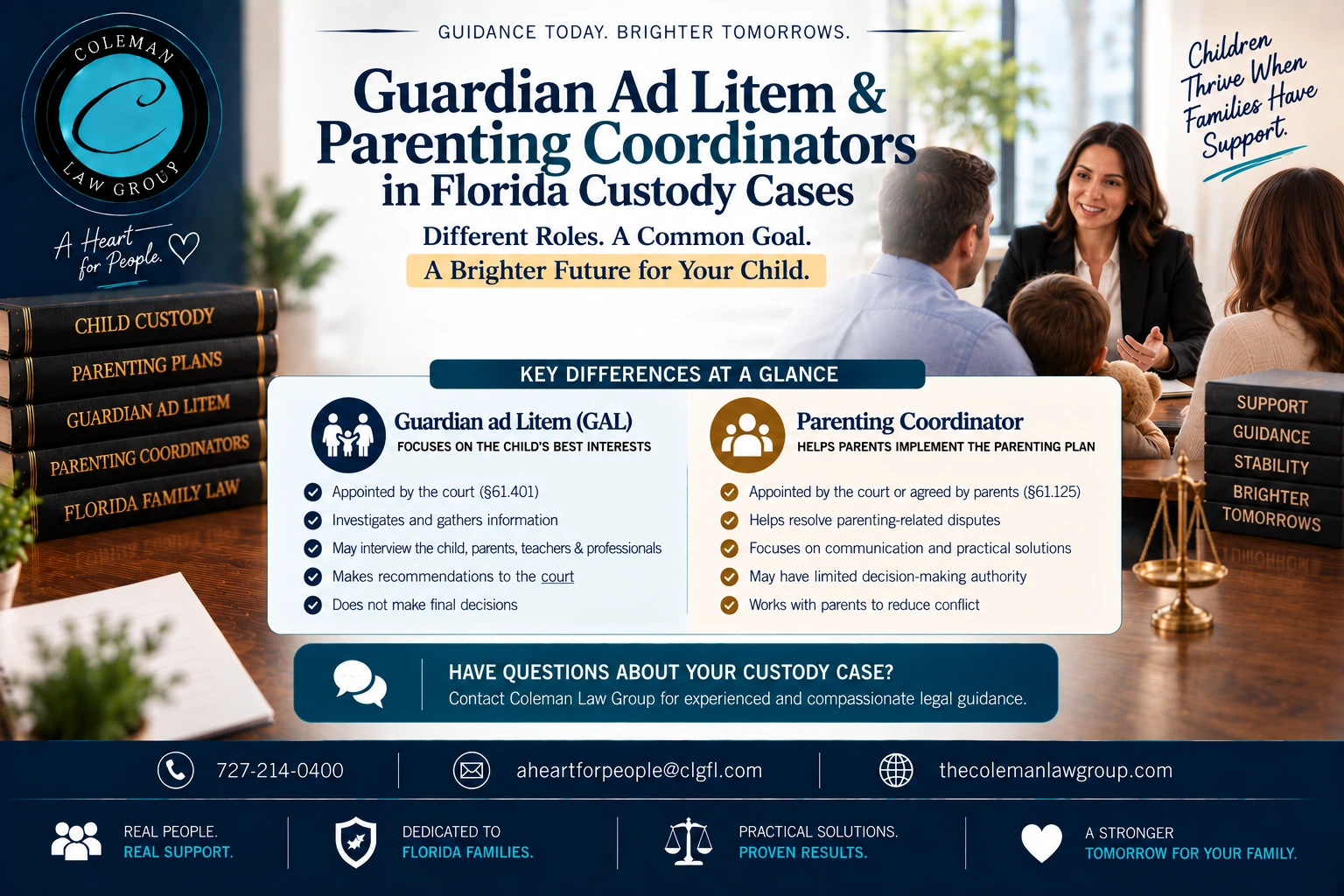
Guardian ad Litem & Parenting Coordinator – How they are different
Although both professionals deal with challenging custody cases and have different responsibilities towards their clients. A guardian ad litem looks into matters relating to the child and reports their findings and recommendations to the court regarding the best interest of the child.
On the other hand, a parenting coordinator is concerned with helping parents develop or adopt a parenting plan or negotiate parenting issues.
Here is how the difference can be summed up:
| Guardian ad Litem | Parenting Coordinator |
| Focuses on the child’s best interests | Focuses on implementing the parenting plan |
| Investigate issues affecting the child | Helps resolve parenting-related disputes |
| May interview the child and other people | Works with parents and other participants |
| May review relevant records with court authorization | Helps address practical parenting disputes |
| Can make recommendations to the court | May make recommendations within the statutory and court-ordered scope |
| Acts under the authority provided by §61.401 and §61.403 | Acts under §61.125 and the court’s referral order |
How Confidentiality Works in Parenting Coordination?
Florida law generally provides confidentiality for communications made during parenting coordination.
Section 61.125 states that communications between the parties and the parenting coordinator during parenting coordination sessions are confidential, unless statutory exceptions apply.
The law identifies circumstances in which information may be disclosed or used:
- Child abuse
- Neglect or abandonment
- Domestic violence
- Compliance with court orders
- Other matters specifically identified by statute
Parents must know their rights regarding confidentiality before seeking assistance.
When is the right time to Speak With a Child Custody and Visitation Attorney?
Parents may need to consult with a child custody and visitation attorney if the court appoints a guardian ad litem or parenting coordinator. An experienced attorney explains the entire process of what a GAL or coordinator can and cannot do for your specific case requirements.
Seeking legal counsel may also be in your best interest if your case involves:
- Allegations of domestic abuse
- Child abuse or neglect
- Disputes of parental responsibility
- Parents do not agree on a visitation schedule.
- Relocation issues
- Repeated violations of a parenting plan by your ex
- Disputes about the child’s education or medical care
Parents should also know that a guardian ad litem’s suggestions may be presented as evidence during the child custody hearing.
Why Legal Representation is Critical in High-Conflict Florida Custody Disputes?
Courts in Florida make their decisions based on the child’s best interests when it comes to parenting plans and time-sharing arrangements. There are several factors under Florida Statute §61.13 that the court considers while making any decision regarding the child:
- Each parent’s ability to encourage their child
- Allow the child to have a relationship with the other parent.
- The parents’ ability to fulfill the child’s needs
- Comply with the parenting plan.
- Protect the child from the harmful effects of the litigation.
Both parents should respect the court orders and seek legal remedies in the event of a dispute. A parent should not assume that disagreement with a guardian ad litem or parenting coordinator automatically entitles the parent to disregard an existing court order.
Contact a Florida Child Custody Lawyer
Guardian ad litem appointments and parenting coordination can have a major impact on the outcome of a Florida custody case. Their duties and authorities are different under Florida law.
Consult a child custody lawyer if you are dealing with a parenting coordinator or a dispute of substantial importance relating to parental responsibility. An experienced attorney can help you understand your rights and obligations.
Contact Coleman Law Group at +1 (7272140400) or send an email to aheartforpeople@clgfl.com to speak with a child custody and visitation attorney today.