

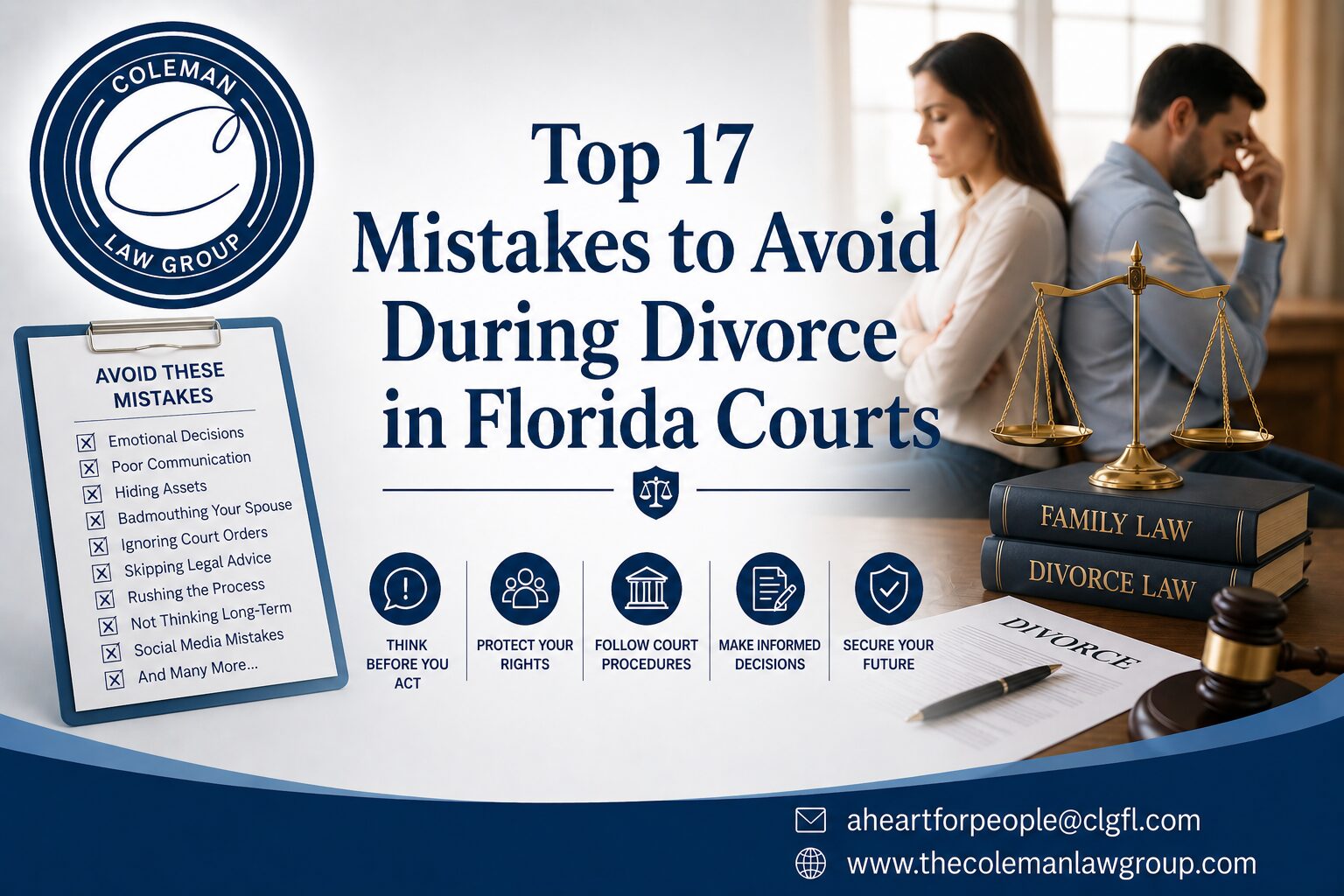
Deciding to end a marriage is not a simple choice, and the process that follows in Florida courts can be equally grueling. In Florida, “no-fault” doesn’t automatically mean “no consequences.” Even though you don’t have to prove your spouse did something wrong to end the marriage, how you carry yourself during the split is crucial. It’s easy to slip up and get judged for it — maybe you hide a bank account or fire off an angry text when you’re stressed, but those small choices? They can haunt you for a long time. Truly understanding the mistakes to avoid during divorce is less about paperwork and more about looking for your future self and your kids.
The reality is that Florida’s legal system is pretty unforgiving. Between tight deadlines and complex asset division, there isn’t much room for such mistakes. This is usually when the benefit of having an expert in your corner becomes all the more necessary. Often, knowing how a divorce lawyer helps avoid costly mistakes is what stands between a fresh start and a financial nightmare.
Mistakes to Avoid During Divorce in Florida
Phase 1: The Initial Legal Hurdles
1. Treating “No-Fault” as a License for Reckless Spending
Many people mistakenly believe that filing in a “no-fault” state means their personal conduct is irrelevant. What Florida judges will notice is “intentional dissipation of assets.” If you begin spending marital money on a new partner, high-end vacations, or revenge purchases, the court can—and likely will—deduct that total from your final share of the estate.
2. The 45-Day “Mandatory Disclosure” Trap
Under Florida Rule 12.285, both parties needed to exchange a massive amount of financial data within 45 days of the served petition. This includes tax returns, bank statements, and even crypto-wallet history. Failing to meet this deadline or “forgetting” to list a side-hustle income isn’t just a typo; it’s a red flag to the judge. Transparency early on is the only way to avoid the court looking at you with suspicion for the rest of the case.
3. Representing Yourself in a Contested Fight
It’s tempting to try to dodge legal fees by going “Pro Se,” but showing up to a contested battle without a lawyer when your spouse has one is an uphill climb you don’t want to take. This is a classic example of legal mistakes to avoid in divorce. A lawyer isn’t just there to handle paperwork; they’re there to make sure you don’t accidentally sign away things you’re actually entitled to—like a share of a future pension or Right of First Refusal when it comes to your kids.
4. Filing in the Wrong Jurisdiction
Florida doesn’t budge on its residency rules. Either you or your spouse must have lived in the state for at least six months before you even think about filing. Beyond that, picking the wrong county can get your entire case tossed out on a technicality. If that happens, you’re stuck paying those filing fees all over again and restarting your disclosure timeline. It’s a massive waste of time and money that can be avoided.
Phase 2: Financial Survival and Asset Division
5. Emotional Attachment to the Marital Home
This is perhaps the most common financial mistake in divorce. You might have raised your kids in that house, but can you afford the mortgage, the soaring Florida insurance premiums, and the maintenance on a single income? If the house eats up more than 35% of your post-divorce budget, it isn’t an asset—it’s a liability. Often, selling and splitting equity is the only way to ensure both parties stay solvent in the long run.
6. Ignoring the “Tax Tail” on Assets
Not all dollars are created equally. A $100,000$ savings account is liquid cash. A $100,000 401(k) is a future tax bill waiting to happen. If you agree to an even split without accounting for the fact that you’ll pay 20% or more in taxes when you eventually withdraw that retirement money, you’ve actually taken a much smaller settlement. It’s about catching those small errors before they turn into huge financial headaches.
7. Missing the QDRO (Qualified Domestic Relations Order)
If you are part of your spouse’s retirement plan, a standard divorce decree is not enough to actually get the money. To actually get paid, you absolutely need a Qualified Domestic Relations Order. Without a QDRO, you’re essentially holding a winning lottery ticket that you can’t cash in. It’s a technical hurdle, but if you forget it, that portion of the retirement savings stays firmly out of your reach.
8. Rushing to Settle Due to “Divorce Fatigue.”
By month eight of a contested divorce, most people are exhausted. You might be tempted to sign a mediocre deal to make the emails stop. Don’t. Decisions made under extreme emotional fatigue are rarely sustainable. Take a week to breathe before signing anything that dictates your financial future for the next decade.
Phase 3: Parenting and Custody Slip-ups
9. Violating the 50/50 Time-Sharing Presumption
Following the 2023 law update, Florida judges now enter divorce cases assuming an equal time-sharing split is in the kids’ best interests. It is the new baseline for what is considered best for the children. If you try to restrict your spouse’s access or control the schedule without proof of real danger, the court will likely see you as the unfriendly parent. That label is hard to shake and can actually jeopardize your own standing when the judge makes a final custody decision.
10. Using Kids as Messengers
In the middle of a heated divorce, many parents start asking their kids, “What is Dad doing at his new house?” or “Tell Mom the child support is coming late.” This puts an impossible emotional burden on the child and can be cited by a court-appointed Guardian Ad Litem as evidence that you are not prioritizing the child’s mental health.
11. Relocating Without Court Permission
Florida has a very strict “Relocation Statute.” Relocating with your child isn’t something you can do on a whim in Florida. If you’re planning a move of more than 50 miles that lasts longer than 60 days, you absolutely need a signed agreement from your spouse or a judge’s approval first. Taking the “move now, ask later” approach is a huge mistake. The court can—and often will—order the immediate return of the child, and you might even find your custody rights stripped away on the spot for ignoring the rules.
12. The Social Media Slip-Up
Your Instagram story is a goldmine for your spouse’s attorney. If you claim you can’t afford child support but post photos of a new boat or a weekend in Key West, that evidence will be in front of a judge within days. Even “venting” about your ex online can be used to show you aren’t cooperating with the parenting plan. During a divorce, the best social media strategy is to stay silent.
Phase 4: Conduct and Credibility (The “Invisible” Evidence)
13. Forgetting to Update Estate Plans and Beneficiaries
Don’t fall for the trap of thinking a final judgment automatically cuts all ties. Even after your divorce is finalized, your ex-spouse can remain the beneficiary of your life insurance or 401(k) unless you manually swap them out. Failing to update these documents is one of those critical divorce legal mistakes to avoid because, legally, your old paperwork can often override your new divorce decree. It’s a nightmare scenario where your assets end up exactly where you didn’t want them to go.
14. Venting to Mutual Friends or Colleagues
In a contested divorce, there is no such thing as a “neutral” party. Information has a way of traveling. If you complain to a mutual friend about your spouse’s parenting or your “hidden” cash, don’t be surprised when those comments appear in a deposition. Keeping your circle small and limited to people who aren’t connected to your spouse is vital to protecting yourself during divorce.
15. Withholding Information from Your Own Attorney
Your lawyer cannot protect you from what they don’t know. Whether it’s a past arrest, a secret bank account, or an embarrassing text thread, tell your legal team. “Surprise” evidence introduced by the opposing counsel in the middle of a hearing is almost impossible to manage. If your lawyer knows the truth up front, they can build a strategy to mitigate the damage.
Phase 5: The Financial Long Game
16. Underestimating Post-Divorce Living Expenses
When filling out your Financial Affidavit, many people guestimate their monthly costs. This is a massive financial mistake in divorce. In the Bicol region’s current economy—or anywhere in Florida—inflation and rising insurance costs are real factors. If you underestimate your utility bills or your child’s extracurricular fees now, you may find that the alimony or child support you agreed to doesn’t actually cover your life. Use real bank statements to track every cent before you sign.
17. Thinking “Equitable” Always Means an Equal Split
People often fall for the myth that Florida judges are forced to cut everything exactly in half. That’s not the case. Florida follows “equitable distribution,” and “fair” doesn’t always look like 50/50. If one spouse wasted marital cash or helped pay for the other’s degree, the court can shift the scales. Spotting these nuances is precisely how a divorce lawyer helps avoid costly mistakes—they make sure you aren’t settling for a “fair” half when you actually deserve more based on the facts.
Making Sense of the Florida Court System in 2026
Even if you manage to sidestep the seventeen mistakes we’ve covered, it’s helpful to understand the broader landscape of Florida family law right now. We are seeing a major push toward efficiency in the courts this year. Judges aren’t as patient with delays as they used to be. There is a massive push right now to move families through the system efficiently, largely because of new rules designed to enforce time-sharing schedules without the old-school wait times. If a parent starts flouting the schedule, don’t expect the old months-long wait for a court date. Judges are moving much faster now, often jumping in within just a few weeks to keep things on track. It’s a much tighter ship, making compliance an absolute must.
It’s also important to remember that, while the law aims for a 50/50 split of assets, Florida remains an equitable distribution state. This year, with the cost of living and insurance premiums in Florida hitting record highs, judges are paying closer attention to the actual math of survival after a divorce. A split that looks fair on a calculator might not be fair in real life if one person is left without a realistic way to pay for a home. Professional guidance is often the only way to make sure the “fairness” the law promises actually shows up in your final paperwork.
How We Can Support You at The Coleman Law Group
A contested divorce often feels like chaos. Between the emotional weight and the endless legal hoops you’re expected to jump through, feeling burnt out is pretty much a given. At the Coleman Law Group, we don’t believe you should be stuck navigating a pile of court forms on your own. We see the real person behind the file, and our priority is providing the steady, grounded support you need to get your life back on track.
Our team handles Florida family law with a focus on your actual life. Winning, in our view, is about more than just getting a judge to sign a piece of paper. It’s about making sure your money, your self-respect, and your relationship with your kids come out on the other side intact. We actually sit down, listen to what’s keeping you up at night, and explain your options without all the confusing legal jargon. This kind of hands-on, specific focus is how a divorce lawyer helps avoid costly mistakes—we spot the small, messy details that those “fill-in-the-blank” internet forms or DIY kits often miss. Our goal is to be the calm; capable voice you can actually rely on.
You’ve already researched what traps to avoid. Now, let us take over the legal side of things. If you want a legal team that invested in your future, give us a call at (727) 214-0400 or email aheartforpeople@clgfl.com. You don’t have to do this alone—let’s start working toward your new beginning today.