


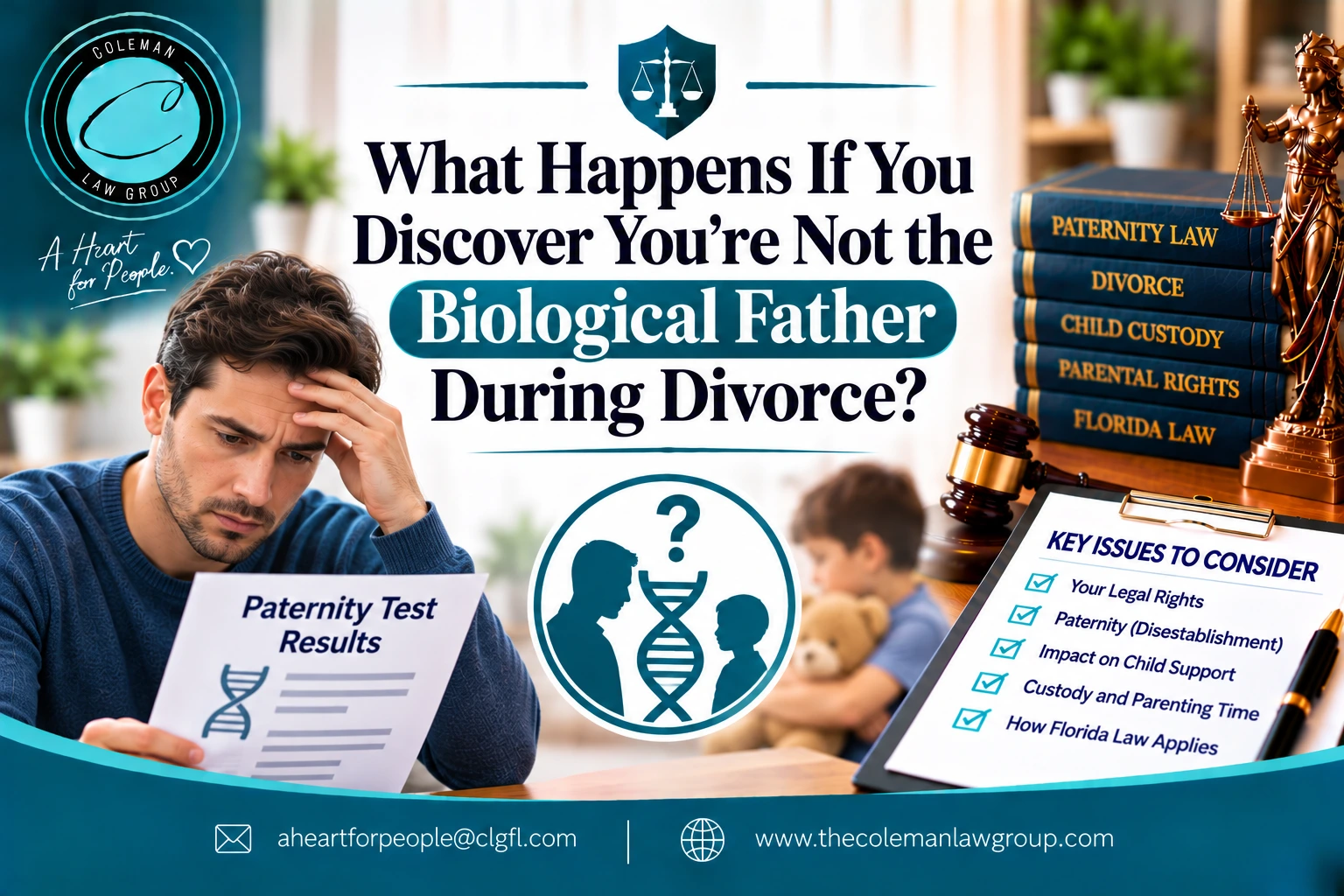
Discovering that a child you have loved and cared for might not be biologically yours is heartbreaking. When this realization hits in the middle of a divorce, it turns an already stressful situation on its head.
Suddenly, you are not just dealing with dividing assets or moving into a new place. You are asking scary questions: Will I still have to pay child support? Do I lose my right to see my child? How does the court handle the biological father concept?
At Coleman Law Group, we help people navigate these painful, complicated situations every day. We are here to guide you if you are dealing with issues around paternity or divorce. Here is a simple breakdown of what happens under the law and what steps you need to take next.
Understanding the “Presumed Father” Rule
Before you learn how courts handle this, it helps to understand the basic family law rule. This law is based on the marital presumption of paternity.
This law states that if a child is born while you are legally married, the law automatically assumes you are the biological father. In a divorce, you are considered the presumed father.
What does being a presumed father mean for you?
- Your name goes on the birth certificate: You are legally recognized as the dad from day one.
- You have full legal rights: You have the same rights to custody and visitation as the mother.
- You have legal obligations: You are financially responsible for providing for the child.
This rule was created to protect children and make sure they always have two legal parents looking out for them. But when you discover during a divorce that the child isn’t biologically yours, this rule can make untangling your legal rights complicated. The court won’t automatically remove your name from the birth certificate based on a rumor or a hunch; you must follow a specific legal process.
Getting a DNA Test During Divorce
If you suspect you aren’t the biological father, you can’t just tell the judge or bring in an over-the-counter home testing kit. Family courts require official, verified proof.
How a Court-Ordered DNA Test Works
To get proof that a judge will accept, your lawyer will file a request for an official DNA test during the divorce.
- The Request: Your attorney asks the family court judge to order genetic testing for you, the mother, and the child.
- The Swab: A professional collects painless cheek swabs from everyone involved.
- Chain of Custody: Unlike store-bought test kits where samples could theoretically be swapped, court-ordered tests follow strict rules to ensure the samples are authentic and haven’t been tampered with.
- The Results: An accredited lab returns results with over 99% accuracy, indicating whether you are the biological parent.
What if the mother refuses the DNA test?
If the mother refuses to take the child for testing, she is disobeying a court order. Judges can penalize a parent for refusing, fine them, or rule in your favor regarding the paternity challenge.
Common Issues During a Paternity Divorce
Once the DNA results come back confirming you are not the biological father, several major legal issues need to be resolved. How the court handles these depends on your goals, state laws, and how long you’ve acted as the child’s parent.
Issue 1 – Removing Legal Parentage (Disestablishing Paternity)
Proving genetics is step one. Step two is getting the judge to officially sign an order removing your legal status as the father.
Courts look at a few main factors before agreeing to remove legal parentage:
- Time limits (Statute of Limitations): Almost every state sets strict deadlines on how long you have to challenge paternity. This clock usually starts when the child is born or when you reasonably could have discovered you weren’t the biological father. If you wait too long after finding out, you might lose your right to challenge it.
- How long you have known: If you knew years ago that you weren’t the biological father but kept acting as the legal dad anyway, a judge might decide it’s in the child’s best interest to keep you legally responsible.
Issue 2 – What Happens to Child Support?
Child support is often the biggest financial worry in a paternity divorce.
- Future Support: If the court grants your request to remove legal paternity before the divorce is final, you will generally be relieved of any future child support payments.
- Past Support Paid: Getting back money you have already paid in child support is very difficult. Courts usually treat that money as having been used to feed and house the child. Getting a refund is rare unless you can prove the mother committed outright fraud.
Issue 3 – What Happens to Custody and Visitation?
Biology is one part of what makes you a father. If you have raised a child, you may want to keep seeing them, or you may still want them in your life after separating from your partner.
- If you want to stay in the child’s life: Just because you aren’t biologically related doesn’t mean you have to abandon the child you raised. Many states allow non-biological fathers to request custody or visitation rights as a “psychological parent” if it’s clear that cutting ties would hurt the child.
- If you want to end all legal ties: If your goal is to separate yourself legally and financially completely, and the judge approves the disestablishment of paternity, your legal rights to see or make decisions for the child will end.
Issue 4 – Bringing in the Real Biological Father
After a judge removes you as the legal father, the child has only one legal parent. The mother or the court will take steps to locate the real biological father so he can be held legally and financially responsible for child support.
What You Should Do Immediately
If you are going through a divorce and suspect you might not be the biological father, taking quick action is critical.
- Talk to a Family Lawyer Right Away:
Because state time limits are so strict, delaying action by even a few weeks can permanently lock you into financial responsibility for a child that isn’t yours. - Don’t Sign Any Legal Agreements:
Do not sign divorce papers or voluntary acknowledgments of paternity until you have official DNA results and legal advice. - Get Official Testing:
Work through your attorney to file a court motion for an admissible DNA test. - Save Your Records:
Keep texts or emails where you discussed paternity or doubts about fatherhood. - Prioritize your child’s safety:
Remember that your child didn’t ask for the stressful situation. Try to keep adult conflict away from your child.
How Coleman Law Group Can Help
When it comes to paternity issues during a divorce, it is incredibly emotional and complicated. Do not carry it on your own.
At Coleman Law Group, we provide straightforward, compassionate legal advice to help safeguard your rights and your family’s future. If you need to file for a court-ordered DNA test or you want to file to terminate a father’s legal paternity, we are here to support you.
Contact Coleman Law Group today at 727-214-0400 or email aheartforpeople@clgfl.com to discuss your situation confidentially with an experienced family law attorney who can explain your options and what to do next.