

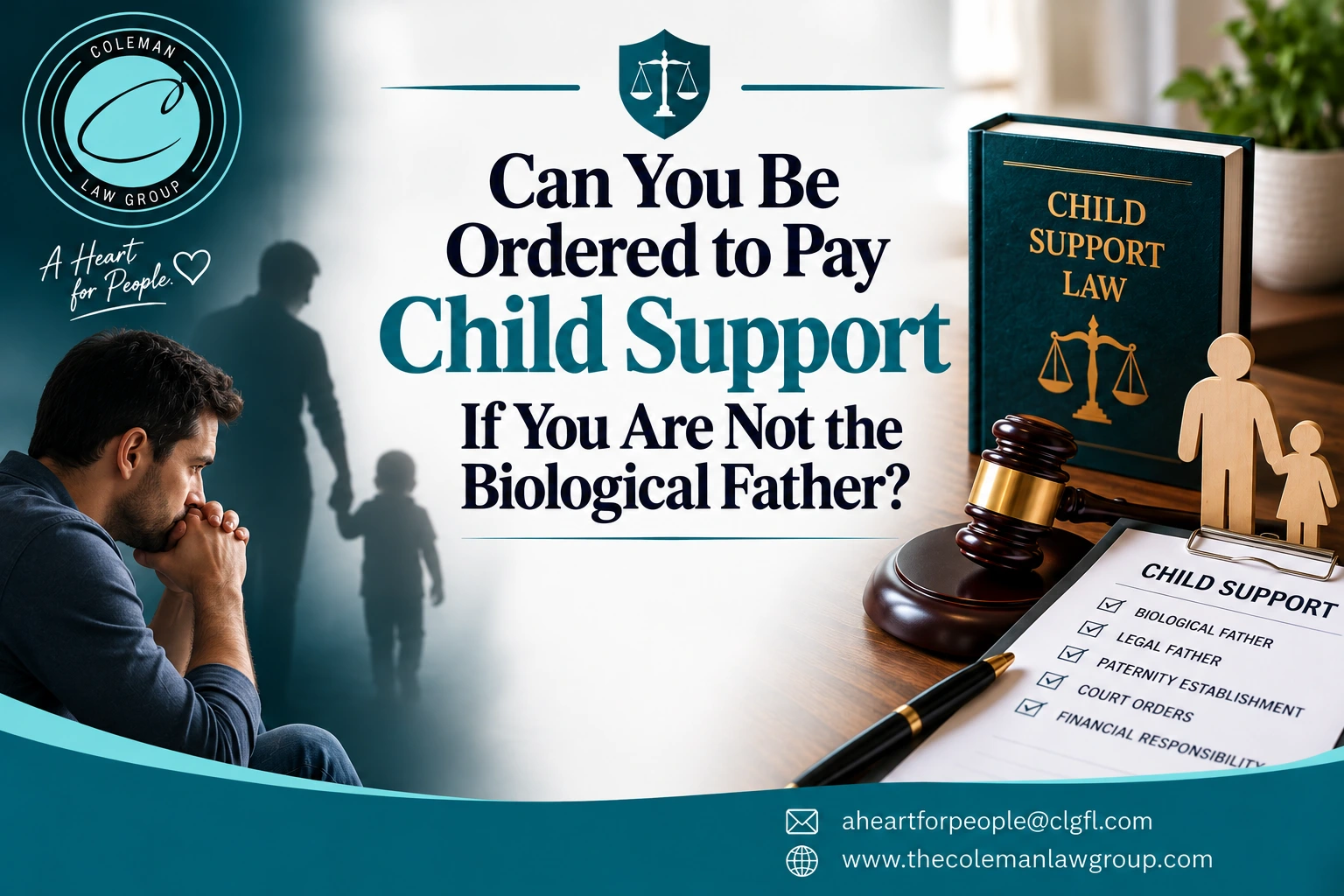
A man walks into our St. Petersburg office with a manila folder. Inside is a DNA test showing a 0.00% probability of paternity. He has carried it in his glove box for eleven months.
In that same folder is a Florida Department of Revenue income withholding order. The state has been taking $612 out of his paycheck every two weeks for a child who is not his. He assumed the DNA test would end it. It did not.
This is the part of Florida paternity law that surprises people most: a court can order you to pay child support for a child you did not father. Biology creates a relationship. It does not automatically erase a legal one. If you are searching for answers about child support when you are not the biological father, what matters is not what a lab report says. It is what the court file says.
There are two kinds of fatherhood, and only one of them is linked closely with DNA
Florida separates these concepts cleanly. Most men who call us have never heard the distinction explained.
| Biological father | Legal father | |
| What it means | Genetic contributor | The law recognizes as the child’s parent |
| How it is created | Conception | Marriage presumption, signed acknowledgment, court order, or DOR administrative order |
| Who enforces it | No one directly | The court, the Department of Revenue, and the child’s mother |
| Financial duty | None, standing alone | Full child support obligation |
| How to undo it | Irrelevant to the court | Formal petition under Fla. Stat. § 742.18 |
Read that last row twice. A negative test is evidence. It is not a legal remedy.
Five ways a man/father ends up legally obligated
The route into a support order matters because it determines the route out:
- The marriage presumption. A child born during a marriage is presumed to be a child of that marriage. In Simmonds v. Perkins, 247 So. 3d 397 (Fla. 2018), the Florida Supreme Court confirmed the presumption is rebuttable, but it is still the starting point. Your wife’s child is legally yours until a judge says otherwise, even if another man is the father.
- A signed voluntary acknowledgment. Hospitals hand these forms out within hours of birth. Under Fla. Stat. § 742.10, a signed acknowledgment is a legal finding of paternity. You have 60 days to rescind it. After that, you must prove fraud, duress, or overreaching. Signing one without a test is one of the most expensive five seconds of a man’s life.
- A divorce judgment. Courts routinely enter support orders in divorce cases without ever addressing paternity. That order stands on its own.
- An administrative order from the Department of Revenue. Under Fla. Stat. § 409.256, the DOR can establish paternity and support administratively. Miss the response deadline, and it becomes enforceable without a courtroom.
- A default. You were served, you thought it was a mistake, you did nothing. The court entered an order anyway.
What the statute actually requires you to prove
Fla. Stat. § 742.18 is the disestablishment statute. It is narrow, and it is unforgiving. If you file a petition that is missing any of the three attachments below, it gets dismissed. The support order keeps running while you refile.
Filing requirements:
|
Requirement |
Detail |
Common failure |
| Newly discovered evidence | Affidavit describing what you learned and when | Claiming you “always suspected it” |
| Scientific testing | Test administered within 90 days before filing | Using a drugstore kit from last year |
| Support compliance | Affidavit that you are current or substantially compliant, and any arrearage was not willful | Being $4,000 behind with no explanation |
Findings the judge must make:
|
The court must find |
The court must also find |
| Test was properly conducted | You did not adopt the child |
| You are not the biological father | Child was not conceived by artificial insemination during your marriage |
| Child is under 18 | You did not block the real father from asserting his rights |
The trap nobody warns you about
Even if you satisfy every box above, the statute contains a gate that closes the courthouse door.
The court shall not set aside paternity if you married the mother knowing you were not the father, or if you kept holding yourself out as the child’s dad after you found out.
We call it the “you knew” problem. Judges are not indifferent to it. Neither is the case law. Florida courts have long applied a paternity-by-estoppel doctrine, going back to Department of Health & Rehabilitative Services v. Privette, 617 So. 2d 305 (Fla. 1993), and Wade v. Wade, 536 So. 2d 1158 (Fla. 1st DCA 1988). The reasoning is not really about the father. It is about the child, who did nothing wrong and still needs to eat.
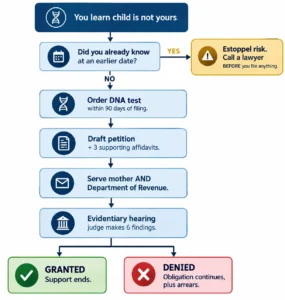
Here is the practical reality, laid out in sequence:
Mistakes that cost you as a father:
- Ignoring the DOR letter. An administrative paternity order is not a suggestion. It has deadlines. Miss them and you have waived arguments you will never get back.
- Shaking hands with the mother. She may genuinely agree you are not the father. That agreement binds neither the court nor the Department of Revenue. Child support belongs to the child. Parents cannot contract it away.
- Filing your own petition. We see this constantly. The petition is procedurally defective, it gets dismissed with prejudice, and the man has now spent his one clean shot.
- Waiting for the “right time.” There is no right time. There is only the 90-day testing window, and it does not wait.
Why this is not a do-it-yourself case
Family court is not a search for the truth. It is a procedural contest. You can be factually correct and legally defeated in the same afternoon.
A child support lawyer who handles paternity matters knows the difference between the DOR track and the circuit court track. They know how to get test results that survive an evidentiary challenge. They know how to handle an arrearage that could otherwise sink your compliance affidavit. And when estoppel is in play, they know how to frame your conduct so a judge sees a man who acted in good faith, not a man trying to escape.
You are also not facing this alone on the other side. The Department of Revenue has staff attorneys. The mother may have counsel. Walk in unrepresented and you are the only person in the room without a professional.
How does The Coleman Law Group handle a disestablishment of paternity case?
When you bring a disestablishment-of-paternity case to us, we don’t hand you a checklist and wish you luck. We carry the file from the first phone call to the final order, and the work generally moves through these stages:
- We gather the facts and build the file. Every order, every notice, every DNA result gets pulled together before we file a single page — because a § 742.18 petition lives or dies on its paperwork.
- We account for every order with your name on it. In Title IV-D cases, the Florida Department of Revenue (DOR) is the agency issuing and enforcing those support orders, so we confirm exactly what you’re bound by and who must be served.
- We confirm the correct statute applies. Section 742.18 does not fit every situation — it’s reserved for a man who was adjudicated or acknowledged as the father and is later shown not to be the biological parent. Proceed under the wrong theory and you can lose months.
- We draft and file the petition. That includes the sworn affidavits the statute requires: newly discovered evidence, the results of scientific testing, and proof that you’re current on your support obligation.
- We serve the proper parties and argue your case. The petition must be served on the mother or the child’s legal guardian or custodian (and on the DOR in IV-D cases). At the hearing, we establish the seven findings the court is required to make under § 742.18(2) before it will grant relief.
And because paternity rarely stands on its own, we handle the related pieces too — time-sharing, parental responsibility, and support recalculations under Fla. Stat. § 61.30 — all under one coordinated strategy, so nothing slips through the gaps between separate offices.
Paying support for a child who isn’t biologically yours is not a life sentence. It’s a legal problem with a legal answer. But that answer runs on deadlines, and the clock started ticking the day you were served.
Call the Coleman Law Group at +1 727-214-0400. We’ll review your orders, tell you honestly whether § 742.18 relief is realistic in your case, and walk you through what comes next. You can also reach us through our contact page