

Every shred of safety shatters instantly when home becomes unsafe, throwing you into total limbo. Domestic abuse wears a person down. We understand that you are making hard family decisions, filling out court forms, and worrying about what happens next, and you are doing all of it while trying to keep yourself safe. The first step back to safety is knowing what the law allows and setting limits the other person cannot cross. In Florida, a protection order sets those limits in writing, and a respondent who violates them can be arrested.
You may need protection today, or you may be gathering evidence for a judge to be presented during a court hearing. In either case, it helps to know how a Florida domestic violence injunction, often called a restraining order, actually works.
How Does a Protective Injunction Work in Florida?
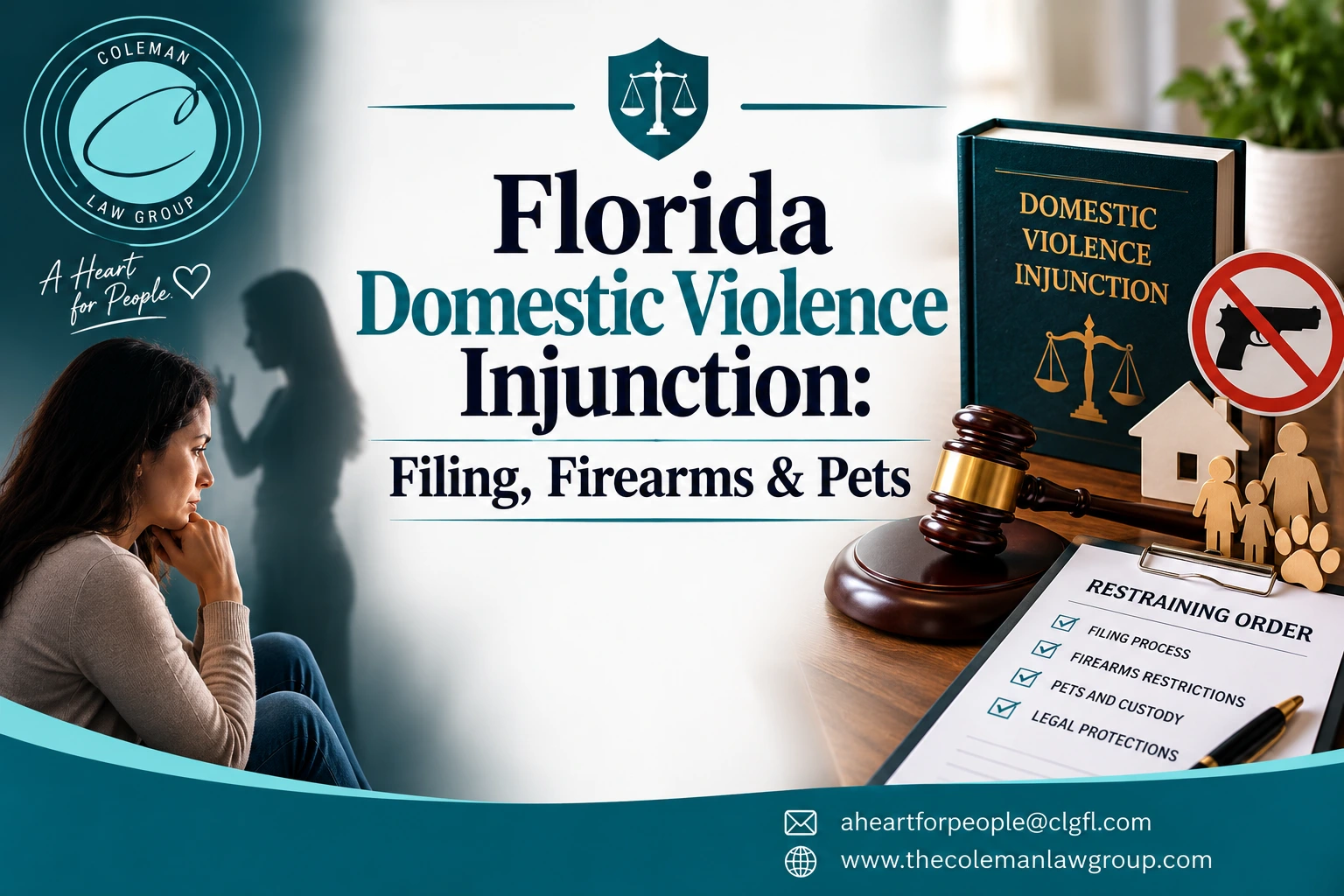
A civil injunction for protection is a court order that tells the abuser to stay away from your home, your workplace, and your children’s school. As per Florida law, a judge can go further and pass the order as follows:
1) The respondent might need to surrender any firearms.
2) Give you an exclusive right to use the home you share,
3) Set temporary custody and time-sharing for the children, and protect the family pets.
Keeping your life stable during legal disputes is essential. Working with a qualified family law attorney near me ensures that all legal requirements are met, so your entire family stays protected.
What is a Fla. Stat. § 741.30 Protection Order?
In Florida, personal protection is defined by specific guidelines. A Fla. Stat. § 741.30 protection order specifically protects people from domestic violence committed by family or household members.
The definition of domestic violence is outlined in a companion section, Fla. Stat. § 741.28. It covers assault, battery, sexual assault, sexual battery, stalking, kidnapping, and false imprisonment, along with the aggravated forms of assault, battery, and stalking. It also covers any other criminal offense that causes physical injury or death. What makes it domestic violence is that one family or household member commits the offense against another.
Defining Family and Household Members
Florida strictly defines who can file for a domestic violence injunction compared to other protective orders. Under the statute, family or household members include:
- Current spouses and former spouses
- Persons related by blood, adoption, or marriage
- People who currently live together as a family or who have lived together in the past in a single dwelling unit
Parents who share a child in common, regardless of marital status or cohabitation history
Unless you share a child, the law requires that you and the respondent have lived together in the same home at some point. If you haven’t lived together, you may still qualify under dating or repeat violence injunctions.
How Do You File a Domestic Violence Injunction in Florida?
You file the petition with the clerk of the circuit court, and there is no filing fee. Florida gives you three choices of county:
a) where you live now, even if you are only staying there temporarily,
b) where the respondent lives,
c) where the violence took place.
The petition is a sworn statement, so take your time collecting all the required proof. Describe each incident or threat that makes you fear you are in imminent danger. Also, do mention when and where the respective incident happened. Attach whatever supports your statement, such as police reports, photographs, and text messages.
The Temporary Ex Parte Review Process
A judge reviews your petition right away without notifying the respondent first. If the judge sees an immediate danger, they will issue a Temporary Injunction for Protection.
This temporary order takes effect as soon as a sheriff’s deputy serves the respondent. It stays active for up to fifteen days until your full court hearing takes place.
The Full Evidentiary Hearing
The full hearing is set within fifteen days of the temporary order. Lawyers representing both parties will be there to testify, call witnesses, and present documents or photographs to the judge. The formal rules of evidence apply. An experienced restraining order lawyer in Tampa knows how to get your evidence admitted.
If the judge finds that you are a victim of domestic violence or that you are in imminent danger of becoming one, the court may enter a final judgment of injunction for protection. This final order remains in effect until the court modifies or dissolves it.
What Relief Can the Court Order?
The judge writes the order around what happened in your case, so the terms differ from one injunction to the next.
Under Fla. Stat. § 741.30, a final injunction can order the respondent to:
- Commit no further acts of domestic violence and stop any threats or harassment
- Move out of the home you share, and leave the other party (domestic violence sufferer) with exclusive use of it
- Keep a set distance, typically 500 feet, from your home, your workplace, your school, and other places you go regularly.
- Have no contact with you by phone, text, email, or social media, or through another person
- Hand over all firearms and ammunition to law enforcement
- Attend and complete a batterers’ intervention program
- Follow a temporary parenting plan and pay temporary support
Firearm Regulations and Pet Safety Protocols
To keep you safe from armed violence and intimidation, a Florida injunction can order the abuser to surrender their firearms. It also protects household pets by giving you sole care and keeping them away from the abuser.
Mandatory Firearm Surrender Rules
Under Fla. Stat. § 741.30(6)(g), a final injunction prohibits the respondent from owning or possessing firearms and ammunition. The judge will order them to surrender all weapons to the local sheriff’s office, usually within twenty-four hours.
Under federal law, anyone bound by a qualifying protective order commits a felony by owning or possessing firearms or ammunition. The state also automatically suspends any active concealed carry license the moment a final injunction goes into effect.
Failing to surrender weapons violates the order. The judge will require them to hand over all firearms and ammunition to the local sheriff’s office, typically within twenty-four hours.
Legal Protections for Household Pets
Pursuant to Fla. Stat. § 741.30(6)(a)(4), the court has the authority to award you full care and control of any family pets so the respondent cannot reach them.
In addition to custody, the court can legally bar the respondent from approaching the animal, making threats, or concealing it. This allows you to leave a dangerous home without leaving pets behind.
Consequences of Violating a Protective Order
Breaking the terms of a domestic violence injunction is a serious crime under Fla. Stat. § 741.31.
A violation occurs if the respondent willfully disobeys the order by:
- Refusing to leave your shared home
- Coming within five hundred feet of your residence, job, or school
- Committing any new act of abuse or harassment
- Contacting you directly or through third parties
- Failing to surrender weapons as required
- Damaging your personal property
Initial noncompliance is classified as a first-degree misdemeanor, exposing the offender to a one-year jail term and a $1,000 monetary penalty. A repeat infraction elevates the charge to a third-degree felony, carrying a maximum sentence of five years imprisonment.
Why Should You Seek Legal Representation?
Standing before a judge alone puts you at a severe disadvantage, whether you initiated the protective order or you are the one forced to defend against it.
Support for Petitioners Seeking Protection
When your safety depends on a court filing, the petition has to be right the first time. A local family law attorney can go through it with you so that each incident is described accurately and nothing the court requires is left out. Your attorney can also gather the evidence, request the police reports, and prepare your witnesses. At the hearing, your attorney speaks for you, which matters most at the moments when it is too hard to speak for yourself.
Defense Strategies for Respondents
Being served with a restraining order is a shock, and the consequences start right away. A final injunction can take away your right to possess firearms, require you to complete a court-ordered intervention program, and force you out of your home. With that much at stake, you should not go to the hearing unprepared. A family law attorney in Tampa can protect your rights and make sure the judge hears your side of what happened.
Take Action for Your Safety
At the Coleman Law Group, we step in to help you handle the heavy court system, lock down essential protection, and push back against aggressive opposition. Knowing how a Florida domestic violence injunction works under Fla. Stat. § 741.30 gives you the power to act, and our team is ready to walk you through every phase. From emergency temporary filings to fighting for your long-term safety and your pets’ safety, we deliver sharp, practical advocacy tailored to your situation.
If you are dealing with an injunction or need someone in your corner for a hearing, reach out. Give us a call at 727-214-0400 or drop a line to aheartforpeople@clgfl.com