

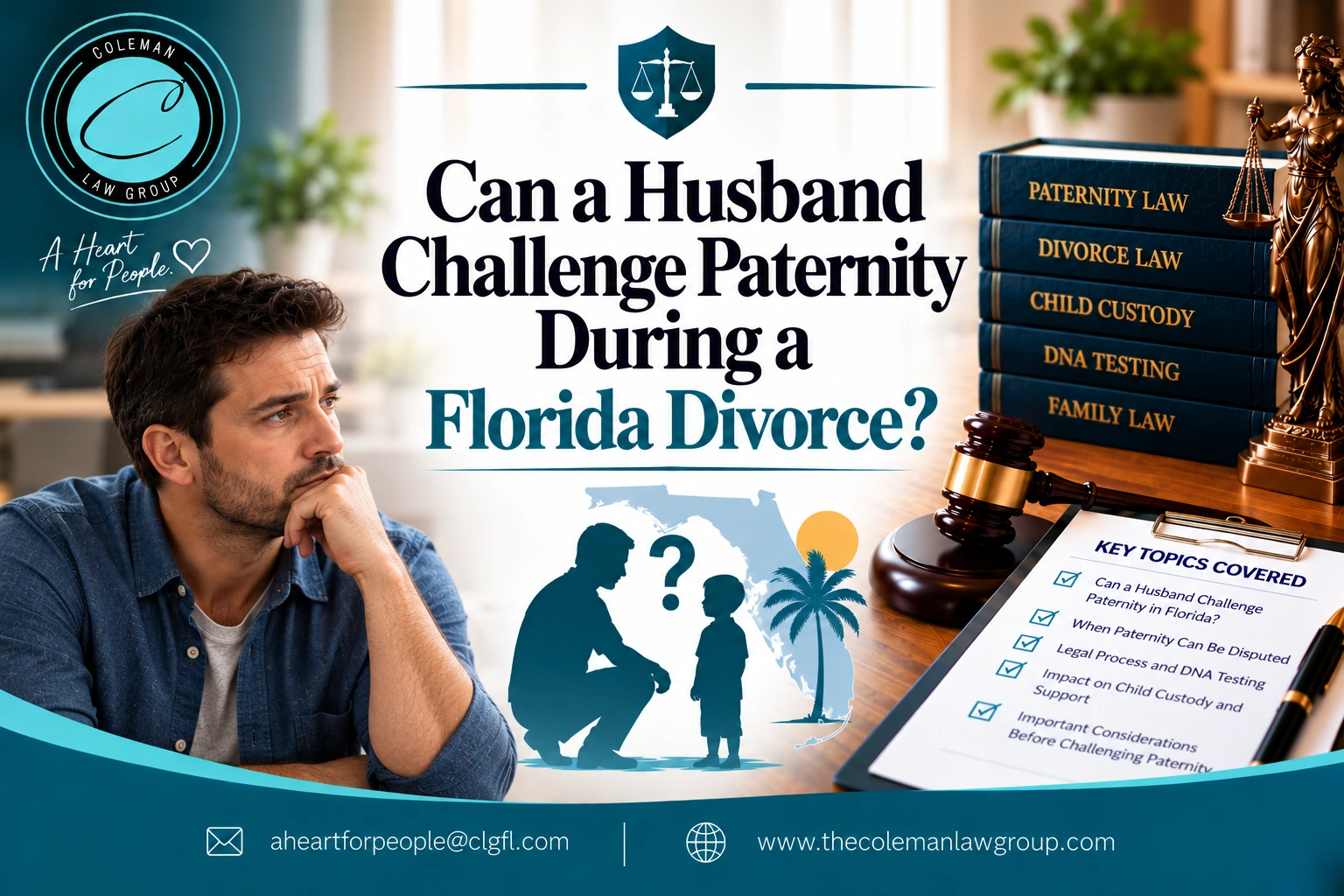
Divorce brings up many hard questions. One of the most painful issues is paternity. A husband may doubt whether he is the biological father of a child born during the marriage. He may wonder if he can challenge paternity during the divorce process.
At Coleman Law Group, we help clients navigate complex cases across Florida. You can challenge paternity, but strict legal rules may apply. Here is what you need to know before you sign any settlement agreement.
The Legal Presumption of Paternity in Florida
Florida law treats marriage uniquely when a child is born. Under state law, a legal presumption exists. If a child is born to a married woman, the law assumes her husband is the legal father. The court automatically views the legal husband as the legal father.
Legal Father vs. Biological Father
Florida law distinguishes between the two types of fatherhood:
Type I – Legal Father: The man recognized by law as the father. He has legal rights and legal duties.
Type II – Biological Father: The man who shares DNA with the child.
A legal father may not always be the biological father. However, the legal father is obligated to pay child support. He also has custody and visitation rights.
This rule exists to protect the child. Florida courts want every child to have legal parents.
Can Paternity Be Challenged During a Divorce?
During a divorce, a husband may contest the paternity of the child. The courts in Florida do not automatically terminate paternity. A husband has to file a paternity challenge early in the divorce process.
Florida Statute section 742.18 specifically sets forth the procedures and criteria for disestablishment. There are specific steps that must be taken to successfully challenge paternity.
The first step is to obtain a DNA test. Reliable genetic testing from an accredited laboratory is required to support a claim. The report must prove 100% certainty that the petitioner is not the father.
The court does not hear a petition without this evidence. The best interests of the child and the need to preserve stability and existing family relationships are priorities in Florida. In addition, Florida law requires that the petitioner sign an agreement of affirmation acknowledging that they have discovered new evidence. The evidence must be supported by detailed documentation showing that they have made all child support payments or justifying any nonpayment.
When the Husband Can Challenge Paternity
A husband may challenge paternity when:
- He doubts he is the biological father.
- He has not formally adopted the child.
- He has not signed documents admitting paternity after learning the truth.
- He files a formal request with the court before the final divorce judgment is entered.
Why You Must Act Before Signing a Settlement?
Signing a marital settlement agreement is a major step. Challenging paternity can become extremely difficult after a judge signs your final divorce decree. It can also become impossible in many cases.
The Problem with Signing Too Soon
Many men sign settlement agreements to end the divorce quickly. They may think they can fix paternity issues later. This is a big mistake. Signing a divorce agreement with child support terms means you accept legal responsibility. Courts rarely overturn a signed settlement agreement.
The court will treat you as the legal father if you sign the agreement. You will have to pay child support even if a future DNA test proves you are not the biological father.
How to Challenge Paternity
The most common way to challenge paternity is through a scientific DNA test. A DNA test compares the genetic material of the child and the father.
Asking the Court for a DNA Test
You cannot force a mother or child to take a DNA test on your own. You must ask the court for an order. Your attorney files a motion for genetic testing during the divorce. The motion explains why you doubt paternity. If the judge approves the motion, the court orders a court-approved DNA test.
Why is a Home DNA Test Not Sufficient?
DNA Kits purchased from a normal store fail to meet court standards. A chain of custody is required for evidence in Florida courts. The legally admissible test is conducted in an accredited lab. Identities are checked, and staff members record every step. A Florida divorce will only be affected by an official facility DNA test.
What Happens After DNA Testing?
The test results will dictate the next legal proceedings in your divorce.
DNA test shows you are the biological father:
If the test is positive, you will still be considered the legal father. The divorce proceeds as usual.
The court will establish:
DNA test shows you are not the biological father:
If the test is negative, the court does not automatically drop your child support duties.
The judge must evaluate several factors:
- Did you know you were not the biological father earlier?
- Did you act as the child’s father anyway?
- Did you stop the real biological father from stepping forward?
Your legal duty to pay child support ends if the court disestablishes paternity. You also lose legal rights to custody and visitation.
What is the disestablishment of paternity?
A person can be a child’s legal father even when later genetic information says he is not the biological father. Florida law gives some people a way to ask the court to end that legal father status. That request is called disestablishment of paternity.
Florida Statutes section 742.18 governs the disestablishment of paternity. This law allows a man to file a petition to disestablish paternity if new evidence comes to light.
Potential Challenges and Obstacles
Disestablishing paternity is not without challenges. For the disestablishment of paternity in Florida to go forward, the court must find that.
- The legal father must not have adopted the child.
- The child cannot have been conceived by artificial insemination while the couple is married.
- The child was under 18 years old when the form for the disestablishment of paternity was filed.
But even if the disestablishment of paternity is filed properly, the court can deny it if the court finds that the father:
- Married the mother of the child and represented to others that he was the father of the child.
- Allowed himself to be named the biological father on the child’s birth certificate.
- Ignored a notice from the court asking him to submit to a genetic test.
- Made a sworn statement that he was the biological father.
- Signed a voluntary acknowledgment of paternity.
Keep your Legal Rights Safe Today!
The issues of paternity in a divorce can be complicated and emotional. One error on a settlement document can impact you for 18 years or longer.
Make sure you get a professional family law attorney to clear up any doubts before you sign any documents.
Make an appointment with Coleman Law Group’s family law attorney.
At Coleman Law Group, we do our best to preserve our clients’ rights. We explain the paternity case, motions for DNA testing, and settlement negotiations clearly and compassionately.
Don’t wait to find out what your paternity rights are going to be during your divorce petition. Call our divorce lawyer right away for a private and trusted discussion. Contact us at 727-214-0400 or aheartforpeople@clgfl.com to start making plans for your future.