

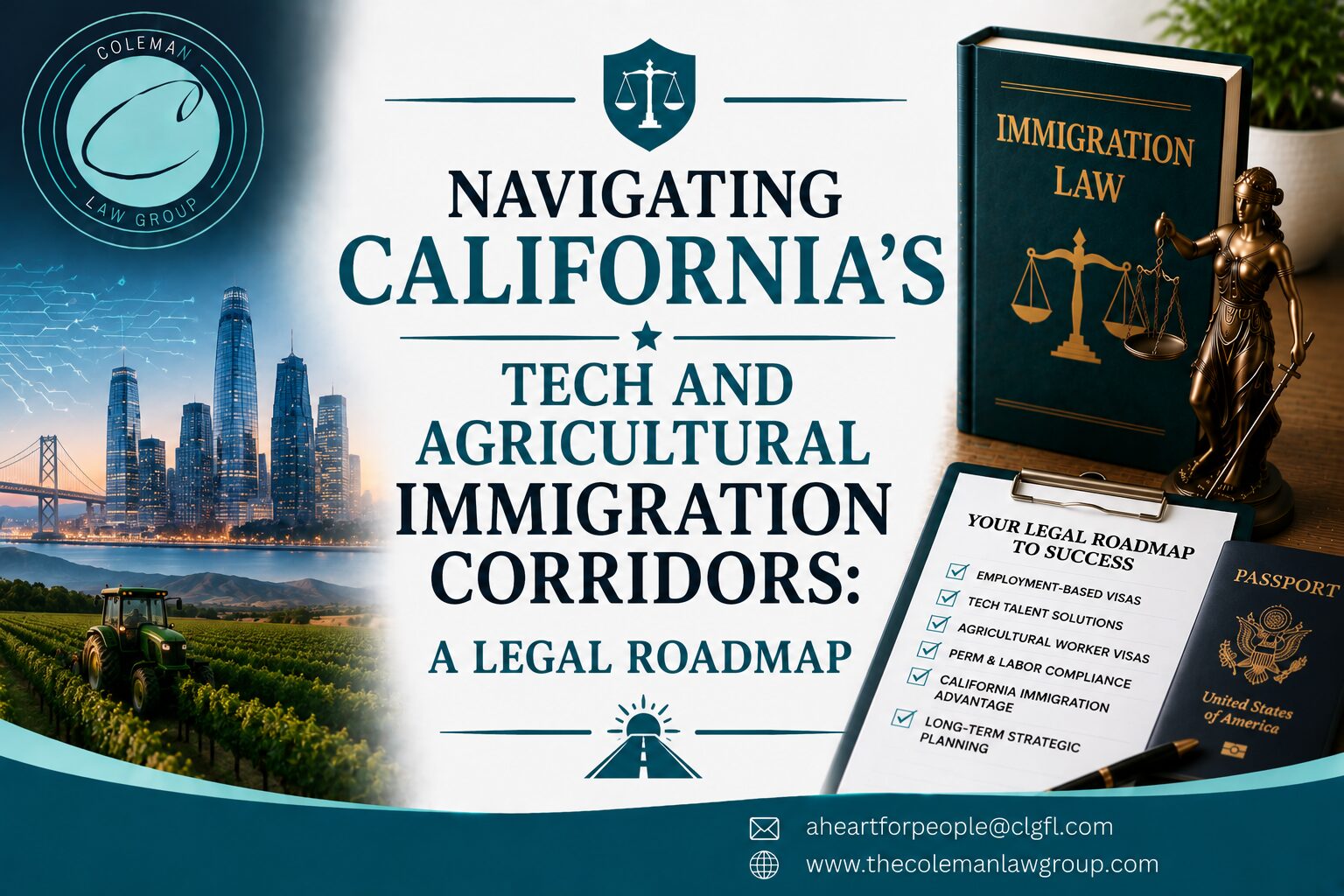
California’s economy is defined by two distinct pillars: the high-velocity innovation hubs of Silicon Valley and the labor-intensive agricultural corridors of the Central Valley. While these sectors power the state’s global competitiveness, they face drastically different regulatory pressures in 2026—from shifts in rigid H-2A wage rules to volatile tech visa caps.
This guide outlines the critical compliance frameworks corporate leaders must master to insulate their operations. We will examine specialized startup visa pathways, tactics to bypass administrative backlogs, and the defensive governance protocols necessary to survive heightened federal worksite enforcement.
The Dual Engine: California’s Integrated Immigration Economy
Managing California’s diverse workforce requires a shift from standard paperwork to a more proactive approach. For a California immigration attorney, providing high-level counsel means mastering two distinct operational strategies. First, there are the high-stakes retention methods required to secure specialized technical talent in places like Silicon Valley. Second, there are the rigid, program-specific compliance mandates necessary to stabilize agricultural workforces in the Central Valley, where federal H-2A oversight can be intense.
That said, a cookie-cutter strategy can put your business at risk. Immigration rules move fast, and whether you are hiring engineers or managing field labor, a basic plan leaves gaps. Working with a California immigration lawyer helps avoid the sudden, expensive hurdles that stall growth, making it possible to build a practical plan. The goal is to cut through the legal complexity and ensure operations continue without interruption.
High-Tech Talent: Navigating Silicon Valley’s Evolving Pathways
H-1B visas are becoming increasingly difficult to rely on for tech hiring due to caps and changing wage requirements. Relying on a random lottery is a dangerous strategy when you are trying to scale. Instead, you need to leverage non-cap visa options and alternative hiring structures to ensure your team continues to grow without interruption. Securing the right Silicon Valley startup options is essential to maintaining your edge in today’s global market.
-
The O-1A and EB-1A Blueprint
For high-level engineers and founders, the O-1A and EB-1A are the most reliable immigration paths. They bypass the H-1B lottery entirely, giving you much more control over your timeline. On top of that, you can use premium processing to secure an official decision in 15 business days, cutting out the typical months-long wait.
To qualify, candidates must demonstrate “extraordinary ability.” In the 2026 regulatory environment, our firm builds these petitions by moving beyond mere job descriptions to document the following:
- Venture Capital Funding: We prioritize objective evidence of commercial recognition, such as successful Series A or seed funding rounds from reputable investment firms.
- High Remuneration: Petitions must demonstrate that compensation packages place the professional in the top tier of their field, using comparative wage data.
- IP and Peer Contributions: We emphasize the technical impact of a candidate’s work, including proprietary software patents, significant contributions to widely used repositories, and expert roles in peer-review processes.
-
International Entrepreneur Parole (IER)
For founders from non-treaty nations, the International Entrepreneur Parole (IER) offers a critical mechanism for operating a startup in the U.S. By demonstrating “significant public benefit,” founders with at least a 10% ownership stake can qualify for an initial 30-month stay.
As of 2026, the financial thresholds for IER have been adjusted to account for inflation. To qualify, a startup must demonstrate:
- Qualified U.S. Investment: At least $311,071 in funding from qualified investors.
- Government Grants: Alternatively, $124,429 in qualified government awards or grants.
While IER is a powerful tool, it is essentially a “parole” status rather than a traditional visa. We often advise founders to use IER as an immediate bridge while simultaneously developing a long-term plan for an O-1A or EB-2 National Interest Waiver (NIW) to secure a more permanent foothold in the United States.
The Agricultural Baseline: H-2A Compliance & Seasonal Scaling
While California’s tech sector relies on high-skill talent, its agricultural sector depends on the H-2A program. As of mid-2026, finding a reliable workforce remains a struggle for Central Valley producers. For employers, succeeding with this program means more than just filing forms; it requires a disciplined approach to domestic recruitment and a strict adherence to federal standards.
Navigating the 75-Day Filing Window
Underestimating the H-2A timeline is the fastest way to lose control of your labor supply. To have a workforce ready for harvest, the process must begin months in advance. The official filing window opens 75 days before your anticipated start date, when you must submit your ETA-790A job order to the State Workforce Agency (SWA).
Missing these deadlines—or failing to document your efforts to recruit domestic workers—can lead to severe consequences, including certification denials. You must keep thorough records of every local recruitment attempt, as the Department of Labor (DOL) audits these files to confirm that your need for guest workers is genuine and that no domestic candidates were available.
2026 Update: H-2A Eligibility for Dairy
Federal agencies recently clarified that dairy operations are not automatically barred from the H-2A program. While your work happens year-round, you can now qualify if you can document a specific, temporary labor need. The government will review your petition on a case-by-case basis, just as they do for crop farms, so the key is to prove your need isn’t for permanent staff but for a defined surge or seasonal activity.
The new policy bridges this gap by acknowledging that dairy labor needs, such as calving, breeding, or production surges, can be cyclical.
- Operational Mapping: To qualify, you must now clearly map out your staffing fluctuations. Your petition should reflect how your labor needs change with specific operational cycles, rather than presenting the work as a static, year-round role.
- Case-by-Case Review: Because the DOL evaluates each petition individually, standardized job descriptions often fail. You must provide clear, evidence-based descriptions of your operation’s unique seasonal patterns to justify the temporary nature of the positions.
Housing and Safety Standards
Compliance extends well beyond payroll. Your housing must clear a mandatory SWA pre-occupancy inspection before any guest workers arrive. The requirements are demanding: you have to meet specific standards for square footage, fire protection, cleanliness, and kitchen setup. Any failure here risks a total shutdown. Check your utilities, ventilation, and food storage areas now to ensure everything is functional and inspected well ahead of the season.
Managing Processing Backlogs: San Francisco USCIS
Administrative delays currently represent a significant operational risk. The San Francisco USCIS field office is currently caught in the same massive backlog affecting the rest of the U.S. With over 12 million applications waiting for a decision, your I-485 adjustments and work permit renewals will almost certainly take longer than they did even a year ago. For a business, this means you can’t rely on standard timelines; you have to plan for significant delays to keep your projects from stalling.
-
The Operational Impact of Delays
Don’t underestimate the business cost of a paperwork bottleneck. When immigration processing slows down, your team loses its agility. You’ll find staff grounded from client site visits, and worse, you may face a mandatory work stoppage if an EAD renewal falls through the cracks. Every day an employee is sidelined due to a status gap is a day your project timeline slips further behind. Staying ahead of these renewals is vital to keeping your team fully active.
-
Mitigation Strategies
To keep your workforce stable, you must move beyond passive waiting. Where available, prioritize paying the filing fee for premium processing. This remains the most reliable way to secure an adjudication decision in days rather than months. Additionally, we strongly advise HR teams to establish a 150-day internal buffer for all renewals, ensuring that applications are prepared and filed well before any documents expire.
-
Leveraging New Case Law
The legal landscape is evolving rapidly. While the 9th Circuit’s immigration rulings summary often highlights individual challenges, corporate clients should focus on broader structural victories. The June 2026 ruling in Dorcas International Institute v. USCIS provides a powerful new legal tool. This federal decision successfully challenged internal agency policies that had effectively frozen benefit adjudications for thousands of applicants, including “hold” and “re-review” mandates. Because the court declared these internal freezes unlawful, we now formally challenge these unreasonable delays under this precedent. This allows us to push back against arbitrary stalls and compel the agency to resume processing your pending applications.
Defensive Corporate Governance: Navigating Enhanced I-9 Enforcement
The rules for employers changed significantly in March 2026. Immigration and Customs Enforcement (ICE) overhauled its enforcement strategy, now classifying many minor clerical errors as substantive violations. These updates turn what used to be “fixable” mistakes into triggers for mandatory, non-negotiable civil penalties. In this climate, waiting for an audit to check your files is a recipe for disaster. Your organization needs a proactive, defensive strategy.
-
The New Reality of I-9 Audits
Under the updated ICE guidance, the margin for error has basically vanished. Simple oversights such as missing dates, skipping an employee’s birthdate, or incorrectly logging document details are now categorized as substantive violations. The agency no longer provides a 10-day grace period to correct housing violations, meaning you are now subject to immediate penalties. Since fines for serious breaches can exceed $4,000 per incident, one oversight in your housing preparation can result in significant financial consequences.
-
Heightened Worksite Scrutiny
ICE has ramped up its worksite enforcement using a “zero-tolerance” approach. They aren’t just relying on standard Form I-9 audits anymore; they are now actively cross-referencing employment data through federal databases. By linking to IRS records, ICE can spot discrepancies, such as Social Security number mismatches, in real time. Furthermore, the Fraud Detection and National Security (FDNS) unit is performing more unannounced site visits to confirm that sponsored foreign nationals are physically present at the locations and performing the specific duties listed in their petitions.
-
Strengthening Your Internal Protocol
To insulate your business, your HR and legal teams need to prioritize three things:
- Quarterly Internal Audits: Stop waiting for a Notice of Inspection to learn your files are a disaster. Review your I-9 records quarterly so you can address issues yourself before the government forces your hand.
- Compliance as a Core Strategy: Navigating these risks is far more than an administrative chore; it is a critical legal concern. Whether you are looking at Silicon Valley startup visa options or trying to manage complex labor requirements, keeping a California immigration attorney in the loop ensures your internal protocols actually align with current enforcement trends.
- Leveraging Informed Counsel: A skilled California immigration lawyer does more than just file papers. They help you interpret the latest 9th Circuit court immigration rulings summary to understand how judicial changes impact your day-to-day risk. When the San Francisco USCIS office creates a bottleneck, you need a legal strategy, not just paperwork. Proactive filing keeps your team moving and ensures your governance remains solid if the government decides to take a closer look.
The 2026 Regulatory Outlook: Maintaining Operational Resilience
As we move through the second half of 2026, the era of “predictable” immigration is effectively over. The current landscape—marked by increased processing costs, tightened eligibility for employment-based green cards, and aggressive worksite enforcement—requires companies to stop treating immigration as a back-office administrative task and start treating it as a core component of enterprise risk management.
The New Reality of Talent Mobility
The primary shift in 2026 is the transition from a process-driven model to one defined by continuous risk assessment. With new “Visa Integrity Fees” and heightened scrutiny on categories like the H-1B, the cost of error has never been higher. We’ve reached a point where old-school compliance strategies are becoming a liability. If you want to protect your business and maintain your advantage, here’s where you need to focus your efforts:
-
Geographic Diversification
With visa processing delays becoming the new normal, stop relying on centralized hubs. When choosing where to place your R&D and manufacturing sites, consider immigration feasibility a long-term requirement, not just a box to check for convenience.
-
Integrated Mobility Planning
Gather your legal, HR, and tax departments at the very beginning of the planning process. Whether you’re relocating staff or bringing on new international hires, confirm that every move is compliant before you extend any offer.
-
Digital Compliance Sovereignty
Assume that border and labor agencies maintain detailed records of travel history and entry logs. Operate with full visibility, and do not depend on government systems to manage your workforce compliance. Maintain a private, robust tracking system to monitor employee locations, visa renewals, and authorization status so you always have an accurate, independent record of your team’s compliance.
-
Take the Next Step Toward Legal Certainty
The regulatory landscape in 2026 moves too fast for passive strategies. You shouldn’t have to wait for the system to catch up or hope that your filings avoid scrutiny. At Coleman Law Group, we are your first line of defense. We take your most complex immigration and legal hurdles and turn them into a clear path forward. We help you protect your family’s future while keeping your business on track.
We keep our legal advice direct and human, with a sharp focus on your results. If you need a team that recognizes the urgency of your situation and is ready to act, let’s talk. Reach out to us at aheartforpeople@clgfl.com or call 727-214-0400 to schedule a confidential review today.