

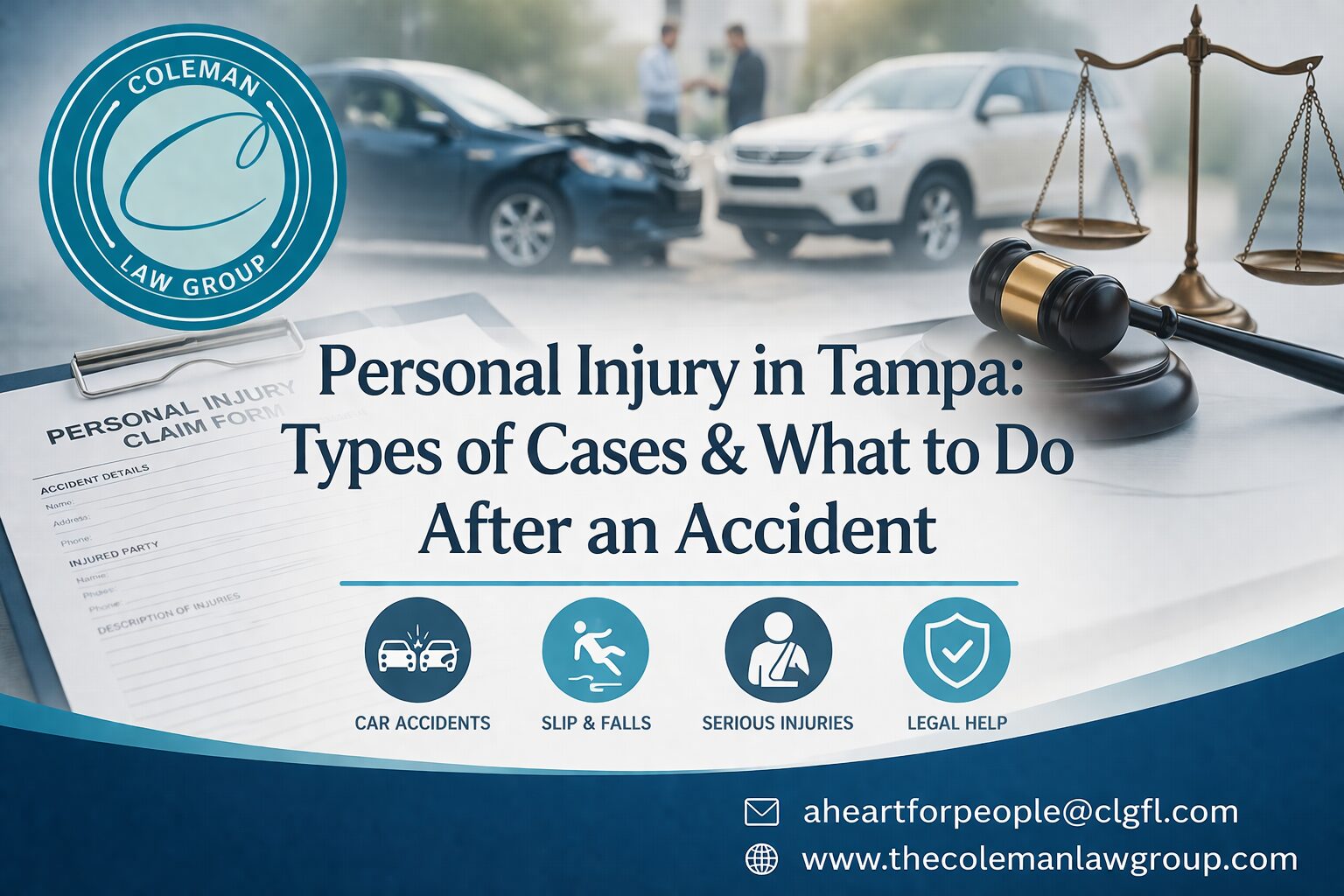
Do not let the word ‘personal‘ mislead you. A personal injury can happen to anyone, anytime, and anywhere. It can also happen to a group of people at once. So, what is a personal injury, and what can you do about them if you live in Tampa, Florida?
WHAT IS A PERSONAL INJURY?
Personal injury is an umbrella term for various injuries caused by someone else’s fault or negligence. Personal injury covers physical, emotional, and psychological injuries.
Personal Injury claims can be brought on the following grounds:
-
NEGLIGENCE
Negligence on a person’s part that causes injury to someone else is grounds for most personal injury claims. Negligence will succeed where the party who caused the damage owes a duty of care towards the injured party, which duty he has breached.
We all owe each other a duty of care, a responsibility to conduct our activities in ways that do not harm others. It is a duty to act as a reasonable person in carrying out or omitting to do anything that will harm someone else.
When an employer invites an employee to work on the employer’s premises, the employer owes the employee a duty of care to provide a suitable, nonhazardous environment for all employees. Where a duty of care is breached, a personal injury may arise.
-
INTENTIONAL WRONG
An intentional act that causes harm to another person is a ground for a personal injury claim. An example of this is assault and battery.
-
STRICT LIABILITY
In certain circumstances, an injured party can hold another person responsible for their injury without proving that the other party was at fault or negligent. This is called strict liability. The injured person does not need to show recklessness or negligence by the other party to succeed in their injury claim.
There are many examples of strict liability torts. For example, when a person manufactures a product or a drug for the use or consumption by the public, and that drug or product harms the person who consumes it, the manufacturer of such an item will be held liable for that injury.
The doctrine of strict liability has been traditionally applied to damages caused by animals. This is because animals, unlike humans, lack a conscience and have a strong tendency to be mischievous and cause harm if not restrained by their owners. Therefore, those who keep animals have a duty to control their animals from causing damage to people. When an injury is caused by an animal that its owner should have restrained, it becomes a strict liability tort. Negligence or fault of the owner need not be proved.
The rationale behind strict liability is that a person can be held responsible for an injury even when they are not at fault or have not been negligent.
Another example is the rule in the landmark case of Rylands v Fletcher. Rylands v Fletcher is an 18th-century English law locus classicus and possibly the most cited example of strict liability. The rule in the case states that if an occupier of land brings and keeps on his ground anything capable of, or likely to, cause damage if it escapes, he will be liable for any damage caused by an escape.
What happened was that Mr. Ryland began construction on his reservoir with workers, which was close to Mr. Fletcher’s mine. Mr. Ryland’s workers did not do a great job on the pool, and subsequently, the reservoir burst open and flooded Mr. Fletcher’s mine. Mr. Fletcher brought a claim under negligence, and it was decided that the claimant had the right to enjoy his land free of interference from water. The rule in Ryland V Fletcher is “that a person who for his purposes brings on his lands and collects and keeps there anything likely to make mischief if it escapes, must keep it in at his peril, and, if he does not do so, is prima facie answerable for all the damage which is the natural consequence of its escape.”
The English House of Lords limited the ambit of the rule to non-natural use of the land. As we have today, the power in Rylands v Fletcher imposes liability on a person for escaping a non-natural substance onto his land.
EXAMPLES OF PERSONAL INJURIES
The list is long. Some common examples of Personal Injuries are
-
Injuries suffered from car accidents
Sadly, Florida ranks third-highest in motor vehicle accidents in the United States. Most of these accidents are caused by one act of negligence or another by road users. This has made car accident claims among the most common personal injury claims in the United States; Florida is no exception. Several injuries can arise from these. Examples are spinal cord injuries, brain injuries, loss of limbs, and broken bones.
-
Injuries suffered from slip and fall accidents
A slip-and-fall injury occurs when a person falls and injures themselves on another person’s premises due to a dangerous condition or the premises owner’s negligence. In such a case, the person who owns or maintains the premises may be held responsible.
-
Injuries suffered from bicycle accidents
Bicycle accidents are common in Tampa. The weather and beautiful scenery of the city can sometimes encourage frequent hiking, riding a motorcycle, or bicycle. Because of this, the chances of a crash are high. Injuries sustained on a motorcycle or bicycle are personal injuries and can be compensated.
-
Injuries because of Defective Product
Where a product is defective and leads to an injury, the injured party can bring a personal injury claim and, where it succeeds, can be entitled to compensation.
-
Assault and Battery
Any harm resulting from assault and battery is a personal injury, and the aggressor can be held responsible for any damage caused.
-
Animal/pet attack (particularly dog bite)
A pet owner is held responsible for the actions of their animal. Dog bites are treated as personal injuries because they result from negligence, or, as mentioned above, strict liability rules are applied. When a person suffers an injury from a dog bite, he can bring a personal injury claim and get compensation.
-
Injuries because of a workplace accident
Injuries sustained by employees in a workplace due to hazardous workplace conditions, inadequate equipment, and a lack of training amount to personal injury. Personnel who work in the construction and manufacturing industries and operate heavy-duty machinery often fall into this category.
-
Medical malpractice claims
A medical claim arises when a medical or healthcare practitioner makes a mistake that results in lifelong injuries while treating a patient. This will amount to a medical malpractice claim. The practitioner’s error may arise from negligence and will be treated similarly to a personal injury claim.
-
Wrongful death
A wrongful death claim will arise when someone dies due to another person’s negligence. Wrongful death is an example of a personal injury, and the surviving relatives of the deceased can bring an action and be entitled to compensation.
WHO IS A PERSONAL INJURY LAWYER?
If you have suffered a physical, emotional, or psychological injury due to the negligence or fault of another person, you will require the services of a Personal Injury Lawyer.
A Personal Injury Lawyer or Attorney is a lawyer who provides legal services to people who have sustained personal injuries like the ones discussed. A Personal Injury Lawyer must be qualified to practice in the jurisdiction.
I have suffered a personal injury. Am I entitled to any compensation?
Yes, if you have suffered a personal injury, you are entitled to compensation. The main form of compensation available is called Damages. Damages are usually monetary compensation for the loss or injury suffered. Continue reading to determine the types of payment (or damages) available.
- Compensatory damages are commonly awarded in Personal Injury cases. Compensatory damages are financial compensation made to the injured person for the costs that they may have incurred due to the injury suffered.
- On the other hand, punitive damages are seldom awarded in Personal Injury cases. Punitive damages are retributive. Its goal is to punish the defendant for the injury that they have inflicted on the injured party. The probable reason for the less frequent administration of punitive damages may be its retributive nature- Retribution is a more sustainable punishment in criminal justice and not personal injury law.
Compensatory damages are further divided into Special damages and General damages.
- Special damages (or Special compensatory damages): Special damages are reimbursement of out-of-pocket expenses incurred by the injured party. When a person has suffered a physical injury, his hospital bill, money for medication, transportation cost to and from the hospital, cost of an ambulance, cost of therapy and rehabilitation, and all expenses as a result of the injury are all out of pocket expenses that can be awarded as special damages in favor of the injured party as long as he can give an account of the costs that has been incurred.
- General damages (or compensatory damages): General damages cannot be quantified, unlike special damages. An example is the pain and suffering the injured party has suffered since the injury occurred.
- Wrongful death damages: Relatives of the deceased who died due to the injury receive this compensation. Wrongful death damages combine special and general damages and only apply solely within criminal death cases. Examples of wrongful death damages are the funeral costs, medical care, loss of consortium, misery, and emotional pain of surviving family members.
What you can do if you suffer a personal injury in Tampa?
If you have suffered a personal injury like any of the ones above in the city of Tampa, we advise that you do the following.
- Call the Police: When you suffer a personal injury or your loved one has suffered from a personal injury, you should notify the local police station in Tampa. Make an official report of what happened and the injuries suffered.
- Gather Evidence: Gather as much evidence as you can. For example, if you suffered a personal injury from a car accident, take pictures if you can do so, or ask someone to take them for you.
- Get Medical Attention: When you suffer an injury, seek medical attention.
- Contact a Personal Injury Lawyer in Tampa: In the City of Tampa, Coleman Law Group specialize in Personal Injury and will assist you in presenting your case.
- Keep Records: Keep an account and record all money spent and expenses incurred due to the injury suffered. A clear understanding of the cost incurred can help grant the relief of special damages in a personal injury claim.