

Between becoming a citizen of the United States of America and being a citizen of a different country is a lifetime decision. It is the last step after many years as a legal resident, demonstrating your commitment to the American community and your duty as a U.S. citizen. But permanent residents (Green Card holders) must meet numerous stringent bureaucratic requirements to naturalize. The central part of this process is Form N-400, the Application for US Naturalization.
The given form is just the tip of the iceberg, and what matters the most in terms of speed and success of your application is what you can prove. United States Citizenship and Immigration Services (USCIS) officers are supposed to verify your identity, permanent status, good moral character, and compliance with U.S tax laws. Lack of proper documentation can lead to a nightmare of Requests for Evidence (RFEs), which can hold your citizenship pending for several months or result in a total refusal.
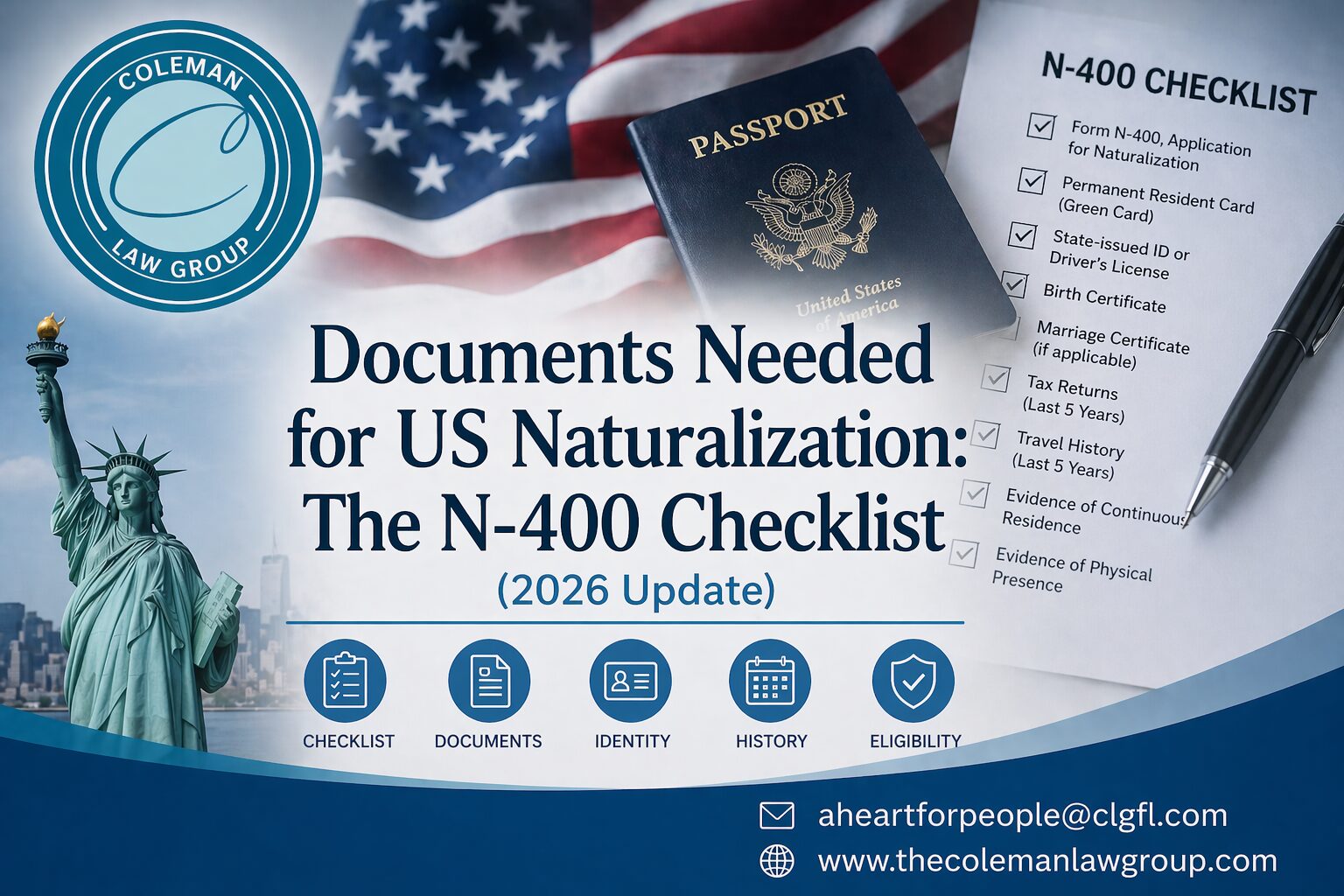
The N-400 Document Checklist and Citizenship Requirements 2026 are designed to facilitate the personnel’s application process. USCIS has fully computerized its operations; however, the onus of providing evidence is squarely on the applicant. It is a comprehensive guide that contains all the documentation you must gather, assemble, and submit to complete the naturalization process.
- The Foundation of US Naturalization: High-Level Identity and Status Evidence
USCIS needs to conclusively verify your identity before granting citizenship. Your original documents define your identity and establish your legal immigration status.
- An Original of Your Permanent Resident Card (Green Card)
You need to provide a clear, readable copy of the front and back of the current and non-expired Green Card. In case of loss, theft, or expiration of the card, you still need to send in a copy of any physical evidence and a copy of your I-90 receipt notice that indicates the request for a replacement.
- Government-Issued Photo Identification
A duplicate copy of a state driving license, identification card, or U.S. military identification. This ID contains your legal name, date of birth, and a recent photo.
- Photographs of the Passport Style (Where Necessary)
Even though most applicants are not required to attach physical photos with the N-400, since USCIS will obtain your biometrics (fingerprints and photo) during your ASC appointment, attach two passport-style photos when you are outside the United States or in the military. The USCIS requirements (2×2 inches, white background, unedited) require these photographs.
- Name Change Documentation
To legally change your name (e.g., by marriage, divorce, or court order), you must provide the official documents to support the change, e.g., a marriage certificate or a court order. The Name changes seekers use the naturalization route, put your preference on your N-400 document and take the oath before a judge who has the authority to ratify the amendment.
- Marital and Family History Documentation
The N-400 process is critical in examining the family background, particularly your marital status. It is especially at the time of filing under the 3-year rule (married and residing with a U.S. citizen spouse) rather than the 5-year rule.
- Current Marriage Certificate
Married people must provide a certified copy of their marriage certificate. Instead of a marriage license or a religious commemoration document, USCIS requires an official document from a civil official.
- Children’s Birth Certificates
Although it is not always required of the applicant when asserting derived citizenship for a child born outside the United States, it is when the marital history is complicated. Submission of birth certificates of all your children assists the USCIS in tracing your family tree and confirming dates.
- Evidence of Spousal U.S.U.S. Citizenship
Individuals who make claims under the 3-year rule must note their spouse’s citizenship status. They may present their birth certificate, a valid U.S. passport, a Certificate of Naturalization, or an official Consular Report of Birth Abroad.
- History of Past Marriages
To prove the validity of your existing union, provide certified documents terminating all your past marriages with both partners. It entails divorce edicts, annulment, or death certificates.
Ensure the divorce decree clearly mentions the dissolution date, or the court specifies it.
Related article: Immigration Benefits for U.S. Military Families in 2026: Parole in Place, Expedited Citizenship & I-130 Fast-Track Guide
2. The Arrest Record: Reality: Certification of Court Dispositions
When questioned about arrests, citations, or police detention, the applicants usually panic. The greatest myth is that you do not have to mention a rejected or expunged charge in the application. It is not true; you should report all incidents, including minor crimes and traffic fines over $ 500, to demonstrate transparency to USCIS.
More to the point, you cannot write a letter explaining what happened. To become a citizen, take the naturalization through court proceedings. A certified disposition is a court-stamped or sealed document that officially overrides the case record.
The U.S. court system is highly decentralized, with no central database. The following is the local, practical information on how to get these records in the five most densely populated immigration target states:
The decentralized nature of California requires the applicant to obtain certified court dispositions from the county of arrest.
The Process: Despite the California Department of Justice (DOJ), which conducts the background checks, only the Superior Court issues the certified disposition necessary for USCIS.
Actionable Step: Visit the Superior Court webpage of the county (e.g., Orange County or Los Angeles County). Request your records using the Criminal Division search tool or Online Services. Most California counties allow you to search by your name and date of birth and receive the certified disposition online for a small fee (usually $15-$25). When it is not available in your county, you must appear in person before the court clerk with a valid ID and a case number.
Florida is relatively easy to locate case numbers, but a certified document needs special action to obtain it.
The Process: In Florida, if you have a DUI, visit the County Clerk’s Court where the arrest took place. The background check by the Florida Department of Law Enforcement (FDLE) cannot substitute a court-qualified disposition.
Actionable Step: Visit the County Clerk website of a particular County (e.g., Miami-Dade Clerk of Courts). Enter your case number using their online criminal search portal. After you possess it, make a formal request for a Certified Copy of the disposition. You usually submit it by mail or online, but it must explicitly state that it is certified; otherwise, USCIS will consider it an unauthoritative printout and refuse it.
The New York system is divided into local courts (City/Town/Village) and superior courts (Supreme Court and County Court).
The Process: Local jurisdiction handles misdemeanors and minor crimes, while the county court handles felonies.
Actionable Step: In New York City, you should search the Office of Court Administration (OCA) statewide criminal history record search to locate your case. However, it is important to request a certified disposition from the specific court (i.e., Brooklyn Criminal Court or Kings County Supreme Court).
There are over 800 local courts in Texas, making it a complicated situation that will require some knowledge of which court holds your record.
The Process: Minor offenses are taken to Municipal and Justice of the Peace Courts, whereas higher-level misdemeanors and felonies are managed by County or District Courts.
Action Plan: In the majority of criminal records, begin with the District Clerk of the county of arrest. To obtain low-level citations or ordinances within a city, you should contact the Municipal Court or the County Clerk. In Texas, submit an Open Records Request to the particular clerk to have the disposition certified.
New Jersey has certain regulations regarding expunged records that baffle thousands of applicants each year.
The Process: For New Jersey expungements, the following are required: the original indictment or complaint and the final cancellation order. USCIS is subject to federal law and may still consider expunged records in determining good moral character.
Actionable Step: Even with a cleared record, an expungement order is insufficient. To gather all necessary paperwork, contact the Superior Court in the county where you are arrested in New Jersey.
You need to submit a copy of the original charging document (indictment, accusation, or summons) with a certificate of disposition of the ultimate decision made before the time of expungement.
Additionally, you should demand a certified copy of the Order of Expungement from the judge. You have to submit all three documents along with USCIS to demonstrate the charge, its disposition, and that the state has closed the record.
The Financial Evidence: Securing Your Economic Connection
USCIS also desires to know that you take an active part in American society and do not owe the federal government any money.
-
N-400 Tax Transcripts
It is non-negotiable. Send not even a copy of your 1040 tax returns. Instead, order your official IRS tax transcripts of the past three (or five, based on your filing type) tax years. These are available immediately online through the IRS Get Transcript tool or by filing Form 4506-T. Tax transcripts – 400 will demonstrate your reported income without revealing any personal financial information. It clearly indicates whether you are filing as a non-resident, which will violate your continuing residence eligibility.
-
Evidence of Spousal Support (where applicable)
Applicants who meet the 3-year marriage rule but receive public assistance (Medicaid or SNAP) must demonstrate financial stability. You must demonstrate that your U.S. citizen spouse contributed 80% or more of your overall financial obligations.
The Citizenship Interview Documents List
Approximately one month before your date of filing, get an Interview Notice (Form I-797C). Do not leave your paperwork until the week before your interview. You need to bring an original document binder to the USCIS appointment. The list of your citizenship interview documents is divided into the following tabs:
- Government Issued IDs
Your green card (expired, not mandatory), state driver’s license or ID, and a valid passport.
- Immigration & Travel History
Any passports carried since you became a Permanent Resident (even expired ones), to show that you did not break continuous residence. Bring any old I-94 records for arrival/departure.
- Financial Documents
The N-400 original Tax transcripts (do not bring photocopies of the transcripts to the interview; bring the official IRS transcripts).
If you are self-employed, also bring your state tax returns and business tax returns.
- Marital & Family History (if applicable)
Original marriage certificate, divorce decrees for all former marriages, and birth certificates for any child.
- Selective Service & Military
Bring your Selective Draft registration confirmation if you are a male and lived in the U.S. between the ages of 18 and 26 years old.
- Moral Character
Make sure this folder has all your certified court dispositions for US Naturalization. For the filing process, photocopies, the original, and a certified version are necessary during the interview. In the case of expunged records, bring the original sealed court record to demonstrate the ultimate disposition of the case.
Conclusion
The process of U.S. citizenship is associated with strict documentation requirements. You are either proving the basic facts about who you are or demonstrating financial responsibility and good moral character, but every document tells a story about your life in America. You must not underestimate the importance of delivering certified copies rather than ordinary photocopies; do not think that a document is insignificant because it appears trivial to you.
These resources are not necessarily present. Naturalization certified court dispositions may take weeks to request, and N-400 tax transcripts may be delayed during high seasonal IRS demand. Due to these deadlines, you are supposed to collect your evidence a few months before filing out your Form N-400.