

When a marriage ends, wanting to find common ground usually comes from a place of maturity and a genuine need to keep your family out of the crossfire. It’s a massive weight off your shoulders when you and your spouse can actually agree on the path forward, and honestly, that mutual focus is the best way to get through such a tough transition.
However, the legal reality of an uncontested divorce is rarely as simple as two people just signing a piece of paper. You might feel like everything is settled, but Florida law is built on very rigid technical requirements. If your paperwork is missing a specific detail or uses language that is open to interpretation, a judge can refuse to finalize your settlement. That is often how a quiet, manageable process suddenly spirals into a public court battle. Having an uncontested divorce attorney look over your files isn’t about stirring up trouble; it is about making sure your agreement is solid enough to stand up in court so you don’t get sent back to the starting line.
The “Amicable” Trap: Why Agreement Isn’t Enough
It’s a common mistake to assume that being on good terms with your spouse guarantees a secure legal outcome. You may have discussed every detail of your separation at home and felt confident, but verbal agreements rarely hold up when things get complicated. While that mutual respect is invaluable, a verbal agreement, or even a basic document you put together yourselves, often lacks the specific language a court needs to grant a final judgment.
The biggest mistake is believing that an uncontested divorce in Florida is simply a matter of filing a few forms to confirm you both agree. In reality, a judge does not just look for evidence that you agree; they look for proof that your agreement follows Florida law to the letter. If your divorce settlement agreement is missing a required clause or if the terms are even slightly vague, the court will likely hit the brakes. This is why having an uncontested divorce attorney review your plan is so vital. It isn’t about second-guessing your decisions or creating conflict; it is about taking the plan you and your spouse have already built and ensuring it is written in a way the legal system will actually accept.
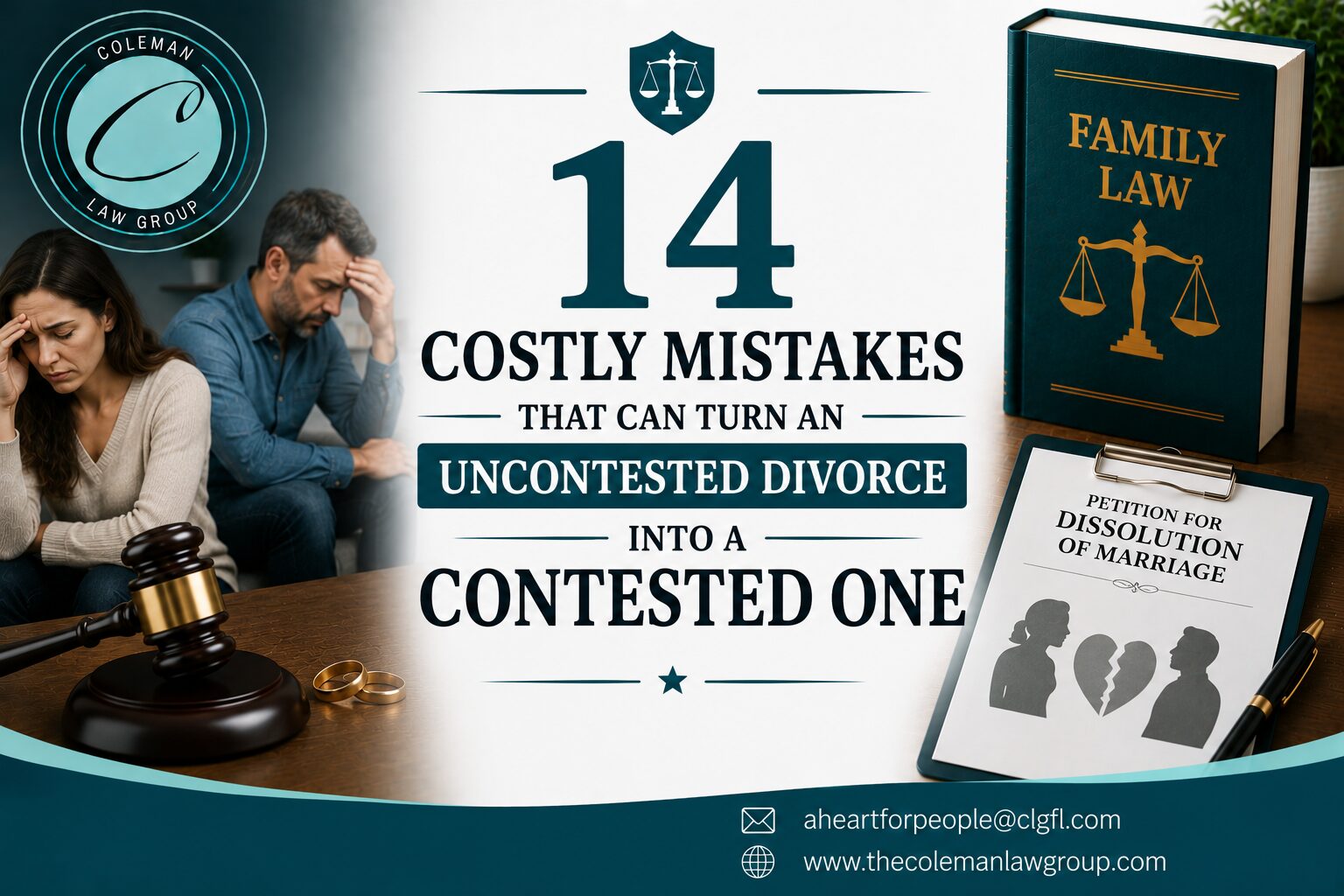
The 14 Costly Mistakes That Can Derail Your Settlement
Keeping things amicable is a great goal, but don’t let that blind you to the fact that the legal system is unforgiving. A tiny mistake today usually becomes a major headache later. To make sure your case stays on track and actually gets finalized, you have to avoid these typical uncontested divorce mistakes.
-
Vague Parenting Plans
If you have children, your parenting plan is the most significant document you will sign. Many couples choose a flexible schedule to remain accommodating. This is often a mistake. A plan that lacks specific dates, holiday rotations, and exact pickup times creates room for future conflict. You have to clearly define how you will communicate and who has the authority to make medical decisions. A solid plan shields your kids by making sure a judge doesn’t have to step in over every little dispute later. Think of this plan as your roadmap; if it’s blurry, you’re practically guaranteed to take a wrong turn.
-
Incomplete Financial Affidavits
Florida courts require a complete picture of your financial life. You might be tempted to omit small debts or secondary accounts to simplify the paperwork, but this is a critical error. Your financial affidavit is a sworn statement. If the court discovers an omission, it can lead to the rejection of your entire divorce settlement agreement.
-
Hiding or Moving Assets
It is tempting to protect certain assets by moving money or property before filing. This is a harmless precaution. The court views this differently. Any lack of transparency during an uncontested divorce in Florida acts as a red flag. If a judge suspects you are hiding assets, they will lose trust in your agreement and may force a formal discovery process. This process is invasive and time-consuming. Protecting your credibility is as important as protecting your bank account.
-
Misjudging Tax Consequences
Dividing a 401(k) or real estate seems straightforward until you consider the tax bill. If you split assets without considering the long-term tax implications, one of you could end up with significantly less value than intended. You need to ensure your agreement accounts for these hidden costs so the division remains equitable years down the road. It is often wise to consult a professional regarding the tax implications of your division. A split that looks fair on paper may not be fair once the IRS takes its share.
-
Using Children as Emotional Pawns
The court is always watching how you handle your children. Any sign that children are being used as leverage can cause a judge to intervene and take control of the case. In an uncontested divorce with children, the judge is only concerned with what’s best for the kids. Any hint that one parent is being manipulative will quickly force the court to intervene. By making your children your absolute priority, you avoid unnecessary conflict and make sure you, not a judge, stay in the driver’s seat.
-
Neglecting Debt Liability
You might have a verbal agreement about who pays the credit card bill, but if both names are on the account, the bank is not bound by that agreement. Failing to formally address how these debts are handled or failing to get names removed from accounts can leave you responsible for your ex-spouse’s spending for years. You must work to close or refinance these accounts. A handshake agreement will not shield you from a collections agency or a drop in your credit score if the debt goes unpaid.
-
Overlooking Alimony Nuance
Simply saying you waive alimony is rarely enough. The language must be specific and legally sound to prevent one party from returning to court later. Your divorce settlement agreement has to be precise if you want to walk away with genuine peace of mind. Any lack of clarity risks dragging you back into litigation later. You need to be crystal clear with your waiver language, specifically to prevent your ex from petitioning for support long after you’ve both moved on and your financial circumstances have shifted.
-
Rushing the Timeline
It can be quite tempting to move on quickly, but speed is your biggest enemy when you’re signing away legal rights you might not fully understand. You have to take a breath and actually look at what you’re signing. If a clause feels off or confusing, stop and ask questions immediately. It is nearly impossible to fix errors once a judge signs off on the final order, so do the work now to avoid a permanent headache later.
-
Ignoring Beneficiary Designations
People finish their divorce and think they are done. They forget that their ex-spouse is still the primary beneficiary on their life insurance or 401(k). If you pass away, that money goes to your ex. Period. It happens way more often than you would think. It is a simple administrative task, so change your beneficiaries as soon as the judge signs off on your final papers.
-
The DIY Template Trap
Using online forms is a major gamble that usually backfires. These documents are almost never designed to meet Florida’s actual legal standards. Judges can identify these cookie-cutter forms instantly, and they have no problem rejecting them and sending you back to square one. These templates rarely handle local county rules or specific financial disclosures correctly. Paying for a template is often just a way to pay twice: once for the bad form, and again for the attorney who has to fix the mess.
-
Poorly Defined Alimony Terms
If you are dealing with alimony, vague language is your enemy. You need to be brutally specific about the “what-ifs.” What happens if you get laid off? What if your income jumps? If you don’t define the triggers for these changes now, you are practically begging for a future court battle. Clear, written rules for alimony are the only way to ensure both parties stay financially independent without needing a judge to mediate every year.
-
Failing to Account for Future Life Events
Life changes constantly. Maybe one parent needs to move for a job, or maybe a child’s school situation shifts. If your agreement is rigid, you will be right back in court as soon as life gets complicated. Build in some flexibility regarding relocation and major life transitions. It is much easier to agree on a “plan B” now than it is to argue about it in front of a judge later.
-
Social Media Exposure
Think before you post. If you tell the court you have no money but your Instagram is full of expensive trips, you are setting yourself up for disaster. Anything you put online is fair game. Whatever you put out there publicly can and will be used to attack your credibility. It’s best to keep your profile private and stay off social media entirely until your divorce case is wrapped up. No single post is worth jeopardizing your reputation in front of a judge.
-
Skipping Professional Legal Review
It makes sense to look at an uncontested divorce attorney as your safety net. You might believe you’ve hammered out a perfect deal, but the legal system is tricky. A lawyer can identify an oversight or a hidden risk in an hour that would be incredibly expensive to repair later. Even if you’re handling the heavy lifting of the negotiations, letting a professional run a check on your work is the smartest way to protect yourself. It is cheap insurance for your future.
Getting through an uncontested divorce without a hitch comes down to how well you prepare. It’s not just a matter of checking boxes on a form; it’s about creating an agreement that’s built to last. If you put in the effort to address the details today, you’ll save yourself the headache of having to fix those same issues in court tomorrow.
Navigating the Timeline for an Uncontested Divorce
Stop believing the myth that an uncontested divorce is a quick fix that happens in a few days. While you are successfully dodging a brutal legal fight, the court system still has its own schedule. It’s a process, not a sprint. To keep your stress levels down, you need to have a realistic grasp of how the timeline works before you even get started.
-
The Filing Stage
Everything starts when you file your Petition for Dissolution of Marriage at the court clerk. Once that is done, you are in the system. Many people mistakenly think this triggers an immediate countdown to freedom. It doesn’t. You still have to deal with the mandatory waiting period and the paperwork exchange. If you have a typo or a missing form in your initial filing, the clerk will send it right back. That wastes weeks, and you haven’t even really started yet. Double-check everything before you pay your filing fees.
-
The Financial Disclosure Phase
Florida law does not require you and your spouse to agree on everything; you still have to hand over the financial files. You have 45 days after the petition is served to swap your bank statements, tax returns, and pay stubs. This is mandatory. If you miss this window, the court can hold you in contempt or park your case in the “delayed” pile indefinitely. Don’t be the person scrambling for old tax returns at the last second. Get your files organized before you even file. The sooner you swap these documents, the sooner you get to the settlement table.
-
Settlement and Judicial Review
After the financial paperwork is done, you move on to the actual settlement agreement and the parenting plan. Once you both sign and have them notarized, you submit them to a judge. Some people think they can show up at a courthouse and walk out divorced the same day. That rarely happens. A judge has to review your work to make sure it follows state law. This review takes time—sometimes weeks, sometimes months—depending on how busy the court in your state (Florida) is.
The Final Judgment
The only thing that truly ends your marriage is the Final Judgment of Dissolution of Marriage. Until a judge actually signs off on that paper, you are still legally married. Don’t go applying for new loans, buying property, or making plans for a second wedding until you are holding that signed order in your hand.
Knowing how this moves helps keep you from panicking when things seem quiet. You aren’t just sitting around; you are clearing a series of legal hurdles. If your financial disclosures are clean and your divorce settlement agreement covers the bases, you are much less likely to have a judge kick your paperwork back for corrections. Keep your files in a safe, organized place, hit your deadlines, and remember that even the simplest divorce is still a formal procedure that needs time to play out.
Don’t Let a Small Oversight Cost You Your Fresh Start
You have worked way too hard on your agreement to gamble your future on flawed paperwork. At the Coleman Law Group, we focus on turning your settlement into an airtight legal reality, ensuring you steer clear of common traps that drag couples back into court later. We know exactly how to avoid the common errors that can force couples back into court, and we provide the expert oversight needed to ensure your documents are fully compliant. We’re here to protect your assets and your peace of mind, long after your final judgment is in hand.
Let us handle the technical complexities so you can focus on the next chapter of your life. Contact our team at 727-214-0400 or by email at aheartforpeople@clgfl.com to have an experienced advocate review your file, confirm that your filings are accurate, and provide the peace of mind that your divorce is built to last. You deserve a final, clean break, and we are here to ensure your transition is as smooth, secure, and permanent as possible.