

The United States is set to undergo a drastic change in its immigration procedures as we approach September 2026. This is because the United States Citizenship and Immigration Services recently issued a new public charge policy memorandum explaining how officers will determine an individual’s inadmissibility as a public charge.
The guidance memorandum was issued on August 18, 2026, and will become effective on September 18, 2026. If you are applying for your Green Card through adjustment of status, then you need to be aware of this new upshot.
What is Changing Under the New Public Charge Policy?
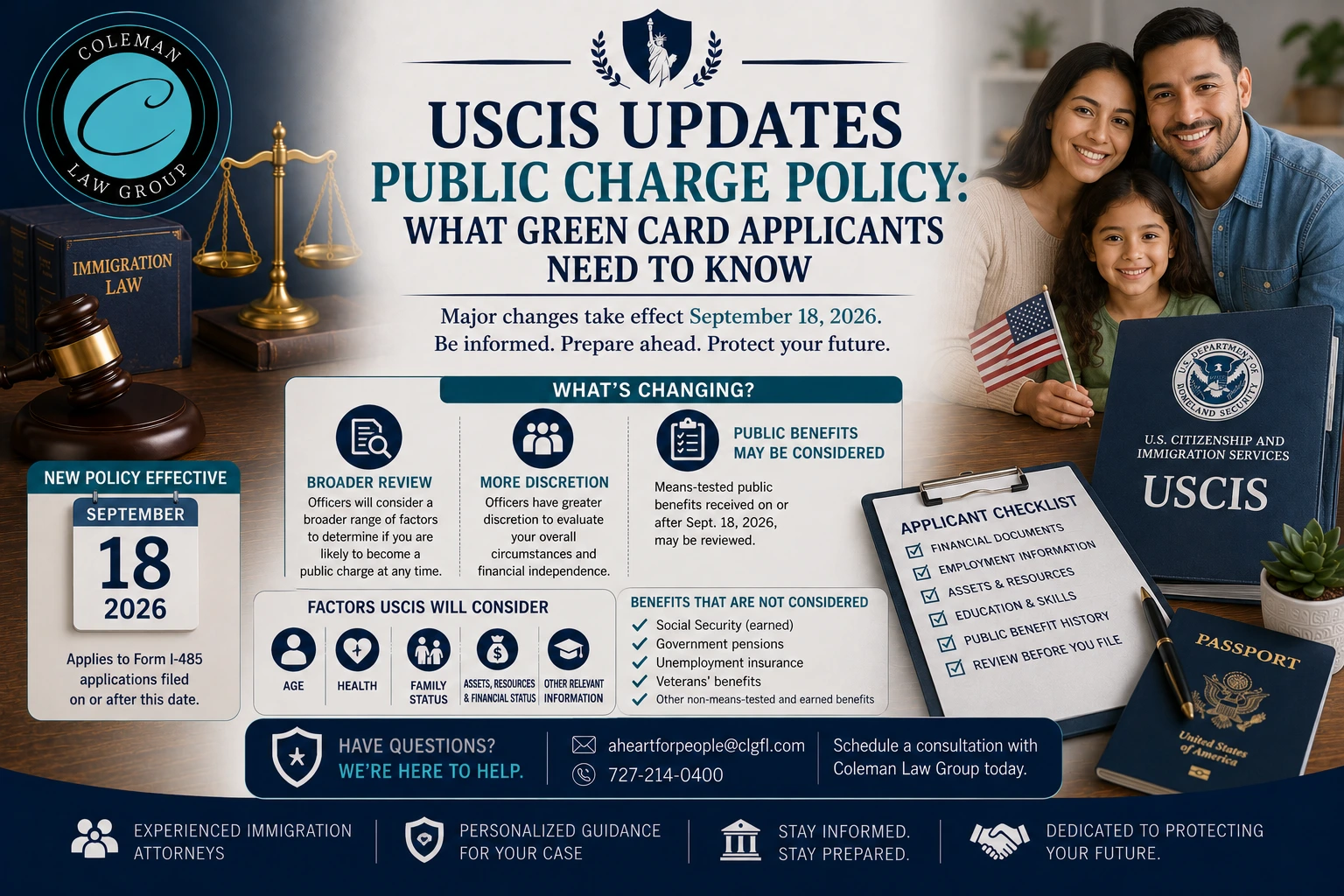
Under the current 2022 framework, USCIS generally focuses on public cash assistance for income maintenance and government-funded long-term institutional care when making a public charge determination. Many other benefits were specifically excluded from consideration.
The 2026 rule takes a broader approach. It removes the 2022 regulatory framework and gives immigration officers more discretion to look at the applicant’s overall circumstances. The goal is to determine whether the person is likely to become a public charge at any time.
The new approach does not mean that receiving a public benefit automatically results in a Green Card denial. USCIS says officers will consider the facts of each case as a whole. The use of a benefit will be one of several factors.
Which Factors Will USCIS Consider?
USCIS officers must consider five main factors required by immigration law:
- Age
- Health
- Family status
- Assets, resources, and financial status
- Education and skills
Officers can also consider other information that may help them determine whether an applicant is likely to become a public charge. This includes an applicant’s application for approval or certification to receive means-tested public benefits or the receipt of such benefits.
This broader review could mean that more information about the applicants’ financial and personal situations will be required. Employment status, income levels, assets, qualifications, and other signs of independence might be crucial in the review.
Public Benefits Could Receive More Attention
For benefits received on or after September 18, 2026, USCIS officers may consider any means-tested public benefits as part of the totality of the circumstances. This is broader than the 2022 framework. Programs such as Medicaid, SNAP, and certain means-tested housing assistance could therefore become relevant to a public charge review.
However, this does not mean every government benefit will be counted. Benefits that are not means-tested and certain earned benefits, such as Social Security benefits based on a person’s work record, government pensions, unemployment insurance, and veterans’ benefits, are not treated as means-tested public benefits.
The timing of benefit use is also important. Benefits received before September 18 will generally continue to be evaluated under the 2022 framework. Benefits received on or after that date may be reviewed under the broader 2026 approach.
What Happens to Form I-485?
The policy change also affects Form I-485. This is the application used by the applicants to register for permanent residency or adjust status.
USCIS updated the form to gather more details related to public charge decisions. This includes details like family status and whether the person is receiving any welfare assistance. Applicants also need to explain when and why they received this support.
Applicants must take into account the application filing date since the new system will apply to all adjustment of status applications dated on or after September 18, 2026. Applications properly filed before that date generally remain under the previous framework.
Those applying during this particular period must review the current USCIS filing instructions. An outdated form can result in the denial of the application.
What Should Applicants Do?
Those applying for adjustment of status must know whether the public charge rule applies to them. Applicants must keep track of all their financial documentation, such as income, employment, assets, education, skills, and other financial means.
Anyone who has received or is receiving means-tested public benefits should not assume that the benefit automatically makes them inadmissible. The new system is based on a totality-of-the-circumstances review. The importance of a benefit will depend on the applicant’s overall profile.
Given that the new policy provides greater discretion, applicants with complex financial and immigration profiles would find it helpful to review their personal situations before filing.
If you have any questions about how the 2026 public charge policy will affect your adjustment of status application, you can seek assistance from Coleman Law Group to explain how the new policy affects a particular immigration case.